Wednesday, 17 July 2024

Slovenia Day 4

The sighting of the swimming snake at the end of day 3 was the result of a brief return to the riverside meadow at the hotel and produced little else.  It led to discussion of why an area that has apparently produced prodigiously in the past should fail to do so again when others we visited proved more fruitful Itt seems effectively to be inexplicable beyond that it has perhaps something to do with the wet weather earlier in the year.

I think we found herself in the area of Stara Fuzina without being entirely sure. Anyway we spent most of the time in an upland area that was also partly wooded after a brief forage in a rich meadow..

The unmistakeable large chequered skipper appeared again at an early stage - completely unmistakeable from its underwing pattern.

Large Chequered Skipper

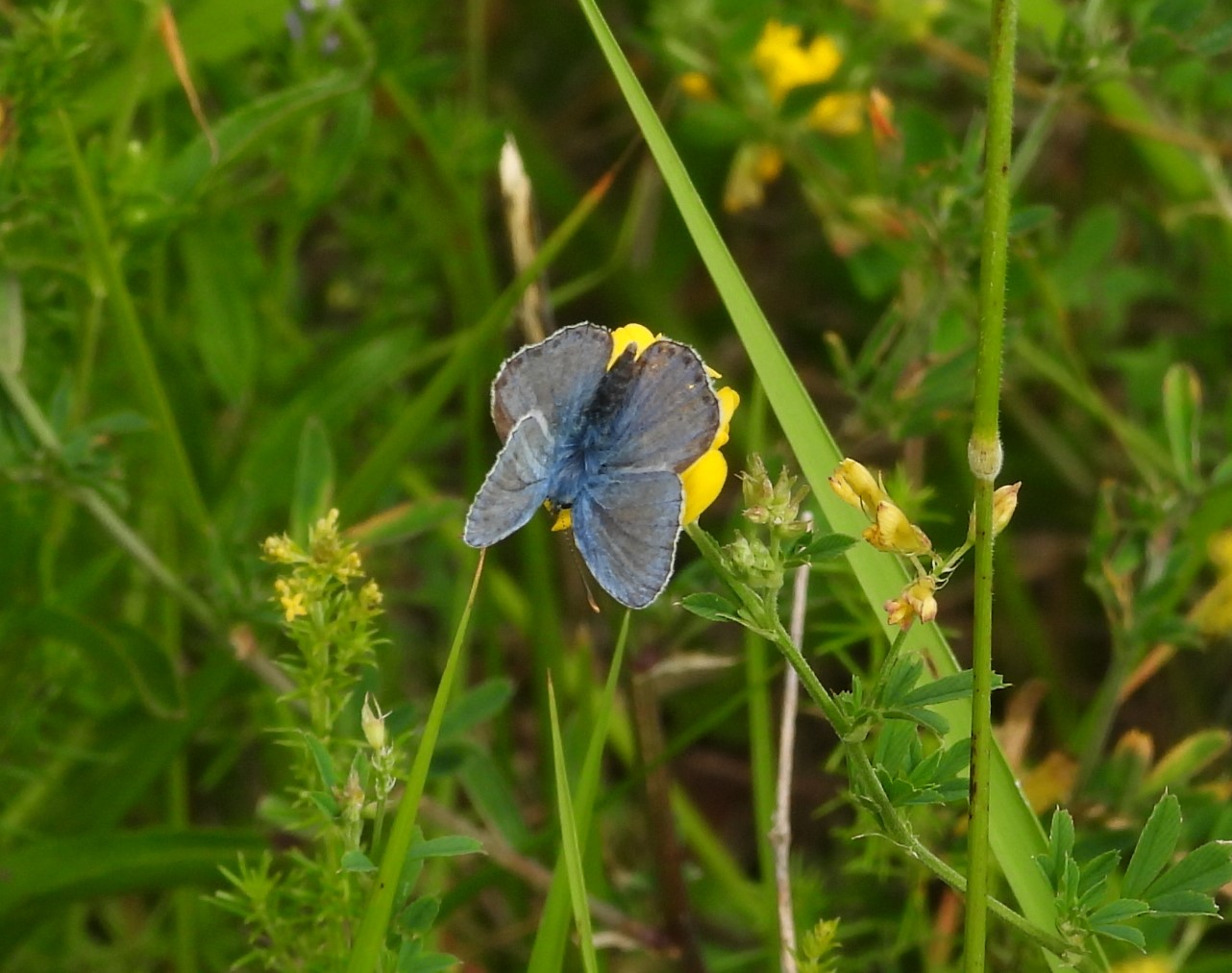
Blue-spot hairstreaks and clouded yellow turned up again and we saw male and female versions of the mazarine blue.
Mazarine Blue (f)
Mazarine Blue (m)
Most of the mazarine blues we saw were female.

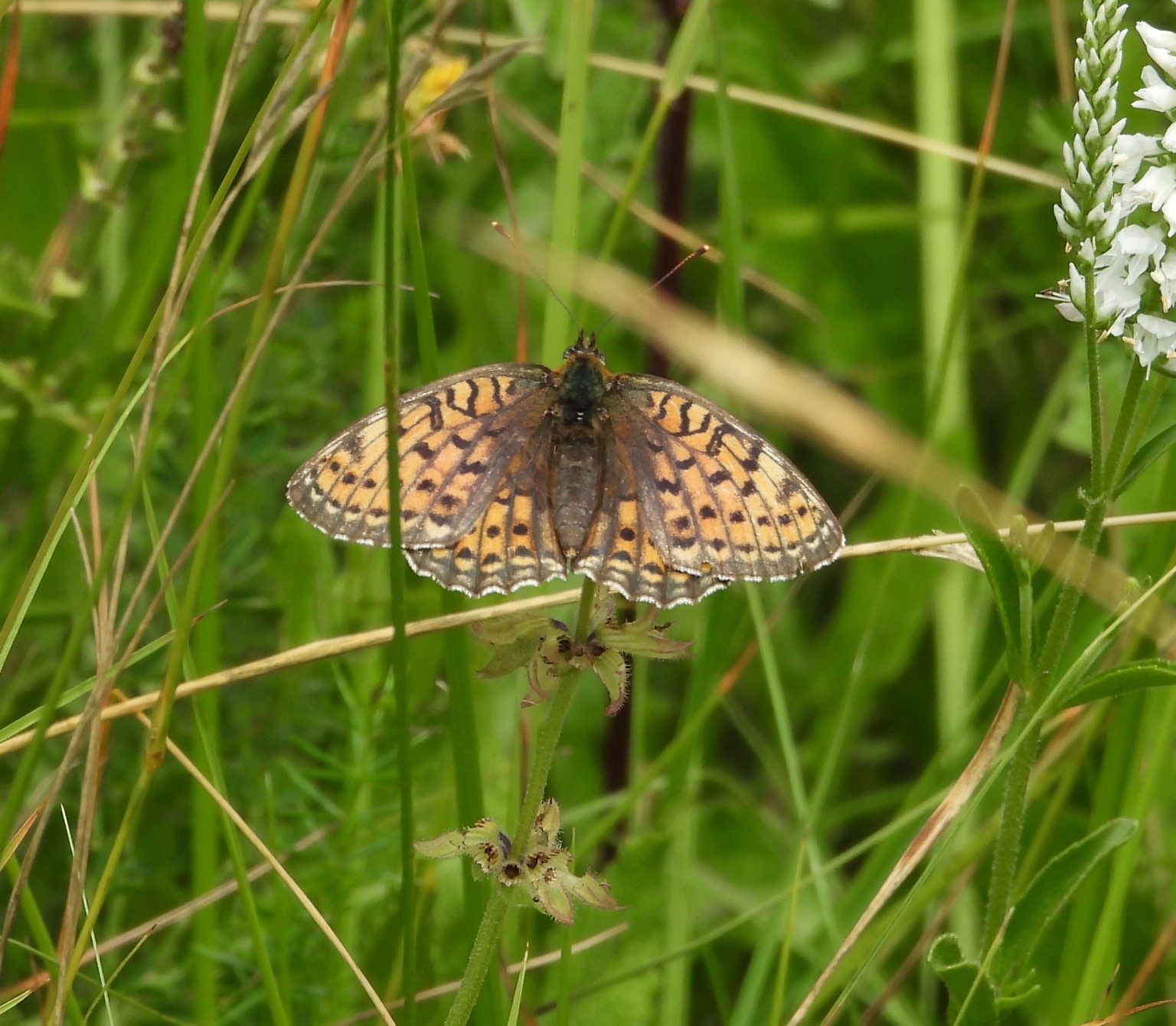
However the star appearance of the day was the sole (I think) appearance on the trip of the Queen of Spain Fritillary.

Queen of Spain Fritillary

It was a good deal smaller than the rather glamorous name perhaps suggests. It was also the day we got first sight of the Large wall Brown.

Large Wall Brown

We encountered some difficulty identifying ringlets - a definite issue in this part of the world as there are several similar possibilities including a couple of highly localised versions (such as Stygian Ringlet).  An additional problem I had was that the ones I encountered repeatedly took to the wing just as the camera was about to shoot!

Some were identified as scotch argus but I wasn't entirely comfortable with this as the scotch argus wasn't supposed to be on the wing for another three weeks.  Some were probably woodland ringlet but in the circumstances, I think the best thing is just to present the photos I did get for what they are worth.
? Ringlet
? Ringlet
? Ringlet
? Ringlet
One thing is certain - they are all ringlets of one kind or another!

Another element of controversy was added by this skipper.

Essex Skipper?

My view is that it is a male and has a sex brand running parallel to the wing edge, making it an essex skipper.  Others begged to differ.

Otherwise I saw another mystery bee, possibly another furrow bee, a moth I couldn't identify and various others that I did tentatively manage to label.


The obvious star here is the longhorn moth with its massive antennae!

Tuesday, 16 July 2024

Slovenia Day 3

On the third day we headed west to a meadow in the Klenik area and then a woodland.

Obviously sightings started to be repeated after a day or so and in particular we got to see so many skippers, meadow browns and marbled whites that we started not to take any notice of them.

However the meadow did produce some new sightings and some better photographs.

In the blues department, Reverdin's blue turned up again and I got a better photo of the eastern short-tailed blue as well as another glamorous entry in the shape of Amanda's blue and a sighting of eastern baton blue.

Amanda's Blue
Eastern Baton Blue

Eastern Short-tailed Blue

Blue Spot Hairstreak

This time you can actually see the short tails!

We started to see some hairstreaks, some thought to be ilex hairstreaks but the ones I saw were blue spot hairstreaks, again a first but one we were to see continuously over the next couple of days.  

The same was true of large chequered blue (see later entries shortly!)

Neither species can be seen in the UK, which sort of makes all the travelling worthwhile.

Fritillaries however proved to be a bit of a problem. My notes indicate that we got to see spotted and twin-spot fritillary but all the photos I got seem to be of marbled fritillary and I think one or two other members of the group had the same experience.

The false heath fritillary is incorrectly named as it is a genuine fritillary, but it often caused as problems as we often confused it with other things.

The other one that turned up was the comma, another that was to reappear several times over succeeding days.
Marbled Fritillary
False Heath Fritillary
Comma

I thought I'd spotted a black-veined white and was a bit surprised to find that it was identified as a clouded apollo.

Clouded Apollo?

I think there remains some doubt over this one...

In the woods for the afternoon session, graylings were a feature as we found both great banded grayling on the way  and woodland grayling, plus I happened on a straightforward, everyday grayling in the village where we got out of the van - so graylings galore...  Also conspicuous (partly for their amorous behaviour) were a could of alpine longhorn beetles, much to the delight of the group leader Terry who has been hoping to see one for years!
Great Banded Grayling
Woodland Grayling
Grayling
Alpine Longhorn Beetle

Through the day I noticed (and was able to identify) a a couple of moths, namely latticed heath and golden yellow wave.
Golden Yellow Wave
Latticed Heath

Bugwise we also had - apart from more damselflies - a big rose chafer and a red bug whose exact name I have forgotten.

Big Rose Chafer
Red Beetle

Less auspicious sights were a snake swimming across a river and our leader wading through a huge puddle to capture a yellow-bellied toad.

Sunday, 14 July 2024

Slovenia - Day 2

On our second day the early risers in the group saw quite a few birds around the hotel and I did manage my first ever definite photo of a white wagtail while waiting for off.

White Wagtail

Generally though I couldn't see much of what the others saw in the way of birds during the whole trip and took a mental note to get an overdue eye test once back home again.

Eventually we set out to look for fresh meadows near the village of Hrastovalje, not far from the farm where the previous night's impromptu birdwatching session took place.

Obviously the main target was butterflies and on and after an upland walk, we found plenty to look at including clouded yellow, plenty of scarce swallowtail, holly blue, more skippers, wall brown, mallow skipper and grizzled skipper.  Particularly pleasing for me was my first encounters with Reverdin's Blue and Eastern Short-tailed Blue: 


Several grizzled skippers were seen near a puddle in the path we used, where there also there were a large number of wood whites puddling. The interesting thing here is that their black spots have shown up far larger than they appear to the naked eye:


Wood Whites puddling

I had mixed feelings when we came across the first small blue I've ever spotted but arrived on the scene late and only got very blurred and useless shots of it...

However the most spectacular photo opportunity, possibly of the whole trip, was presented by the newly-hatched European Swallowtail that flattered around the van when we got ready to move on and hung about for ages as if posing for the cameras.

European Swallowtail

While moving on to the afternoon venue, we saw a couple of white storks from the bus that even I couldn't fail to see.

White Stork

The next venue proved to be a disappointment.  The meadows looked promising and one or two butterflies briefly appeared but after twenty minutes the clouds moved in and, although it never properly rained and stayed warm, butterflies were scarcely to be seen at all.

I think the only one a I noted was a marbled white that remained stoically attached to the same bit of knapweed for ages with wings closed:

Marbled White

When in such circumstances others turn to birds I turn these days to insects but would be hard put to name any of the ones I saw apart from the nine-spot and red wave moths.

Various Bugs

I feel I should be able to identify the bee, which I first thought was a nomad but, having considered colletes and yellow-faced bees, I don't have a clue.

Amongst other animals we came across during the day were a pool frog, a green lizard and a wall lizard.   
Pool Frog
Green Lizard
Wall Lizard
After dinner we returned to the farm area to look for Scops Owls, which duly did not turn up, though we did see a kield skimmer (dragonfly), raven and dulbentan bat and, learning from past experiences, I decided video was the best media to catch the non-stop flight of the hummingbird hawk moth.

Humming Bird Hawk Moth

Altogether quite a productive day the talk at dinner was already about the relative shortage of butterflies compared to previous years due to poor weather throughout Europe..

Thursday, 11 July 2024

Slovenia - Day 1

Another year, another summer so obviously time for another butterfly holiday, this time to Slovenia with Greenwings  which is where I was last week.

By way of a prelude, I think all the group I was with were impressed with the cleanliness and friendliness of Slovenia.  Although a small country, it contains large tracts of natural countryside attractive to those of many forms of wildlife.  The locations we visited were in the West and North West of Slovenia.

Day 1

The first few days were spent near the town of Rakov.  We got in a reasonable session  at a meadow near our hotel but the rains came down while looking round a second area by the River Reka, so we ended up settling for a birdwatching session near a farm.

It wasn't all about butterflies anyway.  By the river there were numerous damselflies, of which the banded demoiselle tends to catch the attention.

Banded Demoiselle
White-legged Damselfly

On the pm birdwatch, a good number of species turned up, including whinchat, white crane, fieldfare, spotted flycatcher, tree sparrow, and black redstart.  Awaiting eye test, I didn't manage to photograph all that was seen.

Spotted Flycatcher
Black Redstart

Fieldfare
Tree Sparrows
We scored well on butterflies in the first field, but not so well by the river, which at the time we attributed to deteriorating weather conditions.  As often the case on my nature trips abroad, there are so many I made them into a short video, including a couple of moths:


I hope I haven't misidentified anything.  My notes suggest we also saw marbled and twin spot fritillaries.

A couple of specimens I struggled with were one bee I couldn't get anywhere with - possibly some sort of mining bee but could be a lot of things - and this cricket that could perhaps be a dark bush cricket.

Mining Bee?
Dark Bush Crcket?

Thursday, 27 June 2024

Even More Butterflies

A quick ride round the northern part of Chopwell Wood proved that my previous laments about the shortages of speckled wood do not signal its total demise, as I saw half a dozen of them within half an hour.

Perhaps more interesting since I don't recall spotting them there before was a healthy display of orchids along the slightly remote track I followed:

Orchids

Common Spotted Orchid
I'm not sure what kind they are but they reminded me that I'd seen a cracker a few days earlier at the Spetchells - a common spotted orchid I believe. 

However I digress...

Last Sunday I cycled to Weetslade Country Park, enticed by an article suggesting the presence of small copper and small skipper, and still anxious to see as many butterflies as possible. 

I arrived about lunchtime and settled near the top of the hill and saw nothing for forty five minutes apart from a single red-tailed bumble bee.  Then just before I moved on a single common blue appeared.

Moving around a bit I didn't find anything until right near the western exit I came across a triangle of grassy heathland, where things really started to happen.

Within an hour I totalled 25 ringlets, 12 male common blue, one of which sunbathed next to me repeatedly plus 5 of what I assumed at the time would be small skipper. On inspection of photographs however they were more likely large skippers - wasn't expecting that one!

Large Skipper

Small copper didn't appear - probably between broods - but a couple of girls said they had seen several small heath and I reckon I might have caught sight of one in flight but wasn't certain.

As at the Spetchells, I noticed a lack of bird's foot trefoil.  As there the main compensation seems to be an immense number of buttercups, which is what the skipper was nectaring on.

There were also a couple of speckled wood along the woodland edge and several on the cycle track through Ponteland, proving that rumours of its demise are indeed exaggerated.

Back at home the tits have finally realised that the caged peanut feeder is indeed for their benefit.


Plus there was a brief but noticeable reappearance of female red mason bees around the bug hotel.


One of them landed on my hand yesterday but more significant was the appearance of a broken-belted bumblebee worker on the plants nearest the house.  Unfortunately, my new wonder camera let me down, only managing hopelessly blurry shots, but I got a clear view and was pretty confident of what I saw.

More Butterflies Less Bees

Taking advantage of the very first day of a predicted dry spell, I rode to The Spetchells last Monday, hoping to at last find some butterflies on the wing, in particular the common blue

I wasn't disappointed.  Within a few minutes of mounting the chalk steps, I'd found a couple of meandering meadow browns and, wandering further, two solitary male common blues within short succession of each other.

Common Blue
Meadow Brown

There were as expected no buffish mining bees to be found but plenty of its predator, Gooden's Nomad Bee, prowling around the holes the miners have made in the paths. 

Gooden's Nomad Bee

At one point I thought I saw a blood bee entering one of the holes but it never re-emerged. Apart from that I only saw a couple of bumble bees (one red-tailed.)

Even a couple of speckled wood appeared underneath the birch trees and on the way back I happened upon four very fresh-looking ringlets. It was the first time I've seen either species this year.
Speckled Wood
Ringlet
I duly reported all to Butterfly Conservation North East and immediately got an automated message saying the ringlets were the first to be reported this year, which really surprised me but tallies with the fresh appearance. The speckled wood looks in good nick as well.

In all of this, I couldn't help noticing that there was far less bird's foot trefoil at the Spetchells than on previous visits, perhaps explaining why there was no sign of the dingy skipper or any burnet moths.  I begin to wonder if I've struck a bit lucky with the blues.

Wednesday, 5 June 2024

Bees but no Butterflies

Foraging in the garden and a visit to Wallington Hall Walled Garden have produced a fair selection of bees but not much in the way of butterflies.  The occasional orange tip and green-veined white has turned up but mainly on trips out.  The big question is what has happened to the speckled wood? I reckon my confirmed total for Spring was two when normally I would have expected to see scores.

In the garden tree bumblebees and carder bees have been fairly consistent while the red mason bee has been much less in evidence.  More common than in previous years have been garden bumblebee and early bumblebee, turning up fairly regularly.

Garden Bumblebee
Early Bumblebee

I've continued to tangle with the odd nomad bee, of which this is an example:

Nomad Bee
Nomad (underside)
I've seen these before so not uncommon. I'd hoped the all-red and black underside might be a clue, but it seems to get me no further.

Red-tailed bumblebees have started to turn up and at Wallington, I got a nice view of a red queen:

Red-tailed Bumblebee Queen

Also there were a few white-tailed bumblebees and one or two that had a break in the abdominal stripe, meaning they could have been broken-belted bumblebees.  White-tailed have also been spotted in the garden.

White-tailed Bumblebees

Wallington provided me with a first damselfly of the year - a common blue.

Common Blue Damselfly

More of a puzzle amongst the honeybees was this. Eventually I came to the conclusion it was a late-appearing buffish mining bee.

Buffish Mining Bee

On the way to and from Wallington I heard and saw several yellowhammer, and tried unsuccessfully to take a photo of one on the way back.  Notably I did not see a single bird of prey and only heard one skylark.  At one point I thought I might have heard a grasshopper warbler but couldn't be certain.

In the garden there have been no noteworthy birds apart from a brief appearance by a woodpecker , but there is an obvious reason for this:

Grey Squirrel