Following my own lead that gardens are the best place to be for insects this year, I've spent a fair bit of time in my own.
The best day so far was yesterday, when I made a rather hurried contribution to the Big Butterfly Count, recording totals of Red Admiral 7, Peacock 7, Large White 5, Painted Lady 10, Comma 2, Green-veined White 2, Holly Blue 2, Humming Bird Hawk Moth 2
I don't think I saw a small white but it was a bit chaotic.
Clearly it is a painted lady year and it is currently being seen daily.
Painted Lady
Painted Lady (underwing)
I continue to find butterflies in compromising situations, which very much applies to two of the large whites in each others' clutches for more than ten minutes that I noticed.
Large Whites
It hasn't quite come out in the image but they had a strong yellowish sheen so that I first wondered if I'd uncovered a female brimstone.
An absentee from the party was however the small tortoiseshell, and I don't think I've seen one yet in the back garden at all.
I was however particularly chuffed to get a great video of one of the hummingbird hawk moths. Unfortunately it was too big for blogger, so you'll have to look for my post on facebook today.
One minor disappointment was not being able to catch up with one of the holly blues, which again landed on the buddleia but didn't hang around.
Meanwhile my neighbours across the road think they are getting visited by a raven - and I think they may well be right.
Raven?
In fact the first shot I took showed a second beak behind the silhouette so maybe there's a pair...
After my brief outing to Chopwell East Field, I decided to see if things were any better at the brownfield site I visited early in the year and saw dingy skipper. If anything they were worse and all I could muster in 45 minutes was a single green-veined white, one shaded broad bar moth and a tatty looking female common blue:
Common Blue
Otherwise the bird's foot trefoil had all but vanished and grasshoppers and mini moths patrolled the large expanses of sunburnt vegetation.
I don't know why I have been catching up with so many amorous butterflies lately but a quick exploration of the surrounds at a nearby car park revealed a couple of large whites getting in the mood.
Large Whites
Taking a policy decision it might be better to visit formal gardens (which get watered by human-beings) I set off yesterday to Seaton Delaval Hall gardens.
Conditions weren't great with a strong wind and very brief glimpses of sunshine. The main formal garden seemed to have more emphasis on symmetry and exotic appearance than on encouraging nature and bees were the main visitors.
I was however quite pleased to find another white-tailed bumblebee on the lavender and also turned up what may be a member of the globetail hoverfly group.
White-tailed Bumblebee
Globetail Hoverfly?
I haven't yet seen a specific suggestion for the hoverfly that accounts for the yellow face.
When the sun flourished briefly, the few whites were joined by the occasional red admiral and one peacock appeared.
Red Admiral
Peacock
The buddleia is now out in the back garden and has today been visited by large and small white as well as peacock. red admiral and some fresh-looking commas, flying strongly.
Comma
Today a couple of holly blues flew over and one caused a slight surprise when it landed briefly on the buddleia. Not knowing they did that, I momentarily mistook it for an undersized small white!
I've been bemoaning the lack of bees, partly the result of a clearout of dying and over-invasive plants. However a new pink plant has appeared without my intervention and has proved popular with honey bees and early bumblebees.
Honey Bee
I checked the plant out and it appeared to be marjoram, which was duly confirmed by sampling one of the leaves.
This was the latest in a series of attempts we have made to see the marsh fritillary there and once again we missed out, mainly seeing more of the butterflies from yesterday.
Two of three times we got excited, only to find we had been deceived by other brown species, namely comma and painted lady. Once when I lagged behind the others all that remained at a bushy area was a peacock.
Comma
Peacock
Part of the delay was that I had come across a honey bee and realised with surprise that it was the first one I've seen this summer. We later had a discussion about the lack of bees observed.
There was also a marshy area where I kept an eye open for the large heath, this time with no success at all.
We moved on to Campfield Marsh where the objectives were slightly different, as marsh harriers and an osprey nest had been reported. This time we were successful with both as they were visible from the hide. After many attempts, I did eventually get a clear shot of the osprey with the chicks peering from the nest. With the marsh harrier I was less lucky but managed to observe it through the binoculars several times.
Osprey and chicks
Marsh Harrier
Not much was seen on the nearby pool - some lapwings and a few greylag geese. Later on we observed some young willow warblers moving through the trees with parental supervision.
There were also quite a few dragonflies around but the only one that settled was this common darter:
Common Darter
An added bonus was a pair of roe deer that were feeding on a farmer's field:
Roe Deer
By the time we made our way back to the car it was early evening but it remained warm and the butterflies were coming out in force. Here there were more meadow brown than ringlet, but also red admiral, small tortoiseshell and painted lady.
Small Tortoiseshell
Red Admiral
Painted Lady
In fact we must have seen going on for 20 painted ladies, confirming the impression that this may go down as a 'painted lady year.'
The siskins have continued to visit the garden. I thought it was just a pair and so was quite surprised this week to see four of them on a feeder. One couple however fled before my attempt to record the moment.
Also visiting, apart from a few two- and seven-spot ladybirds, have been a number of buff-tailed bumblebee queens prospecting the garden for possible nesting sights. They were really tricky to photograph as they were either on the move or ferreting around in the undergrowth. I thought I was about to nail it when one of them disappeared down a crevice in the decking. I must have waited three or four minutes for it to come back into shot, which it never did. So either it escaped by another route without me noticing or hearing, or I can expect a bumblebee nest in my decking...
In the end I had to make do with a brief video of one visitor:
Buff-tailed Bumblebee Queen
Also heard but not seen in the garden and nearby have been a few chiffchaff.
Yesterday I was out for a walk at Geltsdale with V&A together with recent arrival E, who managed to sleep through the proceedings uninterrupted.
I soon saw a curlew on approaching the car park and found a couple of stonechat on arrival. Eventually we headed South nominally hoping to happen upon a whinchat but without much conviction. Instead we came across numerous chaffinches and a reed bunting pair.
Stonechat
Reed Bunting
Further sightings overhead were a couple of kestrel mobbing a buzzard and a possible pink-footed goose.
The weather was quite warm so there were also a couple of butterfly sightings - both peacocks.
Having covered the likely whinchat area, we set off back via the former quarry where short-eared owls have been turning up. We were probably an hour or two too early to be successful. Instead there were several lapwing and on the way a very distant roe deer
Lapwing
Roe Deer
The lapwing seemed to be on the verge of proving a display flight but never quite went through with it.
I always think the rockier sides of the quarry area look good for peregrine falcon, who would be due to nest about now, but none were seen.
On the way back we did however meet up with a decent flock of fieldfare. They saw us and kept on the move. Distracted by another bumblebee queen, I missed the best chance of a photo. They can't be with us for much longer this year.
Yesterday I had planned to head West to Parkhead on the bike, but the cycle path was closed and I didn't fancy the proposed hilly detour. Instead I took a more casual trundle along the banks of the Derwent, which did produce a couple of active goosander.
Goosander
Returning by the Tyne was less productive apart from a couple of cormorants and a brief check at the hide at Clara Vale produced nothing of note at all.
After several weeks of monsoon conditions, there have been several bright and warmer days with even some sunshine.
Not really to do with this has been the appearance of both male and female siskins in the garden.
A siskin and part of a siskin
Not a rare bird and sighted often locally but this is literally the first time I've found them in my garden here, perhaps because there are no conifers in the area apart from a few hedges. In Dumfries they were regular visitors. Interesting that they've gone for the sunflower hearts and not the peanut feeder nearby.
I was thinking that I hadn't heard a greenfinch singing for ages and they too have started appearing. There was one singing in a high tree when I set off down Hookergate Lane, then possibly more in a tree by some houses by the old Post Office on Sunday. I tried to take a photo on my phone but it didn't work.
One thing I didn't expect on the same day was to get a close up of a goldfinch.
Goldfinch
Unfortunately it was dead but didn't appear to have been bitten so maybe flew into something.
However the clearest sign of Spring came yesterday when temperatures approached 15C and I made my first sighting of a butterfly this year. It was clearly sunning itself.
Peacock
I suspect this may be the first sighting of butterfly in a garden on the facebook pages I visit, although small tortoiseshells have been spotted near Blanchland. I've yet to see a bumblebee queen though I'm sure they must be about.
My recent sighting of the twenty plumed moth drew a bit of interest on social media, one commentator noting that he's only ever seen one before and not in the North East while another contradicted that there are many records of it in Northumberland. Well, I'd certainly never seen one before.
During the recent partial heatwave, I've been taking the opportunity to check out some of the local gardens. An interesting find two weeks ago was Birkheads Secret Gardens near Sunniside.
There wasn't much sun on arrival, but I was assured the butterfly garden would have some sightings on offer. I wasn't so sure and thought I'd check out a couple of hoverflies and bees en route.
Common Drone Fly
White-tailed Bumblebee
For the Latin speakers the drone fly is Eristalis tenax according to a local expert. I'm pretty sure about the white-tailed bumblebee.
For the other hoverfly spotted we're stuck with generalisations. Apparently it belongs to the Syrphini tribe, otherwise known as common flower flies.
Common Flower Fly
Anyway on reaching the butterfly section, there were indeed a good number to be seen, and I found I was taking the sort of shots I had been hoping to get in my garden:
Red Admiral with Peacocks
Peacocks warming themselves
One noted absentee was small tortoiseshell. As it hadn't been turning up at home either, I have been reflecting that it used to be far more common and seems to be in decline compared to other members of the Nymphalidae family. The reasons for its demise are not fully clear but there may be some incidence of parasites and habitat loss.
Of more interest on the day was to learn from the lady in the wee shop that the County Recorder for Durham had spotted a brimstone in the Gardens, considerably further north than its known habitats. It's not much on the wing just now but another visit later in the year seems obligatory.
I was also struck by the number of flower meadows on the farm nearby.
Anyway six days later I was at Talkin Tarn for a catch-up with V&A. We did a little walk but in more sombre weather only two butterflies were spotted, a small white and - you've guessed it - a small tortoiseshell!
Small Tortoiseshell
Another bit of useful learning was to find numerous clumps of devil's bit scabious and we wondered if the marsh fritillaries present elsewhere in Cumbria have discovered its existence. It's their food plant.
Devil's Bit Scabious
Last Sunday, I was back on the garden trail, initially visiting Whickham Hermitage Garden at Newburn which wasn't too impressive. Flanked by high trees on the South side, it was hard to see that it would get a lot of sunshine.
Although smaller, the Tyne Country Park Sensory Garden at Newburn was more productive, producing all three main whites, the main members of Nymphalidae including comma - and of course a couple of small tortoiseshell. The only absentee was painted lady.
I again focused briefly on hoverflies and was struck by the pattern on this one:
Drone Fly
This is another drone fly, exact identity uncertain.
My last call was at Bradley Hall Gardens which was the largest and had the biggest variation of flora.
Butterfly sightings were similar to those at Newburn and with similar numbers, but with four or five small tortoiseshells.
Small Tortoiseshell
... plus I think I may have caught a fleeting view of a holly blue, though I didn't see it long enough to be certain.
Typically of course the small tortoiseshell then started to turn up in my garden after an absence of several weeks during which I had occasionally wondered if the comma had effectively replaced it.
I did a couple of counts for the Big Butterfly Count Over the two, the highest numbers were for large white and red admiral, followed by comma, peacock, small white and green-veined white - and just one small tortoiseshell.
I haven't done any major butterfly expeditions but I did do a recce of the Cambois area to check out possible sites for the grayling - more hopefully anon.
On the way by bike I noted a bird singing very tunefully from the top of a small tree and wasn't sure what it was. It turned out to be male reed bunting but I've never heard them sing so beautifully. Maybe like the dunnock it only happens at key times of the year.
It was just on reviewing the photo I could actually identify it.
The only other trip out was a quick visit to Marden Quarry as I happened to be in the area and had heard there had been some sightings of a night heron there.
Anyway I did a circuit of the lake and didn't see anything of note. So I sat on a bench near the car park overlooking the lake for a rest. After a while I looked from my phone to notice... a grey heron squatting behind some flowers on the island opposite.
Grey Heron
At distance I briefly thought I might have hit the jackpot due partly to the untypical hunched-up pose. My sense is that this is also a young bird with its whitish appearance and streaked breast.
One great advantage of having buddleia rather unnaturally in pots at the front garden is that they regularly attract an early season small tortoiseshell. It was again the case this year, the second butterfly to be seen on them.
Meanwhile the larger bushes at the back are out and have attracted peacocks and red admirals but not a single small tortoiseshell. The time was when they would I'm sure have been the most numerous visitor but clearly they are in decline and have been for a long while.
On the other hand commas have often been in evidence as have all three species of white, although the weather has been inconsistent and some times were much more productive than others..
Comma
But possibly the most interesting sighting was a single meadow brown - obviously a more than common species but not one I've ever seen on buddleia.
The whites have also been showing a great deal of interest in the garlic mustard, fluttering around it and other plants slowly and landing frequently. I think they may be females attempting to oviposit. This is an example of the sort of behaviour I mean.
Green-veined White
Lastly a pleasant surprise one morning was to open my garage and find that a tiny moth was completing a sleepover on my rear windscreen.
Having reached Bordeaux in sunny weather, I noticed that it was far bigger and the River Garonne far wider than I had anticipated.
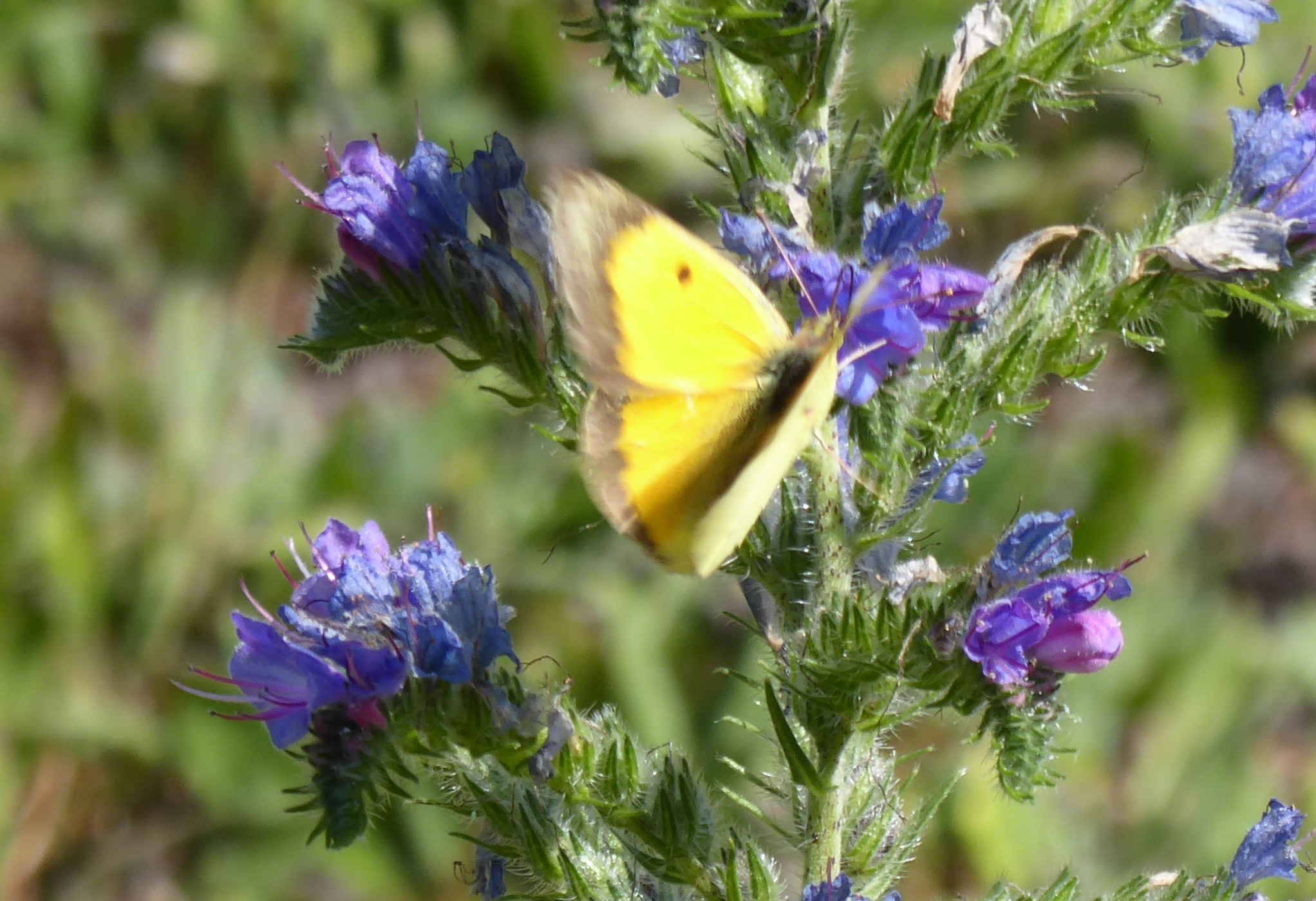
My first cycle was to to the Réserve écologique des barails to the North of the city, where the bike proved its use in enabling me to find a large flower meadow relatively quickly. First sightings were of a number of clouded yellow, this one just about to fly off:
Clouded Yellow
The clouded yellow was to prove one of the most sighted non-whites of the whole holiday and appeared again on my way back via the lake, this time providing a good view of the underwing:
Clouded Yellow (underwing)
The Barails site also produced two first sightings of the year with painted lady (several) and small copper:
Painted Lady
Small Copper
Neither species re-occurred during my stay. Notably almost everything was landing with wings closed, possibly due to the ever-rising temperature which touched 30C as the day drew on.
Thee was a frustration in that I also spotted a number of much smaller blue butterflies and a hyperactive day-flying moth that refused to settle - a theme that was to recur throughout the week.
The day should also have included a trip to the Parc du Majolan which was mysteriously closed, though I did catch sight of a male brimstone and the only peacock I was to see all week in the nearby woddland.
Also closed was a park and woodland area on the Western side of the lake. And this is supposed to be the tourist season!
I ended up having a much-needed beer in the popular Darwin area of Bordeaux, which led to an interesting variation of thieving sparrow behaviour:
In a period of unsettled weather, yesterday looked to be the best opportunity to look for some invertebrates, so I set out for a slow ride to take in Path Head Nature Reserve, Ryton Meadows and the Spetchells. Unfortunately some photography issues limited the possibility of confirming some sightings.
Path Head is a reclaimed recycling site and looks promising for future months and years. During a brief outburst of sunshine, I quickly spotted a peacock, a red-tailed bumblebee queen and a carder bee. Quite a few dandelions were out and I was looking out for mining bees but the result was a number of mini miners, as usual hard and somewhat controversial to identify. However I captured one in my bug box and am fairly confident it was a common mini-mining bee.
Another capture I made later showed a very small bee with a lot of red on the thorax and reddish legs. The photo however was unhelpful. Following a tip that it might be a small nomad bee, I reckon a long shot might be little nomad bee, which preys on the common mini-miner though more prevalent in the South.
Little Nomad Bee?
Later there was an opportunity to see a heron admiring the flora.
Heron
In fairness there was a drainage trench nearby.
I then headed to Ryton Meadows, in the hope of perhaps seeing an early small copper. It wasn't entirely unexpected when that hope proved forlorn (a bit early yet) but I did find another interesting bee on another dandelion. It looked like a small nomad bee but notably had a yellow face. I can't see any potential matches. Maybe it was a wasp.
It was at this point that the technical problems really began to take over as a series of images I'm certain I took between arriving at Ryton and climbing up the Spetchells have simply disappeared from my little travelling camera. As I actually had it round my neck while riding I can only assume that the delete button got pressed a few times accidentally, which seems most unlikely..
So as well as unable to get any further with the possible nomad I lost photos of a peacock and several of orange tips including females and some of suspected chocolate mining bees that I wanted to double check.
Approaching the Spetchells with the camera now back in my rucksack, I noticed a number of small nomad bees patrolling a wee area of grassland next the cycle track. They looked rather like Gooden's Mining Bee but a good deal smaller than the ones up on the chalk. Again having referred to experts for an identification, the suggestion is that it might be a male Gooden's though I must admit I'm surprised it was that much smaller. This time I got a reasonable pic.
Gooden's Nomad Bee (m)
There was about 10-20 of them flying around low and seldom settling for more than a few sedonds.
Before going up to the Spetchells I noticed another bee on a dandelion right next to where I parked my bike. I was fairly confident it was an orange-tailed mining bee but in this case the photo was too poor to say.
The reason for heading to the Spetchells was to see if the buffish mining bees are in action yet. Indeed they are - in their many thousands. It looked to me that they were all males but activity was particularly intense in one small area, I suspect because of the presence of an early female (at the top of the frame in the video):
One Buffish Mining Bee
Many Buffish Mining Bees
As a bonus, I also managed to find the first - excepting my trip to Spain - small tortoiseshell and the first speckled wood (what on earth's happening with them?) I've seen this year, as well as a not so great photo of the last female orange tip of the day.