Showing posts with label shoveler. Show all posts

Sunday, 31 May 2026

Out and About

Last Wednesday I took a trip to the Tees Estuary hoping I might be in with a chance of catching up with a couple of rarities - the glossy ibis and the small blue butterfly. In the event I was successful with neither but still found a few things to catch my interest.

Starting at Saltholme RSPB I headed initially to Paddy's Pond, having found the pollinator garden virtually free of pollinators.  Here the view was largely dominated by a huge number of black-headed gulls with just a few pochard and shovelers for a little variety.  Turning back afterwards however, I did start to see some butterflies and was pleasantly surprised to find, on a path interestingly marked "Wrong Way", my first wall brown of this year.

Not sure how I missed it earlier, but I then immediately happened upon a nice area of banked flower meadow where there was another first of season sighting - at least 15 common blues, all but one of them male.

Wall Brown
Common Blue

A couple of orange-brown butterflies passing over the same area couldn't be identified.

The common blue turned up at several points as I wandered around the site but only one other female appeared.

Adjourning for lunch in the cafĂ©, I was able to observe some common (I think) terns hovering to hunt insects from the surface of the water, the view occasionally interrupted by hunting sand martins from a man-made nesting wall. 

Tern hovering...then diving

Unfortunately I didn't manage to film one of the terns actually splashing into the water.

Here again there were a few pochards and shovelers.

Pochard

Next destination was the Fire Station Pond, which was where the glossy ibis had been reported. However I knew the chances of seeing were slim as the last sighting noted on the whiteboards was a few days earlier on 21st May, after having appeared fairly consistently for some while beforehand.

What I did see was two juvenile and one mature avocet and still more shovelers. Simply because it was so big and placid, I finally persuaded myself to photograph the single black-headed gull.

Young Avocets

Female Shoveler
Black-headed Gull
It seems I forgot to get one of the male shoveler.  A bigger miss however was a flyover by a marsh harrier which was too brief to do much about.

Next I drove to nearby Dorman's Pool, the possible site for the small blue.  Being unfamiliar with the site though, I made the error of following the signs to the hide, which turned out not to be the right place at all and only resulted in me seeing a damselfly.

Azure Damselfy?

A more promising area proved to be the walk along the private road and North towards the viewpoint.  here there was some kidney vetch, the larval food plant for the small blue, though much more bird's foot trefoil and hence several more common blue, this time including several females.

Female Common Blue

There was another wall brown and, noticeably scarcer this year, a speckled wood as well as - so hard to find last year but hard to avoid this - a single dingy skipper.
Speckled Wood
Dingy Skipper

It was more than a little frustrating that, with other things to do, I ran out of time to complete the whole of the path. So no small blue but hopefully I'll start looking in the right place next time!

Saturday, 14 March 2026

No surprises

In terms of rarities, you wouldn't say too much has turned up in the North East this year and so it has been with my own sightings.

I was pleased to see that the siskins have continued to appear in the garden so that I managed to get a better picture of the pair.

Siskins

However an instant drop in temperature to -4C the night after the butterfly appeared and a continuing chilly and wet spell has ruled out further butterfly sightings.

Last Sunday I met with J&J at Nosterfield Nature Reserve in North Yorkshire where we saw a number of birds but nothing to get excited about.  Here's a summary of the results, not necessarily in the order seen:

Cormorant et al
Curlew
Shoveler
Lapwing
Teal

Tufted Duck


Wigeon

However it was J who arguably made the best sightings, first discovering a flock of what we worked out were linnets in a tree and then finding a beetle.  Unlike another lady walker, I made nothing of it and didn't get the camera out.  Later I realised I had just seen something quite uncommon :- a bloody-nosed beetle.

Bloody-nosed Beetle Sign

Apparently this was the earliest in the year that one has been seen there...

Sunday, 23 February 2025

Spain - Day 2

Oh dear, what a catastrophe!

At teatime on day 2 perhaps still jetlagged after getting up at 3.15 am on Monday to make the flight from Stansted, I managed to permanently delete all the photos I had taken during the day including good views of some notable first time sightings.  So all I can do is tell the story of what I saw without the evidence.

The day started well before dawn when we drove a few miles to an observation post at the Southern corner of the lake.  It was still pitch dark but after half an hour, vague shapes could be made out and I used the moon setting on my camera to see lines and lines of cranes in the distance...

The story with the cranes is that they gather on the Laguna di Gallocanta before migrating northwards across the Pyrenees. Each day at this time of year some will make the flight, some will remain and others will move in.  

So as the light improved, they started to move off in increasing numbers, flying straight over our heads in an overwhelming display except for one lone individual that came back.  Someone joked that it must have forgotten something.

We were told that there were around 15,000 cranes in the area on the day but the hotel organised a competition for us to guess how many there would be on the last day of our stay, just before the start of the "crane weekend" when most are expected to make the move north.  The number counted on that Friday was over 27,500, many more than any of us guessed!

Also seen on or the lake were some distant flamingos, shelduck, shoveler and teal as well as calandra lark, merlin and marsh harrier nearby.

Later in the day we travelled around a bit seeing crested lark, several linnets rock sparrow and roe dear. indeed it was going along in the van that led to a spectacular sighting when one of the guides saw two great bustard crossing behind us in his mirror as he drove along!  They disappeared straight away but we caught up with them again by circling around and managed good views. 

Something similar happened not much later when a bird of prey flew out of a tree in front of the advancing van.  Some thought buzzard and some thought marsh harrier but it flew off speedily to a corner of a distant field, where it could eventually be identified as a booted eagle

You can see why I was fed up about deleting the images.

I did manage one photographic capture that evening. In a garden near the hotel there was a bush full of twittering birds, which could only be seen fleetingly as they left and entered the foliage so I tried without much success to video them:

Tree with invisible birds

The Merlin app suggested spanish sparrows but I think not. Bog standard house sparrow is I think the correct answer.  I later learned that spanish sparrow is a more rural species.

Friday, 18 October 2024

Getting Back into Birds

As the summer has faded into autumn, I've started to think more about birds.  In past years I've had some really good luck with birdwatching, which more recently has drained away.  I've increasingly suffered from bird blindness through looking down for butterflies and bees rather than scanning the skies and trees.

A week ago on Saturday, I was in Scotland to see my son and daughter in law, when we fitted in a brief trip to Baron's Haugh RSPB Reserve near Motherwell.  It was actually quite disappointing as not too much was showing - until I looked a bit more closely.

I got a quick early video of a kestrel deciding not to hover but the loch itself was pretty quiet apart from a few standards such as shoveler and lapwing.

Shoveler
Lapwing

There were a small number of waders that I reckoned at first sight to be insignificant but on closer inspection they turned out to be snipe.

Snipe

I was quite pleased about this as I've usually seen them furtively prowling through the reeds rather than in the open.

It was actually quite warm later in the afternoon and I counted four speckled wood flying around the trees.

Overall I haven't been too satisfied with the bird photographs I've taken on my new camera to date, so i asked my daughter in law for some ideas and she's adjusted some of the settings.

The first opportunity to try them out should have been last Tuesday, when I planned a trip to Holy Island to check for migrants but the weather was so appalling that I chickened out.

Instead I decided to visit Newbiggin this Tuesday, as one or two of the more rare buntings had been reported there.

As I wasn't heading for Norway, I skipped the pub and made my way instead onto Newbiggin Moor.


Last Pub before Norway

Working my way up the coastal path, I took opportunities to try out some distance shots of redshank with reasonable success, when I got a slight surprise.

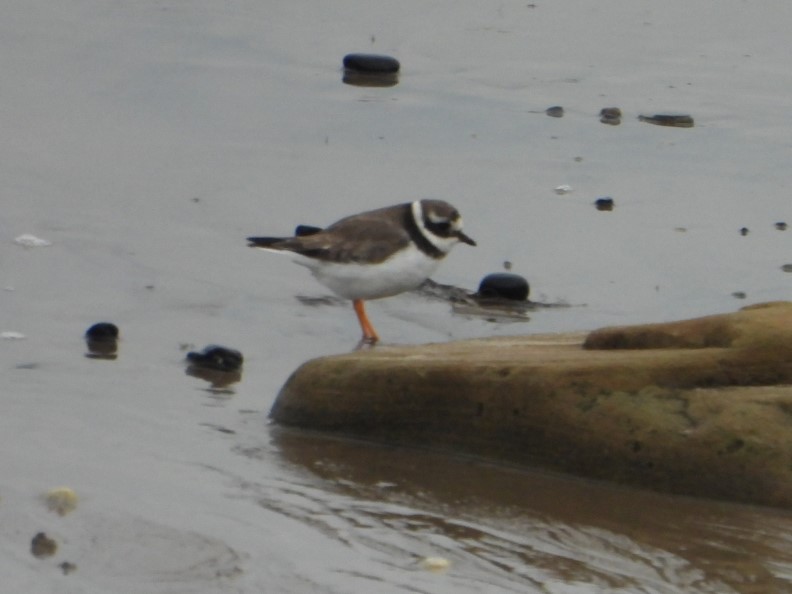
Surprise Plover

Now I reckon on balance this was ring-necked rather than a lesser ring-necked plover, as these should now all have departed and there was no sign of a yellow ring around the eye. It was also the only one I spotted running around the beach. 

There were a few curlew around. one politely posing well on the golf course:

Curlew

I continued along to the point where people sometimes put bird food down and caught up with a numerous flock of linnets, but nothing more special.  Starting back however, I came across a chap lying in wait for a snow bunting  he'd seen briefly.  He also mentioned that a lapland bunting sometimes mingles with the linnets.  This eventually had me scouring the photos to see if I could transform a linnet into a lapland bunting - but it didn't work.

Linnets

Some of the males still had the last vestiges of their summer plumage.

My hands were getting cold so I didn't wait for the snow bunting.

On the way back I remembered a tip on holding the camera and got the best shot of a redshank, later running into a bird that puzzled me and clearly wasn't a redshank.  It turned out it was a turnstone, just didn't quite have the neck pattern I'm familiar with.
Redshank
Turnstone

The tide was just starting to go down and there was a typically large flock of golden plover winging around, landing and relanding.

Golden Plover

My last sighting was of a group of birds that were on the wet rocks near the cliff.  At first I thought there were starlings, which is the general opinion on facebook but on looking at the photo, I'm not so sure.


Starlings?

Some of these birds seem to have brown supercilia and a light colouration I don't see in shots of starlings.  A trick of the light? However there is certainly one added bonus as the one in the bottom right hand area has been identified as a rock pipit.  there's also a small warbler right at the front, partly obscured.

You have to admire the tenacity of some bird watchers - these two have been holding continuous watch over Newbiggin Bay ever since I first visited years ago.

Birdwatchers

Overall I was partly but not fully satisfied with the improved results from the camera.  However it was very windy, as you can hear in the video.

Just for the record I saw three more speckled wood at the Tennis Club on 14th October - maybe the last this year.


Tuesday, 10 October 2023

Never Give Up...

Sometimes I'm too much the pessimist.  Although we did not get the summer-like temperatures experienced in the South of England, we did get a warmer than usual murk with occasional bursts of sunshine into the high teens.  The upshot was that I called time too early on the buddleia, the largest bush suddenly producing a decent sprig of flower in its very centre over the last few days.  This managed to briefly attract a fine red admiral on the 8th October, thereby achieving a personal mini-ambition and establishing a record that may not last long in the face of climate change.

Red Admiral

Meanwhile i have a new toy, a Nikon Coolpix camera, bought especially with the idea in mind of boosting my birdwatching efforts.  The wee Panasonic Lumix I have been using is brilliant in many respects but the zoom can be slow and the focus imprecise.

Perhaps understandably the additional camera has brought some technical issues.  There was a good opportunity to try it out yesterday on a Naturewatch visit to Hauxley Nature Reserve.  As on recent visits to Hauxley nothing spectacular was sighted, which didn't trouble me as I was mainly using it to practice my camera skills.

It was therefore disturbing to note that I had difficulty in seeing much through the viewfinder and when focussing on distant birds.  I started to wonder if I was going to get any usable shots at all.  Anyway I persevered and  managed to solve the focussing issue after a bit.

Here is a gallery of the results:
Coal Tit
Bullfinches with Goldfinch
Chaffinch
Shoveler
Goldeneye
Grey Heron
Mallard
Mallow

Obviously the coal tit was taken in the garden and added as my first ever attempt. 

It wasn't until I got home before I solved how to resolve the dim viewfinder.  Easy enough when you know how but with 308 pages of user manual as well as a very intricate looking piece of photo processing software, it could be a long learning curve!

Tuesday, 3 October 2023

Surprise and Disappointment

 As expected the buddleia hasn't lasted into October well enough to have much chance of attracting further butterflies, as just two or three reasonable sprigs remain.  The last red admiral to visit was sighted on 24th September.  Perhaps surprisingly though, the penultimate visitor on the 21st was a one-off comma.

Comma

Holly blue sightings did manage to rise by one, making a presumed final total of 14.

On Friday I finally got round to manage a planned visit to Hammerlands at Moffat (now apparently The Green Frog) to see if I could catch a trout on my father's old fly fishing gear.  Unfortunately most of the lake was heavily weeded and I didn't catch anything - and neither did the other two visitors on the day.  I did however manage to see some hefty looking trout but most were moving around at considerable speed and seemed disinterested in any offerings.

Staying over with my son in Crawford, we then got out for a birdwatching trip to Lochwinnoch RSPB  that proved my theory that you will often see nothing interesting until you are on the point of giving up.

Although it was a pleasant walk, there wasn't that much birdlife around, the main items noted being shoveler, heron and long-tailed tit plus some distant views of goldeneye.

Goldeneye

One interesting section was the boardwalk to the Peel Tower, where there was an abundance of himalayan balsam.  We noted several bees and wasps nectaring on it, all of which seemed to have white markings on the thorax.  I wondered if the first one we saw was a rare bee or if some kind of disease was prevalent.  We eventually concluded that it was in fact pollen from the balsam as it affected all of them, including honey bee, carder bee and buff-tailed bumblebee.  Attempts to photograph it were  in vain as the marking simply doesn't show up well.  This was my best attempt:

Buff-tailed Bumblebee

On a nearby lake, we did manage to add great-crested grebe and tufted duck to the list for the day.
Tufted Duck
Great Crested Grebe

Giving up on further sightings, we headed for Lanark where we bought fish and chips, which we decided to eat at Lanark Loch, mainly because it is a known carp venue.

Leaving binoculars and cameras in the car, we found a bench near the water and opened up the chips.  It was no surprise when a couple of swans came over but they were then followed by up to 20 gulls we couldn't immediately identify.  It turned out they were bonaparte's gulls, an occasional migrant from North America.  Fortunately, Vicki managed to record this first ever sighting for me on her mobile phone.

Bonaparte's Gull

Tuesday, 11 April 2023

Low Force and High Force Wind

On Saturday I joined up with Jennifer and Joe who are walking the Pennine Way in stages.

We met at Middleton-in-Teesdale to do the section to High Force.  Unfortunately I 'hit the wall' at about four miles and only made it to Low Force, the easy access to High Force from the nearby hotel having closed about 15 minutes before I got there. 

High Force

We saw surprisingly little wildlife during the couple of hours or so.  We thought there was a flock of fieldfares in some trees and there were three butterflies, one of which was a red admiral and a few buff-tailed bumblebee queens.  Birdwise there was the odd lapwing and curlew plus a few pied wagtails.

One surprise though was three completely white mallards that paddled their way across the Tees below Low Force.  Apparently this almost certainly means they were escapees as mallards held domestically are often bred to lose their natural colours.

We actually saw more birds while driving around the moors from place to place: partridge, a possible cuckoo, red grouse and short-eared owl.  And many skylarks.

A buff tailed bumblebee queen finally landed in my garden the other day.  So far they hadn't settled.

Queen Buff-tailed Bumblebee

Due to poor weather I hadn't been out on the bike for a long time apart from a couple of short refresher rides.  Again not much was seen but having got stopped at the level crossing at Wylam, I took a snap of the grey heron that frequently resides there.

Heron

Anyway, on Sunday I took advantage of what had been an excellent weather forecast for a ride up the coast to Cresswell and Druridge - except that the non-stop sunshine expected never happened and I was buffeted all day by a heavy onshore breeze that made me wish I'd taken my winter gloves!

On the Blyth estuary I got a couple of nice views of shelduck and redshank on the mudflats.
Shelduck
Redshank
I've always liked shelduck.

I did a detour around the Newbiggin area in search of Sandy Bay where rarities sometimes turn up - notably a bluethroat recently- but couldn't find it and made a quick exit to escape the Easter festivities.

At Cresswell and Druridge the most notable sighting was my first bar-tailed godwits, which turned up in both locations.  The one of Cresswell has spilled some weed on itself.

Bar-tailed godwit

I had hoped for avocets, which have recently appeared at both locations but unfortunately no luck and the spoonbill at Druridge didn't show either.  

Nevertheless there was a reasonable tally of further sightings recorded including a little egret in the corner at Cresswell, sanderling, lapwing, canada and greylag geese, shoveler, teal, wigeon, lapwing and several more shelduck
Lapwing
Shoveler

Unsurprisingly no butterflies were seen.