Showing posts with label tree sparrow. Show all posts

Thursday, 16 November 2023

Confusion and Consultation

On 11th November I was on the way to the tennis club and paused briefly to check out an expanse of ivy near the Derwent for ivy bees.  What in fact appeared to my surprise was a single red admiral.  I've made a mental note of this as the latest date I can remember seeing an active butterfly, discounting the one I found in my garden in Dumfries one midwinter. 

That one had clearly erred from its hibernation spot in sunny weather but was unable to fly in the near freezing temperature.  Having done a bit of research, I captured it and allowed it to warm up in the house for forty minutes, after which time it hopefully flew back to its chosen place of slumber on release.

On SundayI took my new camera out looking for a couple of bird novelties.

The first target was Northumberlandia, where bramblings had been reported.  A lady said a birdwatcher had seen 24 in a woodland area but I couldn't find them, the only suspect turning out to be a stonechat.

Stonechat

However I did manage to get a nice shots of some tree sparrows on the feeders.

Tree Sparrows

Someone had reckoned they had seen a black-throated diver at the QE2 lake, so that was my next destination.

The trouble was I was baffled by a series of distant sightings of large diving ducks.  In the end I sought advice from those more expert than myself on facebook as to what I'd actually captured on film.  Fortunately it was duly forthcoming.

The first suspects I had lined up turned out to be great crested grebe and goosander in winter uniform.
Great Crested Grebe
Goosander

A third suspect came a bit nearer the shore.  It isn't a black-throated diver but a juvenile red-throated diver according to trusted advice on facebook - a nevertheless excellent first sighting.

Red-throated Diver

It's not actually easy to identify these ducks in winter plumage and the discussion of black-throated v red-throated diver is a particular issue. One respondent suggested this guide on the subject.

Quite amusing at the same location was to suddenly spot a whooper swan by the bank.  According to a local couple it is the ONLY whooper swan on the lake amid hundred or so mute swans!  At the top end there were also considerable numbers of gadwall.
Whooper Swan
Gadwall (male and female)

However my confusions were not at an end as I put in a brief visit to Killingworth Lake on the way home.

Here there was nothing special to mention but another duck that defied identification.

Mystery Duck

It was poorish light and the water looks brighter than the bird!  Anyway, I half suspected a hybrid and this was duly confirmed on referral - probably mallard and domestic duck hybrid.  Apparently it has been there for years and I think I may have photographed it while looking for a scaup a couple of winters ago.

Monday, 6 November 2023

Mission Accomplished

It's a pity the weather in the middle weeks of October was so rubbish as one of my junior buddleia bushes actually produced a couple of decent sprigs during that period that could potentially have attracted a late butterfly or two.

Buddleia - the last blooms

Anyway persistent rain meant it wasn't to be.  The last butterfly I saw passed over the car park at Washington Sports Centre on 20th October.  It was brown so presumably a small tortoiseshell or comma, I couldn't tell.

One nice surprise was however a visit from a tree sparrow to the reduced offerings in the feeders.  Not a rare but nevertheless an infrequent occurrence.

Tree Sparrow

As you can maybe tell, it proved to be a bit of a poser.

After various postponements, we decided that the monsoon season was finally over at the weekend and I drove over to Alex and Vicki's for a visit to the massive reed bed on the River Tay between Port Allen and Errol.  The key target, the bearded tit, is supposed to inhabit the area but we didn't really rate the chances of success.  In particular I reckoned bearded tits might not fancy the extreme cold that can be experienced north of the Firth of Forth.  In fact it turned out to be a lovely day.  The trees were at their most colourful and bathed in sunshine.

After a fleeting encounter with a red squirrel, Vicki thought she heard some bearded tits. Then, on a pathway out through the reeds, we hit gold.  I saw one straight away but wasn't totally sure.  A twitcher turned up, himself sporting a magnificent russet beard, and soon they - the tits - were all over the place, at least a good few dozen of them.

We were snapping away busily as they mostly didn't stay in the same place for long.  And I was quite pleased that I even managed a couple of videos with my fancy new camera.

Bearded Tits

I realise there may have been some unconscious gender bias going on there as I seem to have zoomed in on the males, so here in the interests of balance are a couple of shots of the females.
Female Bearded Tit
Female Bearded Tit?

As you can see and maybe would have expected, they are clean shaven.  We did wonder though whether the second one might be a juvenile.  It was the first time I have seen bearded tits since I visited Minsmere 12 years ago.

After a most pleasant session and no sign of a marsh harrier, we gave ourselves the 'job done' sticker,  and spurning the chance to pursue a mandarin duck at Scone, we headed south for Loch Leven.

This was actually a good deal less rewarding as there wasn't too much going on in the first hide we visited and by the time we got to the second hide, the light was getting tricky so that I, at least found it tricky to see the colouration of the ducks.

In fact the best shots I got weren't of ducks at all:
Stonechat
Little Egret

The others we observed were a lot of coots, some teal, wigeon and a few goldeneye.  

I was a bit disappointed not to see any pink footed geese as there had been plenty around but days earlier and, on trying to perform alchemy on some distant greylags with the camera, I can now see that I actually captured a few whooper swans even further away.  The shot is unfortunately too blurry to publish - even on here!

Otherwise I did dryly remark that there was more wildlife on the steps going down to the trails - which you actually can't see on descending them.

The wildlife steps

Another visual did however catch my interest though.  It was a sign on the butterflies and moths present, which included a picture of a small blue.  Clearly a strong case for a revisit one summer...

There's an interesting sequel to our trip of a non-nature variety.  As we got ready to go home from Loch Leven, I wanted to check a couple of sightings on my mobile phone and discovered to my horror that I no longer had it. Vicki and Alex phoned it several times and got a ringing tone and I realised I had probably lost it somewhere on the woodland trail by the Tay earlier.

As we drove back there frantically to beat the dusk, Vicki got a call from Mr Huang, a (we think) Chinese tourist who'd picked it up and were able to meet him as he reached his airbnb in Errol.  Apparently he'd heard the alarm going off that I had set to remind me to text a friend.  

Bearded tits AND getting a phone back you lost on a woodland trail!  How much luckier can I get?

Monday, 26 June 2023

Catching Up

Dear, oh dear! I'm well behind with all this, partly because I took the liberty of going on holiday and partly because I've seen some things that have proved tricky to identify.

Let's start in the garden - about three weeks ago.

Sadly my forget-me-nots are now finished but the male bullfinch continued his visits to them and was last sighted raiding very close to the house.

Greedy Bullfinch

The same day, while taking a break in the summer house, I discovered this strange looking wasp crawling around.

Strange Wasp

I believe it is a form of ichneumonid wasp, without being able to identify it further.

The mystery bee mentioned in my last post continued to turn up in the same place and the nearest I can get to labelling it is that it MIGHT be an orange-tailed mining bee where the colouration has been faded by the sun.  One or two sightings suggested an orangey tinge on the tail and it has occurred not far from here.  I also considered a honey bee drone but the abdomen is too solidly black.

Suspected Orange-tailed Mining Bee

A few days before all this, I fitted in a trip to Prestwick Carr in temporarily overcast weather.  I went late in the day, hoping to catch up with a short-eared owl which duly failed to appear.  However I did get a nice view of a wren, and a chance one of a willow warbler, which I had first thought was a whitethroat!  At the feeders there was a willow tit and a tree sparrow I didn't even notice seeing.

Wren
Willow Warbler
Willow Tit
Tree Sparrow

Well I did say the light was poor! It certainly made the only speckled wood butterfly seen look a bit sombre.

Speckled Wood

I reckon Butterfly Conservation NE will record a record drop in Speckled Wood numbers this year.

More about my holiday shortly...

Saturday, 4 February 2023

The Many and The Few

January hasn't been a great month for me healthwise.  Having missed the beginning with a cold I lost the end with a nasty chest infection.

In the mean time I managed another trip to Prestwick Carr, which didn't produce anything spectacular but did offer some nice sightings of the regular customers at the bird feeders.

On a chilly day with little wind,  I noticed three or four times trees in the distance with a raptor perched in the crown, as if waiting for some reason to get more active.  Distance made identification difficult but I reckoned they were sparrow hawks.

Sparrow Hawk

Walking along the subsided road there were no more signs of redwing or fieldfare but around three pairs of bullfinches were scavenging in the hedgerow.

Bullfinch

It's not often that bullfinches stay close but they seemed relaxed, particularly this female.  I think you often see them in January, feeding on fresh buds.

There was quite a party going on at the feeders, where someone had added some coconut halves and filled the wee tray with seed.  So I managed to get some quite good shots of participants that weren't members of the tit family.
Tree Sparrow
Chaffinch
Reed Bunting

The one that sort of got away was willow tit, which did visit sporadically.  It was showing interest in the bits of apple I had spread close to where I was standing and I thought there was a chance of a really good close up.  But it never stayed for more than just a few seconds and after about forty minutes, I got fed up of cold fingers and moved on at a brisker pace.

On the way back to the car there were a number of roe deer in the far distance.

Still trying to figure out the lack of non-tit small bird appearances in my garden, I wondered about the theory of a near neighbour that bird flu is to blame.

In this case it would seem to suggest that it has particularly affected the following species here:  bullfinch (which normally show up in January), nuthatch, woodpecker, jay and (in nearby trees at least) greenfinch.

However my complaint about poor sightings in Chopwell Woods was contradicted on the way to the doctor's yesterday, when I heard hundreds of small birds chattering high up in the birches near Chopwell East Field.  I think they were tits, but I did observe half a dozen chaffinches towards the end of the stoney road.

Wednesday, 18 January 2023

Rude birds and Chance photos

I finally accepted the challenge of a possible twitch.

A firecrest in summer in the south of England or as a passing autumn migrant on the East coast is no big deal but I couldn’t resist tales of an overwintering firecrest near Low Hauxley and duly set off there on Sunday morning.

Immediately on heading past some wasteland I spotted a few curlew and, perhaps overexcited by the prospects of a rarity, took a look at what I thought might be a flock of redpolls. The binoculars showed they were in fact goldfinches but I took a snap anyway.

Shortly afterwards I came across some twitchers and had no problem finding the relevant hot spot near the Nature Reserve.  During the next hour I got several sightings of the firecrest darting around very much in the manner of a goldcrest but, frustratingly without getting it in the lense of either camera or binoculars.

It was only when I looked at the earlier photo that I realised that two of the birds in it were certainly not goldfinches and may indeed have been firecrests!

 Firecrests and Goldfinch 

It was a bit rude of them to turn their backs on me but the head pattern would appear decisive.

While I was waiting for the firecrest to turn up I noticed a number of tree sparrows nearby, who also managed to present a rear view to the camera. No matter, I clearly saw the markings anyway. 

Rude Tree Sparrows 

One of the twitchers had reckoned that there was another firecrest at Druridge (so clearly there have been two in the area) so I decided to take a walk there. It turned out he meant Druridge Pools, which was too far for me so I baled out for a coffee at Druridge Visitor Centre.

Setting off to return I took a look at the bird feeders and fortuitously noticed a marsh/willow tit approaching them.

This time I managed to got the camera out before it turned its back on me.

Marsh Tit

Of course it is a bit of a toss up between marsh and willow tit and the habitat could have suited either. On balance I plumped for marsh tit, noting the pale neck and hint of a mark on the beak. 

Back at Hauxley I caught a quick glimpse of the firecrest at the hot spot before the sun left the trees and I waited 40 minutes in vain for it to turn up again, not knowing what was already in the camera. 

Wednesday, 29 June 2022

Mystery Bees and Disappearing Butterflies, Fish and Birds

 Last week I spotted a couple of bumblebees in the garden that I felt I really couldn't identify.  I have sent photos to the Natural History Society to see if they can tell me what they are.

Bee 1
Bee 2

What caught my attention with Bee 1 was the lack of a buff or white tail.  Instead, as can be seen from a second photo, there is the merest tip of white at the very end of the tail.

Bee 1 - side view

After I took the photos I thought I noticed a slight interruption to the abdominal band and so wondered about broken-belted bumblebee.  This seems highly likely however in terms of other factors and it would have to have been far away from its normal local habitat.

Afterwards I did come across some information that Bee 2 might possibly be a late-flying hairy-footed flower bee worker, and not a bumblebee at all.  However I haven't seen one before so it would be interesting to know.

Last Thursday I squeezed in a fishing trip to Horton Grange.  Looking for bream or tench on the swim feeder, I caught just three small roach on worm near in and nothing on corn further out.  The worm bites were fairly consistent if cautious but tackle trouble emerged as the bale arm on the reel started to fly open when striking, thus preventing me catching more.

On Saturday, Alex and I set out to Finglandrigg Wood in Cumbria on a planned mission to track down the marsh fritillary.  In spite of two tours through the suspect area, we were unable to manage a single sighting.  Apart from various speckled wood, ringlet, small skipper, red admiral and meadow brown, the only out of the ordinary sighting was of a small tortoiseshell in pursuit of its mate (presumably).  First seen on a mossy rock in the early afternoon, they were still at it on the nearby boardwalk when we re-visited the area a couple of hours earlier.

Small Tortoiseshells

As when we visited the Campfield Moss a year ago there were some carder bees nectaring on foxgloves.  Last year I thought they were moss carder bees.  On further research I'm more doubtful but they were certainly of a lighter hue that the ones I see here.

Moving on to Campfield Moss for a late visit we again found that the birds had mostly absented themselves apart from oyster catchers, a buzzard and a kestrel.

However it was quite nice to see woodpeckers, tree sparrows and greenfinch on the feeders, amongst others.
Greenfinch
Tree Sparrow

Thursday, 31 March 2022

A Frantic Fortnight of Frustrating Photography

The Covid thing left me with an ongoing chestiness and I decided on a concerted activity campaign during last week's good weather involving several bike rides, tennis and walking cricket.

One of the many bike rides was to Prestwick Carr to see what was on the feeders and looking out for any activity en route, having seen a few peacock butterflies (about 6) and a few bumblebee queens on my other travels as well as hearing several chiffchaffs.

Not much turned up until I came to the end of the track out of Ponteland Park, when I was quite pleased to get a shot of a greenfinch up on a telegraph wire after several attempts.

Greenfinch

Both chiffchaffs and greenfinches have been turning up near the garden and hereabouts, usually heard rather than seen.

It was too early in the day for the short-eared owl at Prestwick Carr, but there was a single tree sparrow on the approach to the area and as usual several small birds near the feeders - notably reed buntings and willow tits as well as more greenfinches, other tits and the odd chaffinch.  Annoyingly, the sun was in such a position that it was impossible to focus on them without scaring them off and the best I could manage was a brief video of a willow tit in the hedgerow.


Willow Tit

There was another peacock and a small tortoiseshell, a large white (probable), a kestrel and a buzzard.

On Sunday, the last day of the really warm sunshine, Alex and I took a walk up to the the Gairs Viewpoint at RSPB Geltsdale in the hope we might see something interesting, which I said for me would be a grouse and either a peregrine or a merlin.

There were a few curlew near the car park.  Afterwards sightings tended once again to be fleeting but we continued well with a redpoll, a greenfinch and a stonechat as we advanced through the tree scrub, having seen a few lapwing in semi-display mode.

Once we reached the moorland, Alex spotted what appeared to be a merlin harassing some passing crows.  It looked like it had settled on a distant fencepost with a crow on another post nearby.  The trouble was that neither of the photos I took clearly showed a merlin so it was a bit of a conundrum.

Further on we started to hear grouse in the heather and a pair or red grouse flew right over our heads - naturally without posing for the camera.

On the way back more and more meadow pipits lifted off in front of us and more peacocks started to appear along with a single buff-tailed bumblebee.  A few buzzards were around and we spent some time working out that another distant bird on a wire was nothing more than a kestrel.  There was no sign of a peregrine.

In all of this the best photos I got were a robin and a stonechat!
Robin
Stonechat
Yesterday I took a quick walk in Chopwell Woods in the hope of seeing a few bumblebees.  One almost flew into me as I went out the door but there wasn't much doing in the Woods apart from another surprise small tortoiseshell at 10C.  As I turned for home more bumblebee queens did start to appear.  Several buff-tailed queens were not keen to settle and a suspected early bumblebee queen on some carnations and a possible garden bumblebee couldn't be confirmed.

Strangely the one butterfly that did linger was a lone tree bumblebee that looked a little small to be a queen but presumably was one.
Small Tortoiseshell
Tree Bumblebee

Saturday, 22 May 2021

Saturday 22nd May

Some incidental sightings have been a recent feature.

On Tuesday Malcolm and I had decided on a trip to Dipton Woods as the weather was just about suitable to look for green hairstreaks.  There was a bit of time to spare beforehand so I sat out in the garden where the forget-me-nots at least are having a bumper spring.  As well as a stray speckled wood butterfly, I kept noticing some bees that I didn't immediately recognise and so was repeatedly jumping up to photograph them.

On further research my initial reaction seems to be correct as I reckon they were red mason bees - not a rarity but the first time I have spotted them and a change from the tree bumblebee workers that have again nested by the front door.  There were some much smaller bees too but I couldn't get a shot of them.

Red Mason Bee

I wasn't particularly optimistic about the green hairstreaks but we did manage to see three albeit briefly, one immediately on arrival in the main target area and two just before we finished in more or less the same place.  This was even less than last year.  I had been quite optimistic about seeing a bilberry bumblebee but no sign.  All the bumblebees were of commoner varieties.  About half a dozen speckled wood, an orange tip and a couple of green-veined white also turned up at different times.

The day after I did a long exercise bike ride to Hexham.  Yellowhammers were about on the way to Greenside and again north of Bywell but I couldn't get them or a suspected lesser whitethroat to pose.

On a break by the river after Prudhoe I decided to snap a small tortoiseshell just to have a photo of something  but in doing so it struck me it didn't quite look normal.

Small Tortoiseshell

The difference is that the four innermost markings on the upper edge of the wing are almost totally white rather than yellow and even the central ones are very pale yellow.  A bit of research suggests that the colouration of the small tortoiseshell can vary if the larva has been affected by cold spring weather, which certainly fits the bill this year!

At the same place there was a nice view of a pied wagtail, which was sharing a pontoon on the river with a female grey wagtail.  I keep looking at pied wagtails to see if any are white wagtails but this one certainly isn't.

Pied Wagtail

Back at home I had been thinking I hadn't seen a tree sparrow for a while.  Then curiously one briefly visited the feeders two days ago.  Then it was here again this morning and actually inspected the nesting box the tits never use.  A tree sparrow nesting in the garden would be a bit of a story.

Monday, 8 March 2021

Monday 8th March

Recent paucity of nature news can be blamed on poorish weather and continuing lockdown, hopefully better is soon to follow.

A slightly bright nore has been offered by several appearances of a male nuthatch in the garden and, on one sole occasion that of a woodpecker.  Yesterday I planted some wild flower seeds at the back of the garden as it is only now that frosty nights are starting to look less likely.  Part of the thinking here is that the copious amount of garlic mustard that used to grow in the same area hsn't yet appeared.  Maybe I was too radical when knocking it back last summer.

I've done a couple more walks in Chopwell Woods, whose main success lay in finding further routes that avoid the heavily-used car park and ice-cream van.  During the first one, there was at least some birdsong to be heard and evidence of jays in the trees, but that was all apart from a grey squirrel, the odd robin and a single wren.  Last week the second one was a return to the baffling near total absence of birds.  I can't understand it.  You'd think among so many trees there'd be treecreepers and even a crossbill or two.

One thing I did come across on the way in was a heron on nearby farmland.  This evokes the question I wondered about often in Dumfries.  Why do herons visit farmland in winter - to seek out worms and insects or because of fishmeal compost?

Heron

This one is obviously next to some flooded land but I can't imagine it would hold fish and it seems to be looking elsewhere.

More interesting was a visit with Malcolm to check out some of the lakes maintained by Wansbeck and Cramlington Angling Club during a brief warmer spell.  Walking up to Milkope Lake there were a good number of skylarks in the fields.  They were flying low in pairs rather than soaring alone and it looked like this was some sort of pre-mating activity.  On actually reaching the pond, a good number of people were fishing and catching small stuff.

On Horton Lake nearby, one elderly angler took about half an hour to land a near 6lb bream on fine pole tackle and a visit to Brenkley Lake established that it had recently produced a 19lb carp.  We've taken out membership and I hope to report on some fishing activity before the end of the month.  I had wondered if it would soon get warm enough for butterflies to be seen early but the weather quickly deteriorated over the weekend

A bike ride the Monday after started in mist temperatures of 3C rather than the anticipated 9C but at least led to the sighting of a group of tree sparrows huddling in a tree,  I was out riding again today in warmer but windy weather and did get a closer than usual view of some tufted ducks at Bradley Pond on the way home.
Tufted Ducks


Saturday, 23 May 2020

Friday 22nd May

After moaning about the birds' failure to eat up my leftover cumin seed in a previous post, it was a bit surprising to notice that it had totally disappeared when I put more food out the other day. How mysterious!  The only thing I can think of is that the tree sparrows were visiting recently.  Can there be an affinity between
Wood Forget Me Not
tree sparrows and cumin seed? Obviously I'll have to put out some more to see if I can find out.

Meanwhile the butterfly emphasis in the garden has shifted slightly.  A few small whites have been showing up and the orange tips tended to be female while green-veined whites continue unabated. There's also been some good sightings of red kites hovering low over the B6305.

In the colder weather I have again fallen back on photographing flowers and then find I can't identify them.  This one however is clearly Wood Forget Me Not - I hope.

The major trip out this week was to Dipton Woods in search of the green hairstreak.  I saw precisely three and one suspect, a complete contrast the the 35 I saw last year  It was probably a week or ten days too late, but my calculation was that dreary weather might have held things up.

It was actually strange to see that the development of the bilberry was quite different along the route.  In most shaded areas it hadn't even started flowering yet but when I reached the 'hot spot', it was clearly past its best
Green Hairstreak
and hanging around for 15 minutes produced only one suspect on the wing.

Then a stroke of luck - as I moved on one flew in front of me and landed on the top of a young conifer.

I eventually continued the walk through the wood, continually scanning the abundant bilberry in flower but there just didn't seem to be any hairstreaks around anywhere that was even partially shaded.

Eventually I came to an area that was on the edge of more open land, but that would have been sheltered from the sun by nearby trees for a good part of the day.  It was here that I found the other two, one of which was a bit tatty and another that quickly made itself invisible in all the greenery.

On the way back down something strange happened.  What appeared to be a minute speckled wood settled briefly in front of me - but it was so small I thought it might have been a moth.  Unfortunately, like the third green hairstreak, it eluded the camera.  I didn't find a moth that looked like it.

Thursday, 16 April 2020

Thursday 16th April

I was pleased to see that three tree sparrows spent some time feeding off the bird table yesterday, so it looks like they may become regular customers.  The bird food has been getting low during the virus crisis and I've reduced the amount I'm putting out .  I've also levened it with some leftover cumin seed but it doesn't seem to have proved popular.  Having sampled a few myself, I'm not surprised.  The taste is pretty pungent.

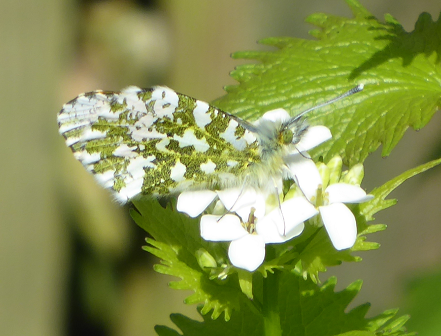
The garlic mustard has been shooting up and the first orange tips have been visiting, five sighted on one particularly sunny day.  It struck me that they are actually quite well camouflaged on this plant with their wings closed.
Orange Tip (wings closed)
Orange Tip (wings open)
There was also a green-veined white on one occasion.

The Garlic Mustard has also been attracting quite a few bees, including the tree bumblebee that is now one of the commonest visitors. There have also been some ressembling carder bees that have struck me as being particularly large, so I doublechecked but I think they are just common carders.
Common Carder
Tree Bumblebee
Yesterday I took my coronavirus exercise in the form of a cycle ride along the Tyne towards Newcastle. The idea was to check out how the flower meadows were developing but it was no surprise to see nothing was flowering as yet.

Around Leamington there were a few butterflies about.  At first it was annoying as none would settle so it wasn't possible to identify any, even though a couple nearly flew in my face.  Gradually it was possible to pick out the recent usual suspects - peacock and orange tip - as well as possibly a couple of other whites.

I continued on to just past Scotswood Bridge and stopped for another disappearing butterfly, when two or three sand martins started looping around in front of me.  Then, just before the stretch where the track runs down next to the main road, there was the first speckled wood of the year in the hedgerow. On the way back a couple of skylarks parachuting down to some waste land just by Scotswood. 

If I'd been looking to see any of these three things, this certainly wouldn't have been where I would have gone to do it.

Speckled Wood
On looking at it more closely, it's noticeable that the speckled wood seems darker than other examples.  I assume this is partly because it is a fresh specimen and that some of the speckles are not yet or only faintly visible.