Showing posts with label amanda's blue. Show all posts

Monday, 22 July 2024

Slovenia Day 7

Our last day in Slovenia was slightly curtailed by the need to get back to Llubljana but still proved productive.

Starting the trail back east we stopped off at a location where there were a series of upland meadows.

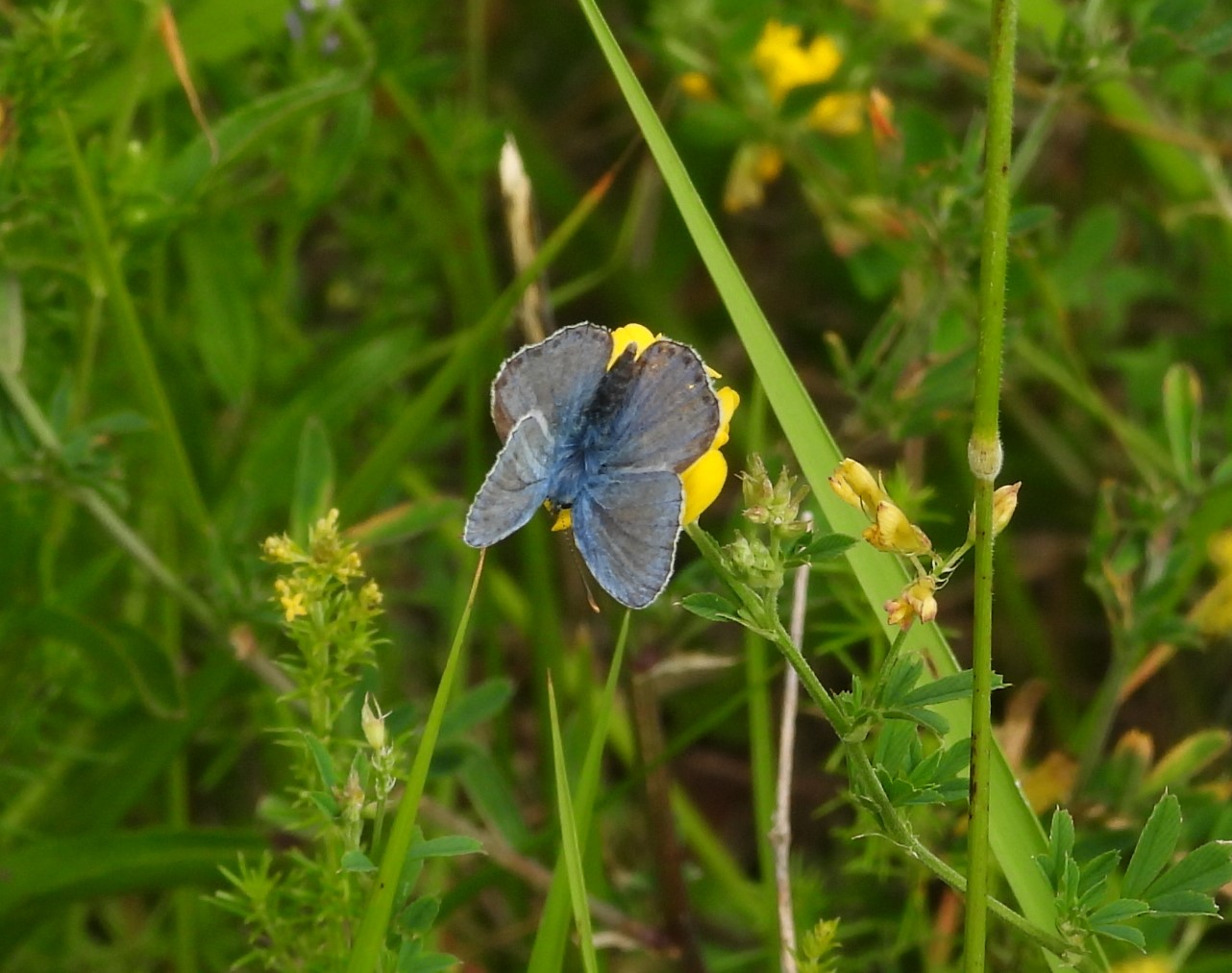
The first one was the one where we saw the most, managing to add chalkhill blue to our somewhat diminished list of blues, and Amanda's blue was also active.  Something of a nuisance was a scarce copper that kept flying around without settling much. It turned out there were several of them in the area and so were hard to miss.

Chalkhill Blue
Scarce Copper

The pearly heath was seen so many times we had more or less started to ignore them! A mountain green-veined white was also seen, looking even darker that the example seen yesterday.  Silver-washed fritillaries were present in good numbers and the lesser marbled fritillary was also observed again.
Pearly Heath
Mountain Green-veined White

Throughout the trip we also saw some small heath. One omission I thought we might see but never did was the bath white.

On the bug front, these four-banded longhorn beetles seemed determined to boost their own population:

Four-banded Longhorn Beetles.

We stopped at another place but saw no butterflies we hadn't already seen. by a river I did however find this bee, which we think to be a carpenter bee - possibly the violet carpenter bee.

Violet Carpenter Bee

Scarlet Tiger Moth

The yellow appearance of the thorax is actually a heavy dusting of pollen.

Then as we got back to the van, a scarlet tiger moth was literally on it, just above the wheel hub.

Also seen is the nine-spotted moth, which in the last couple of days became prolific.  At our last woodland stop, it was the only thing we saw but in massive numbers.


Nine-spot moths

Here they have formed a weird crucifix shape.

After that we headed for the airport through a heavy thunderstorm...

Tuesday, 16 July 2024

Slovenia Day 3

On the third day we headed west to a meadow in the Klenik area and then a woodland.

Obviously sightings started to be repeated after a day or so and in particular we got to see so many skippers, meadow browns and marbled whites that we started not to take any notice of them.

However the meadow did produce some new sightings and some better photographs.

In the blues department, Reverdin's blue turned up again and I got a better photo of the eastern short-tailed blue as well as another glamorous entry in the shape of Amanda's blue and a sighting of eastern baton blue.

Amanda's Blue
Eastern Baton Blue

Eastern Short-tailed Blue

Blue Spot Hairstreak

This time you can actually see the short tails!

We started to see some hairstreaks, some thought to be ilex hairstreaks but the ones I saw were blue spot hairstreaks, again a first but one we were to see continuously over the next couple of days.  

The same was true of large chequered blue (see later entries shortly!)

Neither species can be seen in the UK, which sort of makes all the travelling worthwhile.

Fritillaries however proved to be a bit of a problem. My notes indicate that we got to see spotted and twin-spot fritillary but all the photos I got seem to be of marbled fritillary and I think one or two other members of the group had the same experience.

The false heath fritillary is incorrectly named as it is a genuine fritillary, but it often caused as problems as we often confused it with other things.

The other one that turned up was the comma, another that was to reappear several times over succeeding days.
Marbled Fritillary
False Heath Fritillary
Comma

I thought I'd spotted a black-veined white and was a bit surprised to find that it was identified as a clouded apollo.

Clouded Apollo?

I think there remains some doubt over this one...

In the woods for the afternoon session, graylings were a feature as we found both great banded grayling on the way  and woodland grayling, plus I happened on a straightforward, everyday grayling in the village where we got out of the van - so graylings galore...  Also conspicuous (partly for their amorous behaviour) were a could of alpine longhorn beetles, much to the delight of the group leader Terry who has been hoping to see one for years!
Great Banded Grayling
Woodland Grayling
Grayling
Alpine Longhorn Beetle

Through the day I noticed (and was able to identify) a a couple of moths, namely latticed heath and golden yellow wave.
Golden Yellow Wave
Latticed Heath

Bugwise we also had - apart from more damselflies - a big rose chafer and a red bug whose exact name I have forgotten.

Big Rose Chafer
Red Beetle

Less auspicious sights were a snake swimming across a river and our leader wading through a huge puddle to capture a yellow-bellied toad.

Tuesday, 3 July 2018

Bulgaria Day 2

It was suggested that a forage around the hotel area before breakfast might be fruitful and several of the group ventured forth for a look. Hotel Orfei lies in a deep gorge so it was too early for butterflies but someone heard a black redstart calling and I managed to pick out the silhouette on the rock face, though I would never have managed to identify it. A black woodpecker flew over the valley briefly, plus a couple of other sightings.

Probably the main wildlife feature of Bulgaria is the large amount of unspoilt meadow land.  Things really started to take off at our first destination, following a path through just such country.  I wasted a fair bit of time trying to get a clouded yellow to settle but in the end I settled for a video as it fluttered around incessantly:


The species count quickly began to mount. We saw some of the rarer blues, including chapman's, alcon and
Apollo
amanda's. I enjoyed my first glimpse of a balkan copper as well as my first sightings of green hairstreak, grizzled and tufted marble skippers plus heath and marsh fritillaries.

We saw woodland and bright-eyed ringlets, both of which were new to me and got nice views of the red-backed shrike, often to reappear on succeeding days.

A particular star was the apollo.  After a few sightings of them, one was finally netted and persuaded to settle on a rock.
Looking back, I am a bit disappointed with some of my photographic efforts during the session, but here are a few further impressions I managed to capture, rolled into a video Nb there is a correction.  Simeon our group leader has identified that the one captioned as grizzled skipper is in fact a tufted marbled skipper.  I f you pause the video and look closely, you can see the two white hair tufts.:


Later in the day, we visited a roadside lake where we saw a number of dragonflies, including azure damselfly, white-legged damselfly and blue emperor.  Here we also saw a black-tailed skipper, of which I unfortunately have no memory, southern small white and some crag martins - amongst others it has to be stressed.