Showing posts with label grayling. Show all posts

Monday, 20 July 2026

Better Luck at Cambois

 First of all though I've been forgetting to take photos of what has been a very frequent visitor to the garden - the early bumblebee.  I've always thought I'd do it 'sooner or later' but finally did a week ago. 

Early Bumblebee

Numbers have definitely been up this year.  I'm not sure what plant it's on, possibly marjoram, but it's attracted a few others as well, including honey bee.

Another landmark this year has been the appearance of the first butterfly on the potted buddleia in the front garden - as ever a small tortoiseshell.

Small Tortoiseshell

It nearly didn't happen though as the first flowers were already dying off in the hot, dry conditions by the time it arrived.

Meanwhile my main trip was a revisit to Cambois Beach last Tuesday, hoping to have better luck than a couple of weeks ago.  Conditions were distinctly unpromising though, as there was no sun and temperatures were down to 18C in a Northerly breeze.

Of course there were nevertheless a good number of meadow brown, notably some females settling flirtily on the paths:

Female Meadow Brown

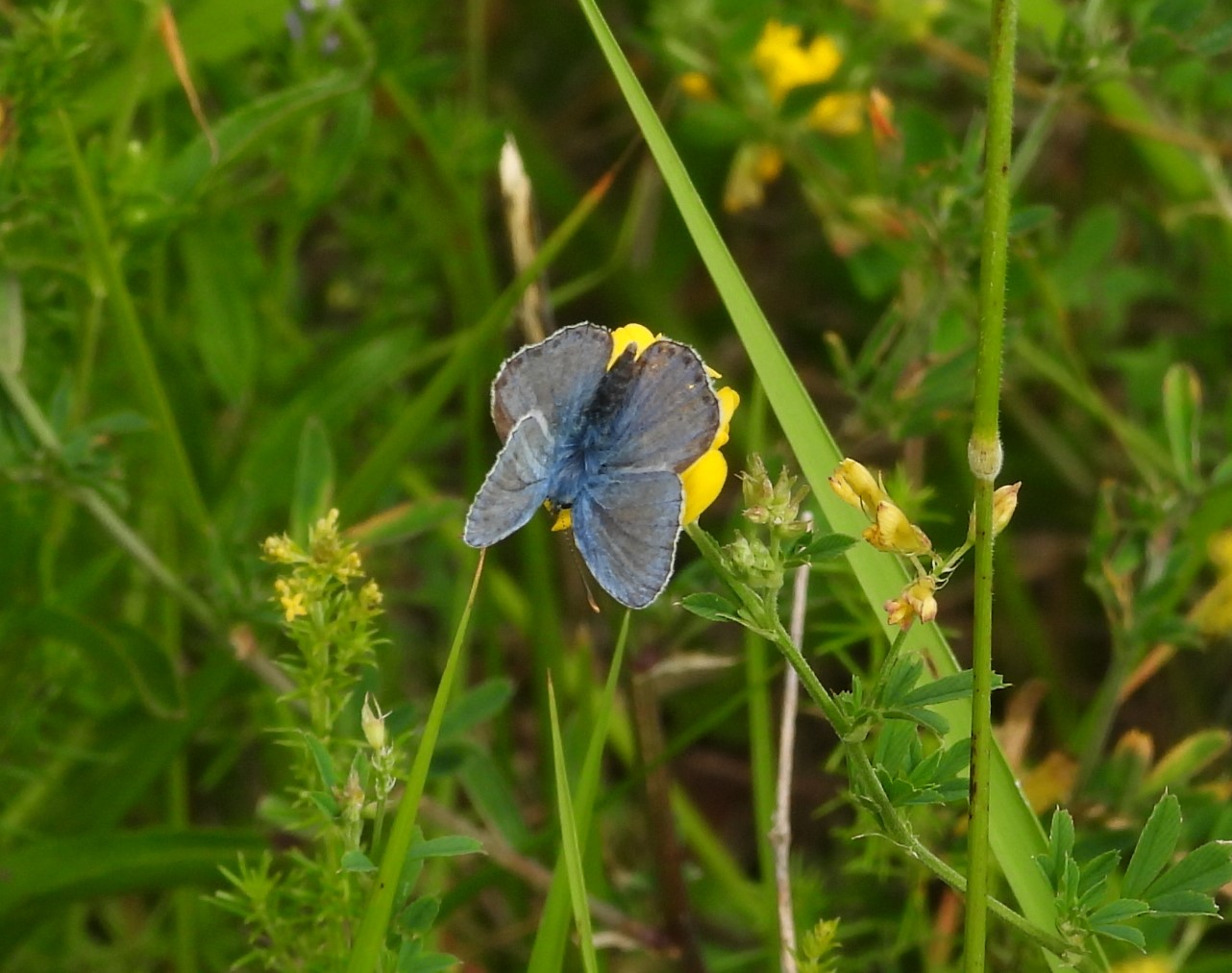
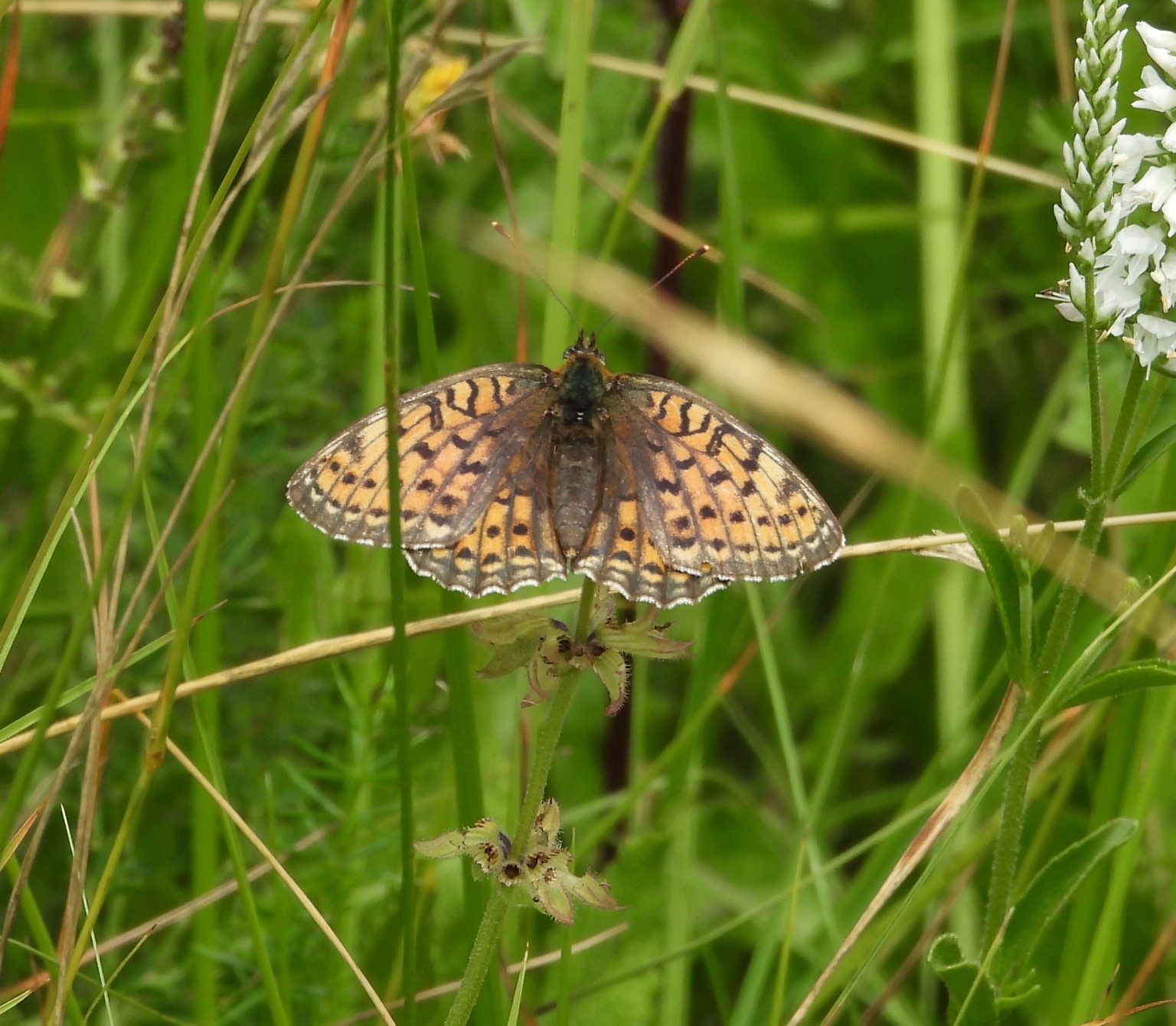
Following the undergrowth close to the railway track, I did get lucky when a grayling flew in and landed directly in front of me.  It was even more lucky that I accidently snapped it with wings open as it flew off.
Grayling
Grayling in flight

One further sighting some moments later may or may not have been the same one.

Otherwise there were repeat sightings of a few small skippers and burnet moths, plus some other moths that my tentative identification skills suggest were common but nevertheless nice to see:
Yellow Shell
Shaded Broad Bar
Silver Y

Yesterday I made a quick visit to Chopwell East Field to see how the nature reserve is progressing.  Frankly it was a bit of a shock to see how little vegetation had survived the conditions, and notably there was very little sign of bird's foot trefoil or field vetch making progress.

So it was a similar pattern of some meadow brown, burnet moths and occasional small skipper.  Several of the bees seen were very faded, in one case unrecognisably so.  However one did catch my eye as I think this may be a white-tailed bumblebee.

White-tailed Bumblebee?

Also in good condition was the red-tailed bumblebee, offering a slightly better view of itself than is sometime the case.

Red-tailed Bumblebee


Tuesday, 13 August 2024

Call me a Liar would you?

It's often interesting how nature can make a fool out of you.

I'd hardly finished writing the last post complaining about the lack of butterflies in the garden when they gradually started turning up, first of all a few whites and then one by one the common members of the maligned Nymphalidae family.

Meanwhile I managed a couple of expeditions to catch up on other species.  First was a bike ride to the dunes at Cambois in search of grayling where I did manage to catch up with one rather battered individual almost as soon as I arrived.

Grayling

That however was it - any number of meadow brown, small skipper, burnet moths and after a bit of foraging, a couple of small whites and small tortoiseshells.  I rather thought I'd done better on my last visit, but on checking this was hardly the case.

Right at the end of July, I tried the Hamsterley viaducts for purple hairstreaks and over a two hour period saw eight - a rather sparse result and as ever they were flattering around the oaks and impossible to photograph.

A mission to Bywell Bridge the day after proved abortive as there was no sign of the white-letter hairstreak and to my surprise the elms were already beginning to turn brown.

Then on the 31st - a really hot day - the first small tortoiseshell appeared in the back garden and, perhaps even more exciting, a brimstone moth slept over in the large bedroom.

Brimstone Moth

A couple of days ago was when the Nymphalidae began to appear, as well as both large and small whites.

Small White

Large White

Small Tortoiseshell
Red Admiral
Peacock
Comma

I'm starting to see an awful lot of peacocks when the sun shines, perhaps not unconnected to the fact that a woman down the road in Rowlands Gill has been breeding them. 

Two I haven't seen to date are humming bird hawk moth and holly blue.  I'd like to think things have changed for the better but the weather remains patchy and unreliable.

An extra frisson of excitement was nearly provided what seemed to be an obscure ladybird on my car door handle.  In fact it was a variation of the invasive harlequin ladybird, which apparently can take a variety of different patterns and colours.  It was completely different to the one I once found in the summer house.

Harlequin Ladybird

So that's what I also thought it was this morning when a black ladybird with two red spots turned up while I was trimming the laurel hedge.  Unless of course it was a kidney-spot ladybird...  That was one photo I should have taken but didn't!

Tuesday, 16 July 2024

Slovenia Day 3

On the third day we headed west to a meadow in the Klenik area and then a woodland.

Obviously sightings started to be repeated after a day or so and in particular we got to see so many skippers, meadow browns and marbled whites that we started not to take any notice of them.

However the meadow did produce some new sightings and some better photographs.

In the blues department, Reverdin's blue turned up again and I got a better photo of the eastern short-tailed blue as well as another glamorous entry in the shape of Amanda's blue and a sighting of eastern baton blue.

Amanda's Blue
Eastern Baton Blue

Eastern Short-tailed Blue

Blue Spot Hairstreak

This time you can actually see the short tails!

We started to see some hairstreaks, some thought to be ilex hairstreaks but the ones I saw were blue spot hairstreaks, again a first but one we were to see continuously over the next couple of days.  

The same was true of large chequered blue (see later entries shortly!)

Neither species can be seen in the UK, which sort of makes all the travelling worthwhile.

Fritillaries however proved to be a bit of a problem. My notes indicate that we got to see spotted and twin-spot fritillary but all the photos I got seem to be of marbled fritillary and I think one or two other members of the group had the same experience.

The false heath fritillary is incorrectly named as it is a genuine fritillary, but it often caused as problems as we often confused it with other things.

The other one that turned up was the comma, another that was to reappear several times over succeeding days.
Marbled Fritillary
False Heath Fritillary
Comma

I thought I'd spotted a black-veined white and was a bit surprised to find that it was identified as a clouded apollo.

Clouded Apollo?

I think there remains some doubt over this one...

In the woods for the afternoon session, graylings were a feature as we found both great banded grayling on the way  and woodland grayling, plus I happened on a straightforward, everyday grayling in the village where we got out of the van - so graylings galore...  Also conspicuous (partly for their amorous behaviour) were a could of alpine longhorn beetles, much to the delight of the group leader Terry who has been hoping to see one for years!
Great Banded Grayling
Woodland Grayling
Grayling
Alpine Longhorn Beetle

Through the day I noticed (and was able to identify) a a couple of moths, namely latticed heath and golden yellow wave.
Golden Yellow Wave
Latticed Heath

Bugwise we also had - apart from more damselflies - a big rose chafer and a red bug whose exact name I have forgotten.

Big Rose Chafer
Red Beetle

Less auspicious sights were a snake swimming across a river and our leader wading through a huge puddle to capture a yellow-bellied toad.

Thursday, 5 August 2021

Another New Sighting

One of the buddleia on the front garden has flowered early, inspiring a couple of visits from small tortoiseshells but so far nothing more glamorous.  Peacocks have been non-existent lately and red admirals have been seldom apart from four or five seen on a walk in Cumbria.

Somthing I have never seen before is a jackdaw sprawling out on the lawn.  I thought it was in distress but it had flown off when I went to take a look.  Perhaps it was just sunbathing?

Jackdaw

Anyway the frog wasn't too concerned.

For the Big Butterfly Count I decided to return to Wingate Quarry, being aware that I had made no attempt to keep a tally on numbers when I went before looking for the marbled white.

My totals over a 15 minute sunny period around midday were:
  • Marbled White 14 (making my guesstimate of approaching 100 in over an hour last time fairly credible)
  • Common Blue 6
  • Meadow Brown 3
  • Ringlet 2
  • Geen-veined White 1
  • Large White 3
  • Small White 2
  • Small Heath 11
  • Small Skipper 3
Surprisingly, The Big Butterfly Count didn't require the last two to be reported, which was a bit of a shame.  Marbled whites weren't quite as numerous as last time, when it was often possible to see five or six at the same time.

Although looking very blue in flight, the one common blue I tried to photograph was clearly female.

One photo I did get was a poorish snap of a moth that I have found it hard to identify.

Moth

It looks a bit like a feathered gothic but doesn't seem quite right.

A surprising absentee from my quarry visits has been the small copper.  I also haven't seen a dingy skipper this year.  I did however spot a couple of peacocks at distance on my way back to the car park at Wingate.

Yesterday as planned for a while I took a bike ride to Cambois to see if I could catch up with the grayling butterfly.  Luckily I saw one - by complete chance as it landed right near me as I pushed the bike back from the dunes.

Grayling

One other suspect was spotted on the wing.  Identification on the wing was however a little troublesome as there were a large number of meadow brown about.  I was expecting the grayling to be larger but in fact the one I saw was about the size of a meadow brown, whereas some of the meadow brown were distinctly bigger than normal.

There were again several small skipper and his time I did manage to catch up with a male common blue.

Male Common Blue

I noticed that the land right up to the coast has been acquired by the car battery factory, so hopefully it's not the begiining of the end for the grayling at Cambois.

My latest adventure has left me wondering what butterflies present in Northern England I still need to see.  Apart from the marsh fritillary, which is on the hitlist for next summer the obvious answers would be large skipper and small blue.  The former is reasonably abundant and it may be that I have misidentified it as small skipper in the past.

But the small blue would probably necessitate a major expedition to even find it away from a private site in Teesside.

Oh, and I suppose there is still the mountain/northern brown argus.

Tuesday, 12 November 2019

Monday 11th November

Autumn has moved in with increasing severity.

Merveille du Jour
Towards the end of October I went to the Butterfly Conservation North East AGM.  It started with a moth trap emptying, which had unfortunately been adversely affected by heavy overnight rain but did produce this nice specimen. There was also some useful information, notably about the small blue introduction on Teesside, which sems to be very near the RSPB site, as well as the precise location of the graylings at Cambois. There was also an explanation the variation of size in the speckled wood.  Apparently research has shown that the ones with larger wings migrate further.  It's thought that wing-shape and colouration are altering as a result of the movement north.

A week or so later I went on a bike ride to Ryal, which didn't produce much in the way of nature though I
Clouded Funnel?
rather liked the 'footpath' of toadstools trailing its way out of the woodland near Stamfordham.  And one pleasant surprise was the appearance of a roe deer shambling along the hedgerow between two roads just north of the A695 at Crawcrook.

In the garden long-tailed tits have come onto the feeders in large numbers on a couple of occasions and several grey squirrels have been seen making their way over to the oak tree, which presumably has produced a lot of acorns this year.  A couple have even ventured into the garden itself briefly.

The other day I saw a (presumably second brood?) jackdaw trying to beg food from the others.  One of them took umbrage and attacked it, forcing it onto its back on the lawn - at which point a magpie immediately swept down, presumably anticipating an easy kill.  Anyway, the victim jackdaw was strong enough to escape on the third or fourth attempt.  Quite a spectacle.

Yesterday, Naturewatchers' trip to Big Waters provided some interesting sightings in addition to the normal fare such as wigeon, shoveler, gadwall etc.  Amongst several hundred canada geese, the twitchers had spotted a white-headed canada goose, pictured below next to the real thing.  Apparently it is the result of hybridisation rather than a separate species.

White-headed Canada Goose (r)
The area to the rear of the hide was under water but the feeders were heavily visited, particularly by tits. I spent a lot of time photographing an elusive willow tit so we could confirm it wasn't a marsh tit but the big surprise for us was when a warbler briefly visited the willow trees on either side.  It seems, according to a local expert, that a small number of chiffchaffs are now overwintering at Big Waters.

Monday, 23 September 2019

Canal du Midi - Part 2

The third day on the road was devoted to a round trip to Minerve, one of the oldest villages in France.  However I was at least as much interested in the huge gorge that stretches out to the West, as I reckoned there was a chance of seeing some wallcreepers, a bird I have wanted to see for a long time but isn't too predictable and varies its nesting sites.

It wasn't to be.  In spite of extensive work with the binoculars, all I could see apart from a few crows and other hirondelles was a good number of crag martins flying around the gorge, plus a fleeting sighting of a red-rumped swallow.  Notably the River Cesse was totally dry, so one suspects this may have had an effect. The absence of birds of prey was disappointing as some quite exotic species have been seen here in the past.

I got a bit distracted into looking at butterflies again in a flower meadow, where a wall brown, a grayling and another brown argus were to be seen.  The latter is interesting in that the black spot on the upper wing is encircled by white. This is normally a characterstic of the French version of Spanish Argus but other aspects of this worn specimen don't suggest any further similarity.

Wall Brown
Grayling
Brown Argus
After still not seeing interesting birdlife in Minerve itself, I managed to catch up with a couple of chalkhill blues 'at it' by the roadside. Again there are several subspecies to choose from but I think they were pretty much the standard offering.

Chalkhill Blue
After that the wind got up and I headed for the swimming pool in the B&B at Olonzac.

Long-tailed Blues
Day 3 was another canalside run through to Narbonne, some delightful scenery breaking up some of the more monotonous sections. Again the butterflies got active once the afternoon was underway, and there were a few nice common blues on the hook in the Canal just past Paraza. Then, on passing a lock just after Le Somail, I noticed some faster flying blues homing in on a single plant. They didn't settle very long so photographs were hard to get but the distinctive underwing pattern shows that they were long-tailed blues - even though one was hard put to see the actual tail, which is basically just a bristle.

A little later I managed to identify at least one bird, a black redstart.  It was surprising not to see more of them in the wine producing areas which are common around here.

Riding past a woodland area next top the canal, I then caught sight of a swallowtail which didn't settle.  At first I thought it wasn't the stadard variety as it was flying rather delicately.  Past the Port de la Robine, I followed another for ages without it settling before I finally got a shot of a delapidated specimen, clearly a standard swallowtail.  Something similar was happening with coppers, as I thought, but when I got one to settle on the path, also just past the Port de la Robine, it proved to be, as far as I could determine, a sparsely marked spotted fritillary.

Swallowtail
Spotted Fritillary
Following a cross country diversion away from the Canal, I managed to see a couple of decent-sized fish, probably dace or carp but they bolted under a bridge as soon as they saw me and couldn't be induced to re-emerge by flicking a few sundry titbits into the water.

Wednesday, 8 June 2016

Wednesday 8th June Part II

Flowers by road
...Having devoted Saturday to other pursuits during we did manage to see some nice flowers (right), we decided on a couple of short walks on the Sunday. The Knowetops Loch short walk probably wasn't a brilliant idea as there weren't many flowers and aas a result very few butterlies in evidence. There was one large brown butterfly that flew across the path at one point (Grayling ???) and a several dragonflies that seemed to me be four spotted darters, plus signs that fish were around. Unfortunately I smashed the LCD on my camera the other week so could not get a decent photo.

So we moved on to the unofficial feeding station near Bogle Bridge, where nuthatch and the three main tits turned up immediately though interest in the nuts I fed them was halting.

Moving on to the Craigadam Woodland area we started to have better luck.  While driving the car along in low gear a willow tit paraded itself on the drystone dyke.  We got out for a brief walk and
Broom
noticed a couple of small heath butterflies floating around. There were also a few carder bees on this plant in the pathway (rubbish photo taken on phone) that I take to be a bit of broom that has spread.

Then to my pleasure, we heard the cuckoo again, probably four or five times. I had doubted but hoped that Malcolm would at least hear one but hereby lies a bit of a controversy as my understanding from the telly was that cuckoos are the earliest birds to leave the country and often do so by the end of May. The RSPB book suggests however that they may be around until August. Could there be a bit of a North South divide on this one? I don't think I've heard cuckoos after June at any rate.

Continuing the second gear journey through the Glenkilns, there was even better luck when we got a view of a brownish bird sitting on a fencepost that proved to be a whinchat, so it was good after the non-appearance of willow tit at Ken Dee Marshes that Malcolm had the chance to see a genuinely scarce bird.

This was quite near where I sighted the whinchat a couple of weeks ago so we stopped there again and there was another probable whinchat sitting on the fenceposts there but it was hard to make out against the light and the brown vegetation in the background.

Further along there were a good number of meadow pipits about but they wouldn't pose for long and weren't parachuting. The skylark was only heard fleetingly.

The other thing we didn't see on Friday or Sunday was very much evidence of birds of prey.  this perhaps confirms the message we got on the goshawk hunt last March, when the ranger pointed out that they tend not to be active  if the wind is low.

We made another brief excurdion along the path from Roukin Bridge as I reckoned it looked possible for redstarts.  We didn't see any but it does.  I may well return.