Showing posts with label avocet. Show all posts

Sunday, 31 May 2026

Out and About

Last Wednesday I took a trip to the Tees Estuary hoping I might be in with a chance of catching up with a couple of rarities - the glossy ibis and the small blue butterfly. In the event I was successful with neither but still found a few things to catch my interest.

Starting at Saltholme RSPB I headed initially to Paddy's Pond, having found the pollinator garden virtually free of pollinators.  Here the view was largely dominated by a huge number of black-headed gulls with just a few pochard and shovelers for a little variety.  Turning back afterwards however, I did start to see some butterflies and was pleasantly surprised to find, on a path interestingly marked "Wrong Way", my first wall brown of this year.

Not sure how I missed it earlier, but I then immediately happened upon a nice area of banked flower meadow where there was another first of season sighting - at least 15 common blues, all but one of them male.

Wall Brown
Common Blue

A couple of orange-brown butterflies passing over the same area couldn't be identified.

The common blue turned up at several points as I wandered around the site but only one other female appeared.

Adjourning for lunch in the cafĂ©, I was able to observe some common (I think) terns hovering to hunt insects from the surface of the water, the view occasionally interrupted by hunting sand martins from a man-made nesting wall. 

Tern hovering...then diving

Unfortunately I didn't manage to film one of the terns actually splashing into the water.

Here again there were a few pochards and shovelers.

Pochard

Next destination was the Fire Station Pond, which was where the glossy ibis had been reported. However I knew the chances of seeing were slim as the last sighting noted on the whiteboards was a few days earlier on 21st May, after having appeared fairly consistently for some while beforehand.

What I did see was two juvenile and one mature avocet and still more shovelers. Simply because it was so big and placid, I finally persuaded myself to photograph the single black-headed gull.

Young Avocets

Female Shoveler
Black-headed Gull
It seems I forgot to get one of the male shoveler.  A bigger miss however was a flyover by a marsh harrier which was too brief to do much about.

Next I drove to nearby Dorman's Pool, the possible site for the small blue.  Being unfamiliar with the site though, I made the error of following the signs to the hide, which turned out not to be the right place at all and only resulted in me seeing a damselfly.

Azure Damselfy?

A more promising area proved to be the walk along the private road and North towards the viewpoint.  here there was some kidney vetch, the larval food plant for the small blue, though much more bird's foot trefoil and hence several more common blue, this time including several females.

Female Common Blue

There was another wall brown and, noticeably scarcer this year, a speckled wood as well as - so hard to find last year but hard to avoid this - a single dingy skipper.
Speckled Wood
Dingy Skipper

It was more than a little frustrating that, with other things to do, I ran out of time to complete the whole of the path. So no small blue but hopefully I'll start looking in the right place next time!

Monday, 18 May 2026

More Flies and Other Creatures

A rather cold and intermittently wet spell of weather having reduced the number of appearances in the garden, I went back to a little birdwatching with F on Friday at Shotton Pools.

I wanted to see if the avocets had continued to frequent the shallow ponds and this was indeed the case, although numbers were not large. Also about were plenty of greylag geese, a few lapwing and a lot of heard-but-not-seen skylarks.

Avocet
Lapwing

I didn't notice at the time that the avocet has managed to fish something out of the water.

We were a bit mystified by the set-aside crop in a big farmer's field nearby, which turns out to be something called crimson clover.

Crimson Clover

A day after the latest captive in the summer house was a very small, moth-type item that wasn't keen to stay still.  So it was hard to be sure of identification but I'm pretty sure, having had one before that it is a drain fly.

Drain Fly

I think I may have solved the mystery of the fly I couldn't identify in my last post.  This time I managed to get better photos, enabling a remote suggestion of green longhorn moth.
Green Longhorn Moth
Green Longhorn Moth (wings open)

On close inspection the horns, which are indeed very long, can be seen like a length of fine fishing line.

So the moth I thought I saw was a fly and the fly I thought I saw was a moth...

The next thing was that a single large white butterfly (female) turned up from nowhere.

Large White

It's the first I've seen this year and a little surprising that it made its garden debut before a small white has managed to appear.

To complete the pattern of unpredictability, a large red damselfly passed by and another minute wasp (I think) but, more reliably, there was of course a nomad bee as well as a chocolate mining bee I didn't manage to photograph.
Large Red Damselfly
Nomad

I keep posting the nomads to iNaturalist but no-one wants to risk an identification.

Today in not great conditions, I saw my first common carder bee of the year. They'll be back.

Tuesday, 11 March 2025

A Good Decision

While writing up my sightings in Spain, I had a couple of sightings South of the Derwent.

On my way to the Metrocentre, about half a dozen roe deer crossed the Derwent Walk a hundred yards ahead of me, including two fawns perhaps suggesting that they are becoming more numerous, as I suppose tends to happen with deer.

I couldn't believe my ears after collecting my first hearing aid at Shotley Bridge on Friday, but then I couldn't believe my eyes either when I saw this heron above the road on the way home:

Grey Heron

Now I'd heard of Leonard Cohen's "Bird on a Wire" but a heron on a wire was total news to me.  I gather the fishing on the B6310 isn't much good these days unfortunately.

Lapwing
My plan on Sunday was to do a long cycle ride to the coast given the forecast of long hours of sunshine.  When the latter had not materialised by 10.30 am I decided to do a few jobs in the garden then spend a couple of hours at Shotton Pools near Northumberlandia, where there have been a few sightings recently.

The whole area was alive with skylarks singing their heads off and there were a good few lapwings around. 

A couple of cheps told me a tundra bean goose had been sighted with some pink-footed geese in the fields.  


I reckoned I managed to see it.  They'd all disappeared briefly and I was quite surprised when they showed up again that I could pick them out at distance with the naked eye, so I had a go at getting a group shot, with the impromptu intervention of a couple of hares. 

Tundra Bean Goose(l), Pink-footed Goose with hares

My bird handbook points out the elongated neck on the bean goose.  It should really show a black tip to the beak but maybe it's not apparent at several hundred yards range.

Avocets have been turning up in Northumberland for a fair while but today I counted six and there were probably a few more, so that was new.

Avocet

A very graceful bird...

On the way back to Northumberlandia, one or two of the lapwings were starting to rehearse their display flight and call.  I didn't manage to capture this example very well, but it was easier than trying to keep up with all the skylarks.

Lapwing rehearsal

One that I didn't catch up with was the white-fronted goose but I saw them once before at Loch Ken.  

All in all I had taken a good decision. 

Saturday, 29 June 2019

Saturday 29th June

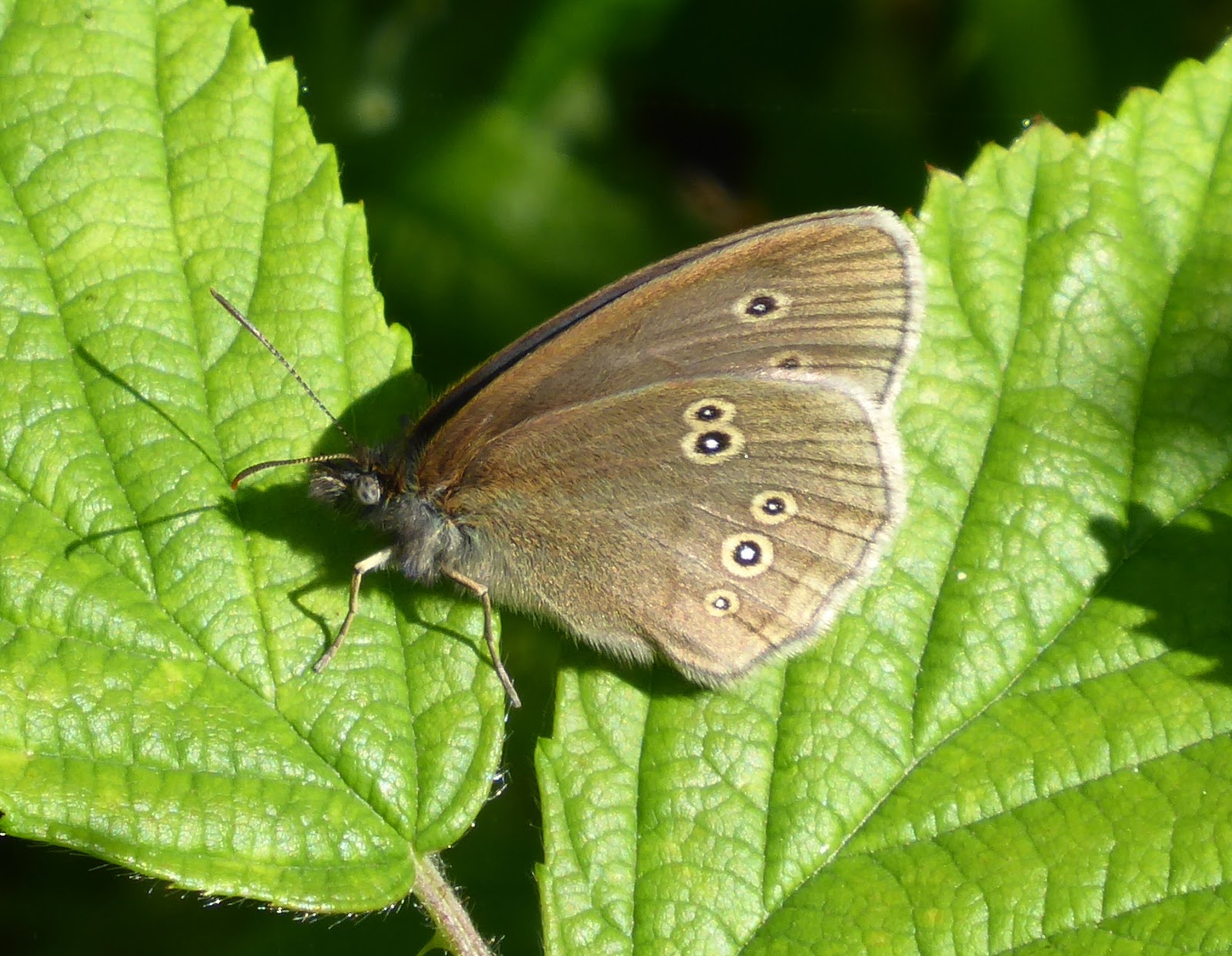
Ringlet
The week just gone has been very rewarding in terms of nature spotting.

On Wednesday I took advantage of being in Northumberland to make a late afternoon diversion to Cresswell Pond.  Striking out along a path I erroneously thought would lead to the bird hide, I was soon seeing painted ladies and red admirals, together with a few speckled wood and a single ringlet, the first I have seen this summer.

Eventually finding the right way to the hide, the sightings continued and there was briefly half a dozen painted ladies visible at the same time.  Maybe it's going to be a painted lady year?
Faded Lady
I noticed that one or two of them had much lighter colouring on the upper forewing and vaguely wondered about an obscure variation but I think in fact it was just the result of wear. They were all of a large size.  In the end the totals were 25 painted ladies and 13 red admirals but zero peacocks.

Quite a lot of bird life was visible around the pond but the main thing that caught my eye was a couple of avocets preening themselves amongst a distant group of gulls.  They have recently worked their way up the East coast and have been seen a few locations recently.  I was also pleased to identify a few sedge warblers buzzing around the bushes as well as a few singing reed buntings.

Avocets (2) on left of sand bank

Walking back to the car along the dunes, I noticed that there were some static brown birds I couldn't readily
Linnet
decide on.  It turned out they were female linnets as was confirmed when a male posed nicely on the fence at the end of the field.

Yestreday I decided to go along on the U3A walk to the Spetchells, hoping to see some common blues. There were a couple of bonuses when I saw a grey wagtail cycling to the meeting place and my first meadow brown of the year as we ambled along the banks of the river.

There were good numbers of ringlet but once up the chalk hills, it took a while before some common blues turned up on bank of scrub sloping down into the sunshine.  There were also some small skippers, a couple more meadow browns and also a number of burnet moths.

Meadow Brown
Common Blue
Small Skipper
Here issues of identification started to creep in as the markings on the skipper were quite similar to that of a large skipper.  I don't think anyone was clued in about the differences between the six spot and five spot burnet moths. I checked one at close quarters and to my eye it had four wing spots.  Unfortunately, I didn't get a photo that was clear enough to settle the matter.

We also found quite a nice cluster of  spotted purple orchids. On the way back down speckled wood were about, including one couple that were mating.

Orchids

Wednesday, 15 June 2011

15th June

Minsmere on short break in East Anglia. An incredible visit, in that I sighted virtually every bird I wanted to see in the minimum amount of time.  Bearded tit, the main target appeared within 40 minutes of arriving, along with reed warbler.

I pretty much expected to see an avocet from the East hide but to see one ten yards out immediately on entering staggered me a bit.  Soon I added spoonbill and flamingo along with various others (that actually interested me less!) thanks to the guidance of one of the RSPB staff. These were: black tailed godwit, gadwall and spotted redshank.

I not only heard but saw cetti's warbler on the way to the bittern hide, where marsh harriers were in action. The occasional bittern was on the move and visible in flight. And then a squadron of hobbies moved in with a spectacular display to feed on the pond dragonflies.

I didn't see the little egret but on moving to the last reed hide, clearly heard a water rail.

Not much was happening in the woodland so I decided to return to the north wall to see if I could improve on the bearded tit sighting, and sure enough a male appeared briefly on the very edge of the reeds.

Many of these spots were aided by wardens and experienced watchers nearby, but eleven first sightings on the same outing has to be a bit special.