A rather cold and intermittently wet spell of weather having reduced the number of appearances in the garden, I went back to a little birdwatching with F on Friday at Shotton Pools.
I wanted to see if the avocets had continued to frequent the shallow ponds and this was indeed the case, although numbers were not large. Also about were plenty of greylag geese, a few lapwing and a lot of heard-but-not-seen skylarks.
Avocet
Lapwing
I didn't notice at the time that the avocet has managed to fish something out of the water.
We were a bit mystified by the set-aside crop in a big farmer's field nearby, which turns out to be something called crimson clover.
Crimson Clover
A day after the latest captive in the summer house was a very small, moth-type item that wasn't keen to stay still. So it was hard to be sure of identification but I'm pretty sure, having had one before that it is a drain fly.
Drain Fly
I think I may have solved the mystery of the fly I couldn't identify in my last post. This time I managed to get better photos, enabling a remote suggestion of green longhorn moth.
Green Longhorn Moth
Green Longhorn Moth (wings open)
On close inspection the horns, which are indeed very long, can be seen like a length of fine fishing line.
So the moth I thought I saw was a fly and the fly I thought I saw was a moth...
The next thing was that a single large white butterfly (female) turned up from nowhere.
Large White
It's the first I've seen this year and a little surprising that it made its garden debut before a small white has managed to appear.
To complete the pattern of unpredictability, a large red damselfly passed by and another minute wasp (I think) but, more reliably, there was of course a nomad bee as well as a chocolate mining bee I didn't manage to photograph.
Large Red Damselfly
Nomad
I keep posting the nomads to iNaturalist but no-one wants to risk an identification.
Today in not great conditions, I saw my first common carder bee of the year. They'll be back.
While writing up my sightings in Spain, I had a couple of sightings South of the Derwent.
On my way to the Metrocentre, about half a dozen roe deer crossed the Derwent Walk a hundred yards ahead of me, including two fawns perhaps suggesting that they are becoming more numerous, as I suppose tends to happen with deer.
I couldn't believe my ears after collecting my first hearing aid at Shotley Bridge on Friday, but then I couldn't believe my eyes either when I saw this heron above the road on the way home:
Grey Heron
Now I'd heard of Leonard Cohen's "Bird on a Wire" but a heron on a wire was total news to me. I gather the fishing on the B6310 isn't much good these days unfortunately.
Lapwing
My plan on Sunday was to do a long cycle ride to the coast given the forecast of long hours of sunshine. When the latter had not materialised by 10.30 am I decided to do a few jobs in the garden then spend a couple of hours at Shotton Pools near Northumberlandia, where there have been a few sightings recently.
The whole area was alive with skylarks singing their heads off and there were a good few lapwings around.
A couple of cheps told me a tundra bean goose had been sighted with some pink-footed geese in the fields.
I reckoned I managed to see it. They'd all disappeared briefly and I was quite surprised when they showed up again that I could pick them out at distance with the naked eye, so I had a go at getting a group shot, with the impromptu intervention of a couple of hares.
Tundra Bean Goose(l), Pink-footed Goose with hares
My bird handbook points out the elongated neck on the bean goose. It should really show a black tip to the beak but maybe it's not apparent at several hundred yards range.
Avocets have been turning up in Northumberland for a fair while but today I counted six and there were probably a few more, so that was new.
Avocet
A very graceful bird...
On the way back to Northumberlandia, one or two of the lapwings were starting to rehearse their display flight and call. I didn't manage to capture this example very well, but it was easier than trying to keep up with all the skylarks.
Lapwing rehearsal
One that I didn't catch up with was the white-fronted goose but I saw them once before at Loch Ken.
The fine weather at the end of March was not to continue and occasional snowfall and hailstorms meant that summer species have since been slow to emerge.
Snow was still on the ground in patches when I cycled up to Parkhead on the Waskerley Way last weekend, naively hoping to see the odd bumblebee queen or butterfly. Instead there were plenty of skylarks on the way plus a few lapwing in semi-display mode and a grouse was clearly audible on the moors. One thing that was surprising is that I was sure I heard a cuckoo calling on the fringe of Consett on the way back. It seemed remarkably early although there are odd records of them turning up in late winter in Southern England. Turning into my street at the end of the day there was a single buff-tailed bumblebee queen.
In the garden, the dunnocks have continued to help somewhat in getting rid of some of the nyger seed from the bird table and a squirrel has been taking some of the peanuts that seem to have become less popular with the birds.
Dunnock
Squirrel
The other day I thought I might have spotted my first non-bumblebee of the year but it turned out to be a hoverfly, probably a drone fly.
Drone Fly
Today was similarly quiet when I went on a bike ride to the Princess Anne Park near Washington Centre. On the way back it perked up somewhat. Chiffchaffs were singing everywhere and there were a small number of buff-tailed bumblebees lclearly looking for nesting sites. At one point there were even some rather strange-looking cows wandering along the side of the track.
When I experimented by offering a nyger seed feeder to the local birds a couple of years or so ago, I was a bit surprised that it was all gobbled up by jackdaws and none of the fancy species I had hoped for got anywhere near it. So when I was offered a bag of nyger seed surplus to requirements in Moffat, I had little doubt that it would quickly go the same way.
In fact the heavy sprinklings I put down on the bird table were totally shunned for weeks and interest could only be aroused by adding other titbits amongst the glut of uneaten tiny black seeds.
Eventually a pair of dunnocks and the odd blackbird have latched on to the permanent free lunch and at least some of the pile is getting shifted. I would have expected the coal tits to love it and at least the odd goldfinch to take a look, but not even the jackdaws have shown much enthusiasm. Perhaps the birds just have other things to do at this time of year. The feeders haven't produced much either.
Finally emerging from Covid confinement, I took a trip to Edinburgh last week for cultural purposes. I did manage to slot in an hour's walk in Princes Street Gardens but there was nothing around apart from a couple of magpies and pigeons in spite of a nice, sunny day. The only other animals I saw were the stuffed ones in the National Museum.
On returning home, there was a little more on offer. On Friday, I briefly saw a small tortoiseshell from the summer house as well as a bumblebee and a female woodpecker paid a rare visit to the peanut feeder.
Greater-spotted Woodpecker
On a bike ride yesterday there was another bumblebee and any number of skylarks singing, giving a strong sense of Spring. Then today, single small tortoiseshell was resting on the laurel in the front garden.
Small Tortoiseshell
There seemed to be some staining on the left lower wing that looked a bit like bird lime. As the temperature was around 9C I was surprised to see it at all and hope it has managed to take cover. It's forecast to freeze tonight.
Last weekend during the storms I was convinced I'd seen a white butterfly flattering past my front hedge. The temperature was 11C but there is no evidence to suggest any whites appear in January so I guess it must have been a leaf. There have been no surprises on the feeders apart from a female nuthatch turning up on the suet nuggets. Nuthatches have not been seen here for a while.
One thing that did "turn up" was an explanation for the burrowings in my plant pots and for the fact I occasionally find an acorn or an oak sapling in them.
Grey Squirrel
Malcolm and I decided on a walk from Amble Dunes to East Chevington, which should have produced more interesting bird sightings. The main thing saw was this dead ray, which I think may be a cuckoo ray although rays are not exactly a speciality with me and the spots have faded.
Cuckoo Ray
I was expecting a lot of stonechats at least but all we actually got was a heron just south of Druridge, a couple of passing goldeneye as East Chevington Pond and some usual wader suspects as the tide went down on the way back.
However I was pleased to manage as much as nine miles with the aid of my long-neglected walking sticks and very much enjoyed the concluding ice cream at Amble!
A recent bike ride only produced some audible skylarks and a fleeting bullfinch.
Sometimes the answer lies nearer home and a quickish visit to Killingworth Lake to check out the ducks yesterday proved more successful. The main interest was reports of scaup and I did manage to see a few although it was hard to distinguish between the juveniles and the many young tufted ducks. It was also nice to see some pochard again and get a close-up of a male goldeneye.
Pochard
Goldeneye
Scaup
At Killingworth the gulls, ducks, geese and swans are often found close to the bank at the West end because of the number of people who feed them. Whether this is a good idea is another thing.
Not a bad past ten days even if the bird rarities aren't showing up in the numbers they were last year.
A week ago on Monday I decided to finally walk a stretch near Gosforth Golf Course, where I knew ring-necked parakeets had once been seen.
A few hundred metres after the start, an old chap with a crutch stopped to chat and told me that parakeets are often in the trees in the area where we were standing, but weren't there today as he would have heard them squawking.
I can't have gone on fifty yards before I did hear squawking and could make them out in the trees overhead, about four in total I reckoned This was a fair slice of luck as hardly anyone else I encountered muttered even hallo unlike most areas I visit.
For the rest of the walk I didn't see anything much beyond a few goldfinches even though I ventured into a North Tyneside designated ecozone, which was actually a rather unpromising strip of land sandwiched between the North end of Longbenton and an industrial estate.
On the way back I was wondering what else I had hoped to see and came to the conclusion it was redpolls, which turned up in some number at the end of last January.
Anyway, the parakeets were still in situ in the same couple of trees when I ended the walk and seemed to be pretty static, not crashing around all over the place like when I saw them in Brussels.
Ring-necked Parakeet
This was the first time I have seen a parakeet in this country. They are in the region but not in anything like the numbers in the South East.
The day after was a bike ride to Belsay, when I heard skylarks for the first time in a while and spotted a yellowhammer in a hedgerow. There were also a couple of buzzards, a kestrel and a probable sparrowhawk.
I tried a walk round Shibdon Pond at the weekend, an area that always strikes me as attractive but doesn't produce much of interest. Apart from large numbers of barnacle goose, I did manage to spot some shelduck and tufted duck on the pond itself.
Shelduck
Tufted Duck
The other thing I have noticed in the past few days is that a robin has started visiting the peanut feeders, not something that I've ever seen before as far as I can recall. I'm wondering if it's something they've learned from the numerous tits.. The winter has so far been mild so you wouldn't think food was in especially short supply.
Monday, 21 June 2021
The return of my bike after a wheel replacement has led to an increase in cycling activity.
On the 12th June, I took a brief trip up the Waskerley Way, hoping to see some butterfly species that haven't been showing up so far. The only result in that direction was a couple of passing red admirals and a speckled wood. Once up on the moorland, I did find a bank of bilberry not in flower, a good bit of uncut fern and some advanced bird's foot trefoil but no resulting pollinators. Lapwing, curlew and skylark were around but otherwise the most noticeable feature was the impressive view.
Waskerley Way
The most exciting thing was a momentary sighting of a redstart on the path on the way back down, just after I'd had a close up rear view of a red kite.
On Wednesday I set out from Newbiggin to head for East Chevington Pond, where one or two rarities have been spotted.
Going slowly, I again kept a careful eye on the bird's foot trefoil between Lynemouth and Cresswell but again no common blue were seen. What I did see was a collection of what I was fairly confident were linnets around a house just South of the first caravan site. A few turned up later coming back along the dunes but in both cases they didn't hang around. Linnets are nervous birds.
Stopping at the north end of Cresswell Pond, I didn't really expect to see the spoonbill that had been reported a few days earlier. After returning from inspecting the undergrowth and stumbling upon a red admiral, I spoke to a chap who thought he had seen a little egret. However another chap with a telescope confirmed it was indeed the spoonbill and I could pick it out in a field on the other side, snoozing with its beak tucked in. There were some avocets around but I didn't spot them, just a lot of gulls including a little gull.
It was only on the way back in the afternoon that the spoonbill was active and I got a good view of it. Apart from my visit to Minsmere several years ago I hadn't seen them in this country before.
Spoonbill
Little Gull
Compared to that East Chevington pond was a bit of an anticlimax as all I saw beside more gulls was several cormorants. At least I got the chance to check out where the hides and approaches to them are.
On the way back more individual red admirals were around, none of them settling. I counted five by the end of the day. Again there were a lot of skylarks and several meadow pipits around, on a couple of occasions perching quite close.
Unusually I only saw one stonechat but a nice surprise was a whitethroat on a lone bush in the dunes.
Whitethroat
... Or at least I think it's a whitethroat as I'm still not sure when a whitethroat is a lesser whitethroat.
On a fitness ride on Friday, I think I may have seen a meadow brown or two, but very much in the passing.
The search for birds continued, similar weather to Day 1 with slightly less wind again largely ruling out the possibility of butterflies and bees.
I did an old trick and drove the bike to Ken Dee marshes enabling me to forage further West. The first target was the Laurieston area where I have heard cuckoos a couple of times before. However my progress was quickly interrupted on the road over when I could clearly hear a cuckoo calling from a conifer spread in the middle distance.
Annoyingly again, I couldn't catch sight of it but stopped at the very next field where about three red kites were performing acrobatics. By the time I got off the bike, removed two layers of gloves and got the camera out they had moved on.
I was just about to do the same when the cuckoo flew right by the road, hotly pursued by two smaller birds - an impressive view. It settled in a small tree along the road but soon retired some distance away. I did not know that cuckoos get mobbed but I suppose it makes sense if the pipits etc have worked out what they are up to.
I rode on amongst a chorus of willow warblers and chaffinches and spent time in a certain area where a golden eagle is reported to pass by. Needless to say there was no sign, nor indeed of any other bird of prey which was a little surprising. There were just plenty of pipits and the odd skylark singing.
Things remained quiet until heading towards Girthon I heard exactly the same insistent chattering from a hawthorn bush as I encountered yesterday. This bird was even more invisible. I wondered about lesser whitethroat but it was only when I replayed the video I attempted that I realised it was a sedge warbler.
Must be a sedge warbler in there somewhere!
This was rather annoying as I have heard sedge warblers before and should have recognised it. Perhaps I eliminated it on the basis that there was no marshland nearby though on reflection there was a small stream as was the case the day before.
At this point I realised I was quite a way behind schedule and pedalled on at some speed for a late lunch at Kirkcudbright. This was a bit of a pity as I passed through some interesting territory and someone told me the day after he had seen grayling at Carrick. I wish I had known that in advance.
The idea was to cycle back slowly to Laurieston from Ringford but a sudden shower sapped the enthusiasm and I did not pay much attention to the cuckoo calling north of Ringford, nor the one south of Laurieston.
After Laurieston I had warmed up a bit and was considering a quick run round the reserve at Ken Dee Marshes to check for peid flycatchers and wood warblers. But just past the spot where I saw the cuckoo that morning I stopped to inspect the undergrowth and spotted a cuckoo in a tree further along. I just managed to get a mediocre shot of it before it flew on further to a telegraph pole and started singing.
Before I could get a better shot peering through the trees it bolted up the valley, singing all the time, and made itself scarce. It was probably the same bird as earlier.
Cuckoo
Thus was a minor ambition achieved in the very last mile or so of the expedition. By the time I reached the car, it was too late for further escapades and I headed back to the B&B.
I noted some while back that spottings in my garden are a bit upside down in that birds that are normally common appear seldom - and vice versa. A recent surprise was to spot two 'rarities' at the same time last week, a male garden sparrow and a siskin. A female sparrow also turned up a couple of days later, as did briefly a goldfinch. Both birds can be seen close at hand but don't usually visit the garden. You'd really expect more siskins, given the amount of nearby woodland.
Siskin
To cap that I also got the best view I have ever had of a jay, which hung around for a couple of minutes just behind the bottom fence. This happened while I was getting dressed upstairs, hence alas no photo.
The weather has done a major u-turn putting an end to butterfly sightings but Spring has now sprung and other species are abundant.
A week ago on Friday Frances and I did a very scenic walk along the Blyth at Humford Mill near Bedlington. There was wild garlic and other woodland flowers starting to come out all over the place, plus one plant I knew I recognised but needed to check - alternate leaf golden saxifrage. There was less in the way of birdlife apart from a grey wagtail and a quick flash of a dipper flying downstream.
Grey Wagtail
Alternate Leaf Golden Saxifrage
Although the weather was already starting to cool there were a good few bumblebee queens on the move, one of which seemed to me on the basis of video evidence seemed to be a buff-tailed bumblebee.
One week later it was quite chilly when Malcolm and I set out from Low Newton to the outskirts of Beadnell against a northerly wind.
There were skylarks all over the place with a good number of meadow pipits, one of which posed nicely on a stretch of cut grass near a holiday park.
Meadow Pipit
It was one of those days when the further we walked, the more we saw. By the time we got back we had also seen kestrels, stonechats, a flock of geese in flight that eventually landed at distance and looked to contain a mixture of greylag and pink-footed geese. there were a good few shelduck around, a couple of which were just about near enough to catch in the camera, though I never even spotted the curlew that was next to them. A shallow pond produced a couple of gadwall and lapwing as well. however I was most pleased with a quick but unmistakeable view of a golden plover through the binoculars.
Shelduck - and curlew
Afterwards we stopped for a coffee back at Low Newton. The tide was in and there was a proliferation of sanderling, redshank and oystercatchers on the crowded shoreline and a fleet of eider duck further out.
I reckoned there were some other small birds running around with the sanderling and took a few casual shots thinking to identify them later. In fact I totally missed the foreshore and got instead a couple of blurred shots of birds in flight above the waves. One had an upwardly curved beak but wasn't an avocet so I suppose possibly a godwit. The other was a small wader but from what little I had looked more like illustrations of Temminck's Stint than the dunlin or knot I anticipated. That however seems rather more unlikely.
If we had visited the foreshore at the beginning rather than the end of the day, I might have paid it more attention.
A lurch into warmer weather has produced an increased level of sightings.
The day after I last posted, we ventured on a fishing trip to Milkhope Loch on 24th March. As I was parking the car I heard my first chaffinch of the year. On a reasonably bright day, Malcolm managed to catch six small roach, although to be honest tiny in most cases. The first one actually looked more like a rudd but wasn't retained. I stuck out for carp on ledger and short pole with bacon grill baits and had nothing more than a couple of sharp, bait stealing bites on the pole which I attributed to ide but it was more about catching something on this first visit.
On Tuesday this week I went back alone to Milkhope to use up the maggots and again had no trouble picking up small and tiny roach. I switched to sweetcorn near in on the waggler after lunch in the hope of better things. One large fish did move through the swim but otherwise it was just tiddlers failing to take the bait.
Bites were continuing on the feeder and the maggots were constantly getting sucked. So I decided to fine down the tackle, which produced a skimmer bream as well as a couple more roach. Then just before five I hooked into a much bigger fish which fought well for four or five minutes before snapping the 1lb 14 oz bs line just below the feeder. Very frustrating as I didn't get a decent view of it, and probably underestimated how heavy it was.
It wasn't much of a consolation that I got a friendly visit from a greylag goose that also ate my apple core. By this time chiffchaffs were calling all around.
Greylag Goose
Buffish Mining Bee
Previously I spent a windy Sunday afternoon at the Spetchells to see if the mining bees were active and ideally identify the rarer ones. There were a few dozen buffish mining bees around as well as some garden and red-tailed bumblebee queens. However I didn't catch up with ashy or tawny mining bee and there was no sign either of the sandmartins over the river yet. Rather surprisingly, I did see a couple ofunidentified butterflies in an area of trees with dark bark and I wondered if they'd hibernated there. On the way back along the river a kestrel hovered enticingly.
Meanwhile I did finally manage to spot a greenfinch high up in a tree at the back of the house. Stretching the capabilities of the camera, I got a shot which just about showed up the large beak and yellow stripe.
Greenfinch
Yesterday I did a bike run up to Lygett's Junction and a couple of miles up the Waskerley Way. In considerably sunnier weather, there were quite a few butterflies on the wing. I wasn't convinced they were all peacocks and red admirals either, too brown and, as I thought not quite right for small tortoiseshells either.
Skylark
Just past Consett there were a lot of skylarks singing above a meadow and one of them was obliging enough to let forth from the fence of a nearby estate. Again more of a silhouette but it's rare to get a skylark in the camera lense.
By the time I headed home butterflies were starting to settle in the sun and I caught sight of two peacocks and two red admirals, but none of them were inclined to linger when I appeared.
The extra two miles were worth it though, as there was a chance encounter with an early bumblebee queen as I took a quick break at the halfway stage.
Recent paucity of nature news can be blamed on poorish weather and continuing lockdown, hopefully better is soon to follow.
A slightly bright nore has been offered by several appearances of a male nuthatch in the garden and, on one sole occasion that of a woodpecker. Yesterday I planted some wild flower seeds at the back of the garden as it is only now that frosty nights are starting to look less likely. Part of the thinking here is that the copious amount of garlic mustard that used to grow in the same area hsn't yet appeared. Maybe I was too radical when knocking it back last summer.
I've done a couple more walks in Chopwell Woods, whose main success lay in finding further routes that avoid the heavily-used car park and ice-cream van. During the first one, there was at least some birdsong to be heard and evidence of jays in the trees, but that was all apart from a grey squirrel, the odd robin and a single wren. Last week the second one was a return to the baffling near total absence of birds. I can't understand it. You'd think among so many trees there'd be treecreepers and even a crossbill or two.
One thing I did come across on the way in was a heron on nearby farmland. This evokes the question I wondered about often in Dumfries. Why do herons visit farmland in winter - to seek out worms and insects or because of fishmeal compost?
Heron
This one is obviously next to some flooded land but I can't imagine it would hold fish and it seems to be looking elsewhere.
More interesting was a visit with Malcolm to check out some of the lakes maintained by Wansbeck and Cramlington Angling Club during a brief warmer spell. Walking up to Milkope Lake there were a good number of skylarks in the fields. They were flying low in pairs rather than soaring alone and it looked like this was some sort of pre-mating activity. On actually reaching the pond, a good number of people were fishing and catching small stuff.
On Horton Lake nearby, one elderly angler took about half an hour to land a near 6lb bream on fine pole tackle and a visit to Brenkley Lake established that it had recently produced a 19lb carp. We've taken out membership and I hope to report on some fishing activity before the end of the month. I had wondered if it would soon get warm enough for butterflies to be seen early but the weather quickly deteriorated over the weekend
A bike ride the Monday after started in mist temperatures of 3C rather than the anticipated 9C but at least led to the sighting of a group of tree sparrows huddling in a tree, I was out riding again today in warmer but windy weather and did get a closer than usual view of some tufted ducks at Bradley Pond on the way home.
I held back on the last couple of items on the last flowery post as I needed to email a friend (and indirectly his Ranger daughter) on a couple of identification issues. Now the panel can reveal that one of the other items was in fact wood spurge. I should have realised too that the other was wild cherry but had not realised they can grow to 20 metres in height and had therefore discounted the idea.
Wood Spurge
Wild Cherry
Following a lead from my sister last week, I took a longish ride to Weetslade Country Park in the hope of seeing a lesser whitethroat, a bird which didn't feature in Dumfriesshire so I was keen to get a confirmed sighting.
Social Isolation
On the way through Wylam it was amusing to see the effects that social isolation has had on the local population. I took the road up past Close House to Heddon, seeing the odd white flattering around and a few speckled wood on the cycle track through Darras Hall.
I didn't hang around much until I got to Weetslade and quickly identified the suspect area. I think I probably did see a lesser whitethroat but it was difficult to be certain, as birds kept scurrying around in the gorse and other bushes. The light was also very bright, making it hard to pick up the colouration well. So much so in fact that I thought the first birds I saw in the treetops were female blackcaps. In fact they were common whitethroats.
At one point I definitely spotted a slimmer, brighter bird, which was probably lesser whitethroat but it was so brief that I couldn't register the definite sighting I wanted. In retrospect, I wish I'd done a bit of homework to distinguish the whitethroats but I hadn't realised there would be so many commons. Other casual sightings were lapwing and skylark, quite good views of both.
I only got one distant photo of a whitethroat at Weetslade, which the bright light made impossible to identify for certain. Then quite by chance, one popped up at the end of Prestwick Carr. But this one was clearly a common whitethroat. Note the pink legs and wing markings.
Common Whitethroat
Green-veined whites have become much more apparent in the garden, and this one settled still for over five minutes on the garlic mustard. I thought it might be laying but there were no obvious signs afterwards.
I was pleased to see that three tree sparrows spent some time feeding off the bird table yesterday, so it looks like they may become regular customers. The bird food has been getting low during the virus crisis and I've reduced the amount I'm putting out . I've also levened it with some leftover cumin seed but it doesn't seem to have proved popular. Having sampled a few myself, I'm not surprised. The taste is pretty pungent.
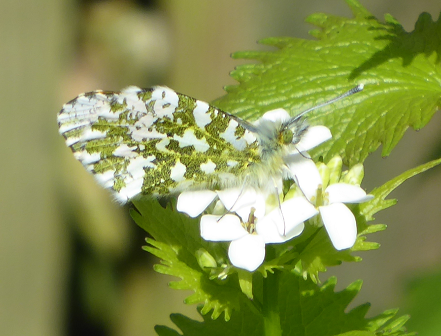
The garlic mustard has been shooting up and the first orange tips have been visiting, five sighted on one particularly sunny day. It struck me that they are actually quite well camouflaged on this plant with their wings closed.
Orange Tip (wings closed)
Orange Tip (wings open)
There was also a green-veined white on one occasion.
The Garlic Mustard has also been attracting quite a few bees, including the tree bumblebee that is now one of the commonest visitors. There have also been some ressembling carder bees that have struck me as being particularly large, so I doublechecked but I think they are just common carders.
Common Carder
Tree Bumblebee
Yesterday I took my coronavirus exercise in the form of a cycle ride along the Tyne towards Newcastle. The idea was to check out how the flower meadows were developing but it was no surprise to see nothing was flowering as yet.
Around Leamington there were a few butterflies about. At first it was annoying as none would settle so it wasn't possible to identify any, even though a couple nearly flew in my face. Gradually it was possible to pick out the recent usual suspects - peacock and orange tip - as well as possibly a couple of other whites.
I continued on to just past Scotswood Bridge and stopped for another disappearing butterfly, when two or three sand martins started looping around in front of me. Then, just before the stretch where the track runs down next to the main road, there was the first speckled wood of the year in the hedgerow. On the way back a couple of skylarks parachuting down to some waste land just by Scotswood.
If I'd been looking to see any of these three things, this certainly wouldn't have been where I would have gone to do it.
Speckled Wood
On looking at it more closely, it's noticeable that the speckled wood seems darker than other examples. I assume this is partly because it is a fresh specimen and that some of the speckles are not yet or only faintly visible.