Showing posts with label linnet. Show all posts

Wednesday, 5 November 2025

Betwixt and Between

I don't like this time of year, when the butterflies gradually disappear and the bees become scarce.  

There still is the odd butterfly around of course but the last ones I saw were a large white and a speckled wood around 8th October and nothing since.  A week afterwards I thought I'd found some ivy bees next to the cycle track north of Styford but it proved they were all honey bees.  It was the pale version of western honey bee that I was confusing. 

The temperature does however remain mostly above seasonal norms and the birds are still gobbling up the sunflower seeds and hearts with gay abandon - particularly coal and other tits but nuthatch and bullfinch of both genders continue to visit regularly.  A good trick would be to catch one of each species feeding together but they are obviously not friendly so the best I managed was male and female bullfinch together.

Bullfinches

A pleasant surprise was to find a green lacewing on my shed window and, with no frost so far, some flowers are still blooming including a very late and rather pathetic attempt at a sunflower. 

With some reluctance though I decided it was time to concentrate on birds.  I started out a couple of weekends ago at Newbiggin.  It was a Sunday so the golf course was busy but on the coastal path I found a twitchy flock of about thirty birds I thought might be twite.  They weren't settling for long and the only ones I snapped were linnets, though I cursed the hiker who walked straight toward one settled group I was trying to photograph, thinking that linnet and twite often mix.

Linnet

I suppose though that twite tend to turn up a bit later in the year.

One or two snow buntings have been turning up, some apparently on the grass at Seaton Sluice so i set off to find them the Sunday after.

It looked like they'd be easy to find but there are a lot of twisting paths through grassy areas at Seaton Sluice so I didn't find them.  By way of compensation there were several stonechats, which I always like and also a solitary pair of male chaffinches, which I must say I regard almost as a rarity as they are one species that I never see in the garden.
Stonechat
Chaffinch

Monday, 24 February 2025

Spain - Day 3

We set off in the wee small hours again the next day, this time in search of the secretive Dupont's lark.  Its shyness meant us standing in line motionless on the site off the road to La Yunta in near freezing temperatures. Well we heard it clearly enough but it seemed to have disappeared by the time there was reasonable light and we only saw one or two bits and bobs on the way back for breakfast. 

Setting off again in the van we stopped briefly for some common cranes that were posing nicely in a field, not daring to get out in case we disturbed them.

Cranes posing

This was on the way for a walk in the hills near Tornos looking for larks, which were well-camouflaged and the one I definitely saw was Thekla's Lark.  Unfortunately my photography skills were again much challenged as many sightings were at considerable distance and several photos came out blurry.  Hopefully I can find an app to rescue some of them

Later we headed to the other side of the laguna, where there were some flamingos at reasonably close range, mainly keeping their heads down.  I think this is the best view I've had of flamingos to date.

Flamingos

There were a good deal of both marsh and hen harriers around and another walk near Las Cuerlas, after a period of seeing bits and pieces at distance, we hit on an area where a large number of raptors were flying overhead, almost as if participating in an air display.  In addition to those already encountered, they included a totally new sighting, the black-shouldered kite (never heard of!) and, almost as an afterthought, a couple of golden eagles...

Of all of them I got nothing but blurry silhouettes so it was a bit of a surprise, on returning to the lagoon near Dirigida, that I managed to get a passable shot of a mass of cranes right on the far side of the lake, many hundreds of yards away.  I must have got the zoom spot on for once.

Cranes at distance

When we first got there, there was also a nice white wagtail close by but the main birds in evidence where great and cattle egret, the latter showing no yellow as still in winter plumage.  I learned you can still tell them apart by the fact that the great egret has a much longer neck.

Great Egret
Cattle Egret

White Wagtail

Great egrets are starting to be seen in the North of England but cattle egrets are still a rarity, though I saw lots of them in the West Indies.  The white wagtail is also infrequent.

However the strangest thing we saw on stopping further down was three roe deer that had apparently decided to swim the whole length of the lagoon in very cold water.  We saw the last part of their journey, lasting several minutes with one pulling ahead to leave the other two straggling behind.

Roe Deer

Also sighted in this area and on the way back to the hotel were: little bustard, stonechat, linnet (lots of), black redstart and spanish sparrow.

In the evening I had a bit of reflection on the photography angle and decided to increase the focal length of the birdwatching auto facility on the camera.

Of course serious birdwatching photographers will tell you you really need to use manual settings...

Sunday, 23 February 2025

Spain - Day 2

Oh dear, what a catastrophe!

At teatime on day 2 perhaps still jetlagged after getting up at 3.15 am on Monday to make the flight from Stansted, I managed to permanently delete all the photos I had taken during the day including good views of some notable first time sightings.  So all I can do is tell the story of what I saw without the evidence.

The day started well before dawn when we drove a few miles to an observation post at the Southern corner of the lake.  It was still pitch dark but after half an hour, vague shapes could be made out and I used the moon setting on my camera to see lines and lines of cranes in the distance...

The story with the cranes is that they gather on the Laguna di Gallocanta before migrating northwards across the Pyrenees. Each day at this time of year some will make the flight, some will remain and others will move in.  

So as the light improved, they started to move off in increasing numbers, flying straight over our heads in an overwhelming display except for one lone individual that came back.  Someone joked that it must have forgotten something.

We were told that there were around 15,000 cranes in the area on the day but the hotel organised a competition for us to guess how many there would be on the last day of our stay, just before the start of the "crane weekend" when most are expected to make the move north.  The number counted on that Friday was over 27,500, many more than any of us guessed!

Also seen on or the lake were some distant flamingos, shelduck, shoveler and teal as well as calandra lark, merlin and marsh harrier nearby.

Later in the day we travelled around a bit seeing crested lark, several linnets rock sparrow and roe dear. indeed it was going along in the van that led to a spectacular sighting when one of the guides saw two great bustard crossing behind us in his mirror as he drove along!  They disappeared straight away but we caught up with them again by circling around and managed good views. 

Something similar happened not much later when a bird of prey flew out of a tree in front of the advancing van.  Some thought buzzard and some thought marsh harrier but it flew off speedily to a corner of a distant field, where it could eventually be identified as a booted eagle

You can see why I was fed up about deleting the images.

I did manage one photographic capture that evening. In a garden near the hotel there was a bush full of twittering birds, which could only be seen fleetingly as they left and entered the foliage so I tried without much success to video them:

Tree with invisible birds

The Merlin app suggested spanish sparrows but I think not. Bog standard house sparrow is I think the correct answer.  I later learned that spanish sparrow is a more rural species.

Thursday, 24 October 2024

Much ado about Sparrows

Since being mislead by the pale starlings last week, I've experienced a good bit more uncertainty - this time about sparrows.

It struck me that there was something slightly odd about a bird I thought was a sparrow. It spent a good long time sitting in the plum tree before finally feeding for a long while at the bird table - not too sparrow-like in itself.

Dunnock

It's the head pattern that troubled me, the rather dark head and white neck band and bib. Anyway google lens thinks it's a dunnock, which surprises me as there's not much flecking on the breast.  I wouldn't normally have much trouble spotting a dunnock.

I'm please to say that a female nuthatch has visited my new caged bird feeder several times over the past few days.  However it makes sure it lands so it's mainly obscured and flies off as soon as I point the camera at it.

Also still at it is the grey squirrel, so there must be more nuts buried somewhere under the lawn.

Where are my nuts?

The sparrow fixation continued when I finally got to Holy Island yesterday, on a day when people generally agreed not much was going on.

The first bird I saw was again motionless in a tree, as if resting, and appeared at first sight to have a yellowish sheen, suggesting perhaps a female yellowhammer or even an exotic warbler...  So I took more photos and tried to get closer.
Sparrow?

Sparrow

Yes, it's actually the same bird.  The yellowish tinge on the first bird is a trick of the low sunlight, the erect posture somewhat untypical and the apparently large beak an illusion.

After a quiet spell, I got another shot of a bird in a tree, largely facing away from me, wasn't sure what it was but thought "Probably sparrow."

Linnet

So google lens thought linnet - entirely possible.

There was however no mistaking the sparrows that decided to assault the remains of my coffee break.  Not many species learn to be so cheeky.

Definitely Sparrows

After the lunch/coffee break - I wasn't sure which - I got what were some quite pleasing results with the camera.

Heading towards the harbour, a call of nature diverted me to the nearby cliffs where a kestrel was hovering.  I tried to video it but it kept moving and then started hovering at more or less head height no more than five yards or so to my left.

Kestrel

So, if you like, I got a bird's eye view of a bird.

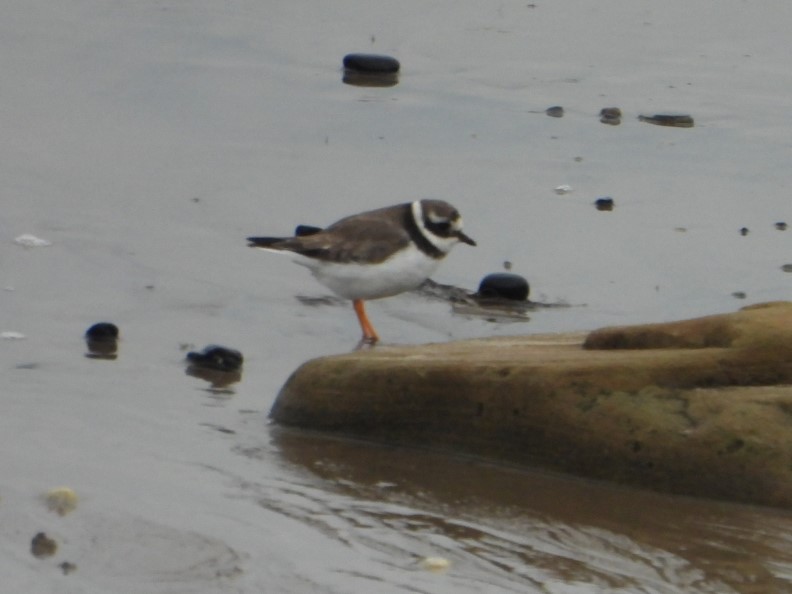
In the harbour area I caught up with another ring-necked plover and was particularly satisfied to pick out one of a pair of rock pipits from a well-camouflaged background.

Ring-necked Plover
Rock Pipit

Google lens however thinks the rock pipit is a corn bunting - oh dear, I don't think so!

But probably the best was this pale-bellied brent goose, because of how far away it was:

Brent Goose

You can't see much of the neck stripe because of its head position.  Incidentally that isn't blood in the water but the reflection of the paintwork from a nearby boat moored at the water's edge.

There was just the one.  However the chap at the crab sandwich stall (I was still hungry) reckoned there had been as many as 6,000 but most had gone inland.  Sure enough, when I ventured further towards the causeway, there were 20 or 30 more, including I think some of the dark-bellied variety.

Brent Geese

Friday, 18 October 2024

Getting Back into Birds

As the summer has faded into autumn, I've started to think more about birds.  In past years I've had some really good luck with birdwatching, which more recently has drained away.  I've increasingly suffered from bird blindness through looking down for butterflies and bees rather than scanning the skies and trees.

A week ago on Saturday, I was in Scotland to see my son and daughter in law, when we fitted in a brief trip to Baron's Haugh RSPB Reserve near Motherwell.  It was actually quite disappointing as not too much was showing - until I looked a bit more closely.

I got a quick early video of a kestrel deciding not to hover but the loch itself was pretty quiet apart from a few standards such as shoveler and lapwing.

Shoveler
Lapwing

There were a small number of waders that I reckoned at first sight to be insignificant but on closer inspection they turned out to be snipe.

Snipe

I was quite pleased about this as I've usually seen them furtively prowling through the reeds rather than in the open.

It was actually quite warm later in the afternoon and I counted four speckled wood flying around the trees.

Overall I haven't been too satisfied with the bird photographs I've taken on my new camera to date, so i asked my daughter in law for some ideas and she's adjusted some of the settings.

The first opportunity to try them out should have been last Tuesday, when I planned a trip to Holy Island to check for migrants but the weather was so appalling that I chickened out.

Instead I decided to visit Newbiggin this Tuesday, as one or two of the more rare buntings had been reported there.

As I wasn't heading for Norway, I skipped the pub and made my way instead onto Newbiggin Moor.


Last Pub before Norway

Working my way up the coastal path, I took opportunities to try out some distance shots of redshank with reasonable success, when I got a slight surprise.

Surprise Plover

Now I reckon on balance this was ring-necked rather than a lesser ring-necked plover, as these should now all have departed and there was no sign of a yellow ring around the eye. It was also the only one I spotted running around the beach. 

There were a few curlew around. one politely posing well on the golf course:

Curlew

I continued along to the point where people sometimes put bird food down and caught up with a numerous flock of linnets, but nothing more special.  Starting back however, I came across a chap lying in wait for a snow bunting  he'd seen briefly.  He also mentioned that a lapland bunting sometimes mingles with the linnets.  This eventually had me scouring the photos to see if I could transform a linnet into a lapland bunting - but it didn't work.

Linnets

Some of the males still had the last vestiges of their summer plumage.

My hands were getting cold so I didn't wait for the snow bunting.

On the way back I remembered a tip on holding the camera and got the best shot of a redshank, later running into a bird that puzzled me and clearly wasn't a redshank.  It turned out it was a turnstone, just didn't quite have the neck pattern I'm familiar with.
Redshank
Turnstone

The tide was just starting to go down and there was a typically large flock of golden plover winging around, landing and relanding.

Golden Plover

My last sighting was of a group of birds that were on the wet rocks near the cliff.  At first I thought there were starlings, which is the general opinion on facebook but on looking at the photo, I'm not so sure.


Starlings?

Some of these birds seem to have brown supercilia and a light colouration I don't see in shots of starlings.  A trick of the light? However there is certainly one added bonus as the one in the bottom right hand area has been identified as a rock pipit.  there's also a small warbler right at the front, partly obscured.

You have to admire the tenacity of some bird watchers - these two have been holding continuous watch over Newbiggin Bay ever since I first visited years ago.

Birdwatchers

Overall I was partly but not fully satisfied with the improved results from the camera.  However it was very windy, as you can hear in the video.

Just for the record I saw three more speckled wood at the Tennis Club on 14th October - maybe the last this year.


Friday, 2 June 2023

Mixed Pickings 2

Last Sunday I was out on a walk in the Durisdeer Hills with V&A.

In reasonable weather there were quite a few butterflies around, the predominant species being the green-veined white.

Green-veined White

Even more predominant were large numbers of red kite, which have clearly spread from Loch Ken and a fair few buzzards.

We were really hoping to see a pair of hen harriers that appeared to have mated in the area and merlin, which are known to be present here too.  In fact we saw neither and speculated that the large number of other birds of prey may have discouraged the harriers.

There were however numerous other birds to see, notably meadow pipits as one would expect, wheatear and a few red-legged partridge - hardly surprising as they are bred widely as a gamebird. 

Wheatear


Red-legged Partridge


The wheatear looks to me like a young female. I also noticed that the pipit appears to have some sort of head or eye stripe, so that I briefly wondered about tree pipit but discounted the possibility.

Meadow Pipit

About two thirds of the way along the trail there was some cotton grass and a large expanse of bilberry and I started to wonder what else might be seen here.  However, the bilberry was only just coming into flower.

On the way back through this area, there was a chance sighting of a small heath butterfly, which pleased me considerably.  There was also a single bird's egg on the path - probably that of a dove or pigeon - which we decided to leave alone.

Small Heath

Towards the end a couple of moths appeared.  One I couldn't identify but the other appears to be a brown silverline.

Brown Silverline

A couple of days ago on the way to the doctor's, I did a reccy of Chopwell East Field, a recently declared reserve to see if it is suitable for a Naturewatch Walk.  

It actually proved quite promising.  Quite a lot of flora is springing up.  At one point there are signs of bird's foot trefoil establishing itself, though I suspect it may get overwhelmed by surrounding grasses.  A shetland pony staring at me from a neighbouring horses' field possibly was showing some interest in addressing this issue.

In an area described as wetland, which was actually pretty dry, I was lucky enough to come across one or two small copper butterflies.  Turning to retrace my steps a pair of linnets started singing from nearby trees and bushes.  It looks like they are both male.

Small Copper
Linnets

Meanwhile back in the garden, I've twice been visited by a pair of bullfinches, anxious to hoover up some seeds from the now over-abundant forget-me-nots.
Mr Bullfinch
Mrs Bullfinch

A bit rude of Mr Bullfinch to have his back turned on us.

There's no more news on the mystery black bee, but I did manage to capture this early bumblebee worker.

Early Bumblebee

No more signs of red mason or nomad bees, perhaps down to poorish weather.

On the "Is it a fly or is it a bee" debate, I think I may have missed out when I found a very small item wondering along the kitchen windowsill while cooking.  I didn't take it too seriously thinking it was probably a fly and only got a couple of poor images.

A pity as I think now that it may have been a wee furrow bee and it hung around for ages!

Monday, 13 June 2022

Bikes, birds and bees

A couple of bike rides have paid off unexpected dividends since I got back from Scotland.

Riding back from Newcastle a week ago on Saturday, I paused briefly at a small meadow near the the Derwenthaugh Industrial Estate and managed to see a couple of small skippers nectaring on tiny mauve flowers.  This was a nice surprise since - as expected - the bird's foot trefoil was only just starting to show.

Small Skipper

On Wednesday, Kate and I did a run up the coastal track, mainly for the pleasant scenery and a visit to the ice-cream parlour at Amble.

As usual there were a few stonechats and goldfinch around but I was a bit surprised to see a linnet singing right next to the path.  

While we were scoffing the ice creams outside, we noticed that there was a plant growing from between the stones in the yard.  It reminded me of the scarlet pimpernel I used to see in my grandmother's garden in Hampshire - and so it proved.

Scarlet Pimpernel

Its appearance in the North East is classed as unlikely though I guess the limestone tracts in Co. Durham might be a favoured habitat.

On the way back, we found a birdwatcher, who it turned out was observing a whitethroat that was gaily singing from the surrounding trees.


Somewhat surprisingly, the linnet was still in the same area on the way back, just after we had observed some Highland and Galloway cattle, and gamely hung around while I fumbled for the camera.

Linnet

Back in the garden I have finished clearing away the garlic mustard with the expected decline in butterfly sightings.  I've also stopped feeding peanuts for the birds as I got fed up with constant flow of jackdaws snaffling all the food.

However the bees have continued to enjoy the various flowers that are still out.  For a while I was mainly seeing garden bumblebees but now the buff-tailed bumblebee appears to predominate.  Occasionally I have suspected white-tailed bumblebee but have yet to provide the proof.

One bumblebee that I hadn't seen in the garden before was an early bumblebee that turned up on the chive flowers.  And one non-bumblebee that wasn't the expected mason bee was in fact a chocolate mining bee - a species I did once encounter here a few weeks ago.
Early Bumblebee
Chocolate Mining Bee