Thursday, 26 June 2025

Bordeaux Day 3

With day time temperatures scheduled to hit a maximum of 36C I was a bit cautious about my plan of heading towards the sea at Lacanau and reckoned to do about half of the approximately 120km round trip.  In the event, thanks to an early start and a good day in the saddle I managed about three-quarters of it, turning back a good way past St Helene.

It was quite a long way to the National Park I wanted to suss out and the main thing I noticed meanwhile was the abundance of some yellow flowers on the outskirts of Bordeaux.

Common Evening Primrose?

Suggestions by AI favour Common Evening Primrose, though this sighting was actually timed at 8.31 a.m. Hmmm?

Meanwhile also a sign advertised the presence of a rare mammal, the 'genet commune' in the Parc des Jalles  Apparently it's totally nocturnal so i didn't look for it.

Anyway there was an early success on reaching the Park when I came across one of the target species - a pearly heath, not a great discovery but it's as near to the UK as I've ever seen one. 

Pearly Heath

Other heaths seen were decidedly common.

After that things frankly got a bit frustrating.  I stopped at a promising looking spot a few miles South of Salaunes, where there was clearly a lot of action.  A number of brown butterflies were fluttering around and arguing with some speckled wood but they refused to settle properly.  I wondered distantly about gatekeeper but could not prove my hunch.  After a while an impressive marbled white spent a long time working the path edges but without landing at all.

So the only ones things I captured on camera were small skippers and, a bit later on, some burnet moths.

Small Skipper
? spot Burnet Moth

I think all the several skippers I saw on the day were small.

From this point on it got even more frustrating.  I notice that the photos I tried to take tended to be poorly focused just as the butterflies' behaviour got extremely skittish and now wonder if these factors were the result of the increasing heat which duly exceeded the 35C mark as promised.

Having just passed Salaunes (where there was thankfully a water pump) I noticed a number of blues zooming around but couldn't manage to get anything like a decent view.  They definitely weren't commons, having a brighter shade of upper wing and dark spots on the underwing.  I wondered about nazarine blue but I think they were smaller than that.

So I rode on thinking to stop at St Helene, seeing continued brimstone, the odd clouded yellow and occasional annoying marbled white until I could smell the sea air and eventually realised I'd overshot the turnaround point.

It was worth it though as my last stop was for another group of fast-flying blues.  After much patience, 
I finally did see one settle for several minutes.  So I managed to identify it as I sat sprawled in the roadside grass with the thing virtually between my feet!  

In the end it was nothing special or new - a short-tailed blue and my only disappointment now was that I didn't get a better shot of it.

Short-tailed Blue

So mystery solved - always assuming that they were the same as the ones at Salaunes! We will never know.

Wednesday, 25 June 2025

Bordeaux Day 2

As temperatures rose to the mid thirties, I thought a tour of the parks of Bordeaux would be my easiest option, though I managed to make it less easy by making a series of navigational errors en route.

Of eight parks visited by bike, the two most fruitful were definitely the Parc de la Béchade and the Jardin Public though almost all had some attraction to offer.

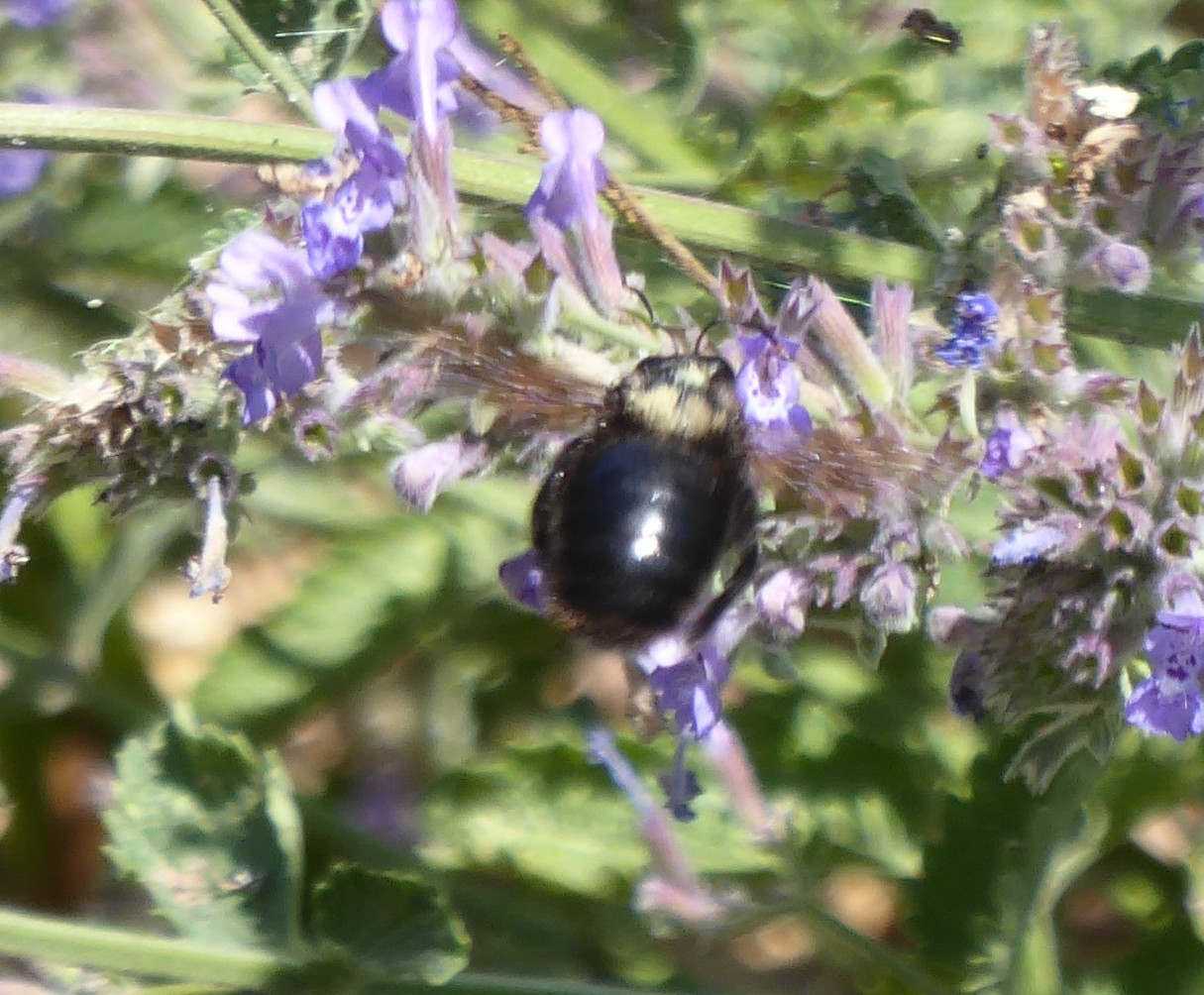
I hadn't yet managed to tangle with any bees of insects but the Parc de la Béchade quickly turned up an interesting new bug - a sulphur beetle - and later on, poorly photographed, an old friend from the Dolomites, the violet carpenter bee, was found in the Parc Bordelais though this time not with its head totally dowsed in pollen.

Sulphur Beetle
Violet Carpenter Bee

In flight the sulphur beetle looked as if a small yellow flower petal had taken to the wing - quite weird.

Geese weren't particularly on my hitlist but there were a couple of strange looking items amongst the canada geese at Parc de la Béchade:

Mystery Goose

I spent sometime wondering what it was but probably just some sort of hybrid.

I always have a soft spot for egyptian geese (seen at Parc Bordelais) but got a serious shock to see the next couple at the Jardin Public.

Egyptian Geese
Barnacle Goose

So yes, there were a couple of barnacle geese, natives of Svalbard in the Arctic Circle and winter visitors to Northern Britain strutting around in 30C + temperatures in a Bordeaux park.

And there were some butterflies. After seeing one male brimstone yesterday, it was good to see several  at Parc de la Béchade.  In fact there were about 10 of them flying around the same plant.

Brimstone

They were seen every day afterwards in all locations.
Speckled Wood

Speckled Wood were seen on two or three occasions in the Southern aegeria variant also in Spain this February.

While offering some lovely flower beds the Parc de l'Ermitage only produced a frustrating chase to reveal a single common blue.  In fact I couldn't understand why thjere were so many flowers and so few pollinators.

However the biscuit was again duly taken by the Jardin Public, which produced my first ever sighting of a geranium bronze.

At first I thought it was a pea blue until I saw the photo.

Geranium Bronze

These are no longer rare in Europe but it definitely made the day for me.

The Jardin Public produced one other sighting which is still under investigation:


Under Investigation

Initial suggestion is that it belongs to the genus of blue-banded and digger bees, of which I have never heard.  It's not a very revealing photo so I doubt if a more precise description will emerge.

Tuesday, 24 June 2025

Bordeaux Day 1

Having reached Bordeaux in sunny weather, I noticed that it was far bigger and the River Garonne far wider than I had anticipated. 

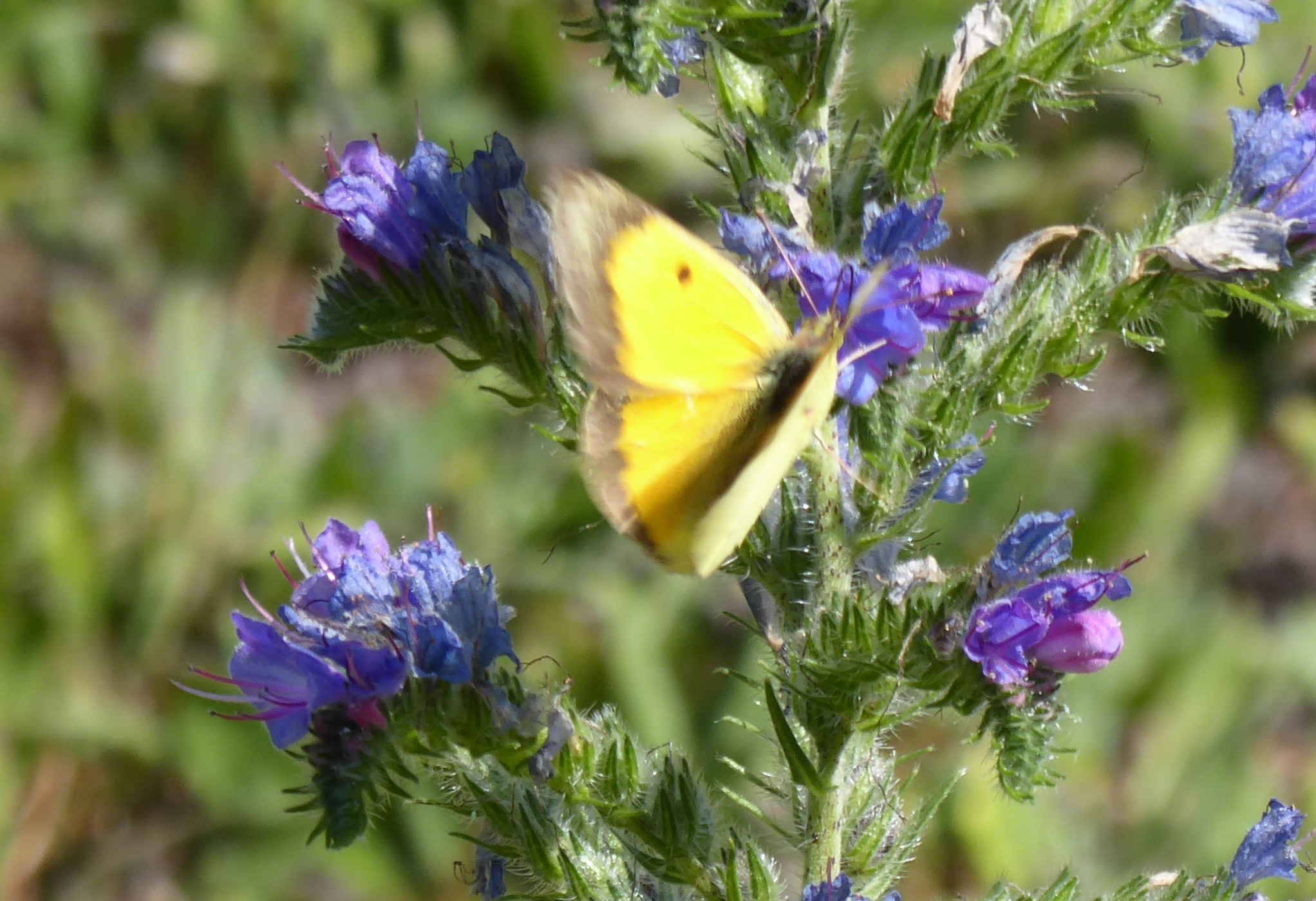
My first cycle was to to the Réserve écologique des barails to the North of the city, where the bike proved its use in enabling me to find a large flower meadow relatively quickly.  First sightings were of a number of clouded yellow, this one just about to fly off:

Clouded Yellow

The clouded yellow was to prove one of the most sighted non-whites of the whole holiday and appeared again on my way back via the lake, this time providing a good view of the underwing:

Clouded Yellow (underwing)

The Barails site also produced two first sightings of the year with painted lady (several) and small copper:
Painted Lady
Small Copper

Neither species re-occurred during my stay. Notably almost everything was landing with wings closed, possibly due to the ever-rising temperature which touched 30C as the day drew on.

Thee was a frustration in that I also spotted a number of much smaller blue butterflies and a hyperactive day-flying moth that refused to settle - a theme that was to recur throughout the week.

The day should also have included a trip to the Parc du Majolan which was mysteriously closed, though I did catch sight of a male brimstone and the only peacock I was to see all week in the nearby woddland.

Also closed was a park and woodland area on the Western side of the lake.  And this is supposed to be the tourist season!

I ended up having a much-needed beer in the popular Darwin area of Bordeaux, which led to an interesting variation of thieving sparrow behaviour:

Thieving Sparrow


Bordeaux Day 0

 Paradoxically, my first day in Bordeaux actually started in Paris...

I had the time to spend an hour or so in the Parc Montsouris where my eye was drawn by this white which I thought might just have been a southern small white and initial checks seemed to confirm this, although Paris is well away from its normal territory.

It's true that the black forewing tip extends somewhat further than normal but this impression is probably accentuated by the unerect position of the wings.  Ultimately I concluded boringly in favour of small white female, summer brood

Small White

There was also a passing red admiral, surprisingly the only one sighted all the time I was in France. Incidentally not a single small tortoiseshell was seen on this holiday.

The lake was also home to a number of decent sized carp, one of which came quite close.

Common Carp

One of things I like about mainland Europe is that the carp do tend to cruise near the surface.  There was a massive one the day after, further out on the Lac de Bordeaux, skimming the surface with its tail fin, as if performing a shark imitation.

Saturday, 14 June 2025

More Butterflies

Realising that, with a trip abroad forthcoming (watch this space) my opportunities were limited, I decided to make a concerted attempt to catch up with the dingy skipper this week.  My efforts took me back to Path Head Nature Reserve, The Spetchells and Weetslade Country Park and unfortunately remained unfulfilled.

Late morning at Path Head looked likely to produce nothing at all. I was actually on my way out when I finally caught up with five small heath, two common blue and a single speckled wood all pretty much in constant flight. 

Worn bumblebee
Later the same day at Spetchells, results were rather better.

The first thing that caught my attention was actually a bee.  My first impression was that it was a worn buff-tailed bumblebee.  it seemed to have some pollen underneath the abdomen so I wondered about another leafcutter but on balance it seems the first impression was correct.

The giveaway is the faded stripe on the thorax.

For a while I again didn't see butterflies and began to speculate why.  It strikes me that there isn't amount of bird's foot trefoil at the Eastern end of the area, where it used to be relatively easy to find common blues, burnet moths and of course dingy skipper.

At some parts it's apparent that bird's foot trefoil is being overwhelmed by cotoneaster spread, others look like they could do with some grazing but in some there was no clear reason.  There were at least a couple of nice orchids to look at:

Early Purple Orchid?
Common Spotted Orchid?

I've no idea if I've identified them correctly.

Anyway the result of my deliberations was that I headed further East, where there are more trees and bushes and somewhat surprisingly started to see things, in particular a number of ringlets.  While they settled long enough to get a decent look, they were too skittish to photograph - probably freshly emerged - and the same applied to pretty much everything else I saw. The butterfly tally this time was Ringlet nine, Common Blue five, Speckled Wood five, Small Heath one and Large Skipper one.

Of these, only speckled wood and the large skipper was posing for the camera:

Large Skipper

For a moment I thought I'd hit on something really interesting when what appeared to be a brimstone was floating around the trees.  Again it was skittish, but when it did briefly settle I detected some wing markings that indicated it was a brimstone moth.  Moths also played a role on the way back as four or five small orange moths turned up and were eventually identified as yellow shell, which together with the previous one were first sightings for me.

Yellow Shell Moth

The day after at Weetslade, I again didn't see much in windy weather until I started foraging, when the dominant species proved to be the meadow brown.  This interested me as it was the first time I haven't seen them earlier in the summer than the ringlet, which I tend to associate more with July and August.

At Weetslade the scores were:  Meadow Brown 17, Large Skipper five, Common Blue four (including the first female I've seen this year), Small Heath one.

Meadow Brown
Female Common Blue

I think the common blue may have been ovipositing. Incidentally, all the meadow browns showing their upper wing were male. It's also interesting that no small skippers were seen over the three visits.

So still no dingy skipper then.  Although local sources suggest May and June is the best time for them, the Butterfly Conservation website states they are still on the wing in July - so there may still be hope.

Back in the garden the male bullfinch continues to appear.  It seems to be getting more confident, even feeding on the lawn, and a female is occasionally sighted.  A couple of goldfinches have also visited briefly - the first time in the seven years I've been here.

The only notable appearance by a butterfly was by a lone red admiral but I did think I might have spotted a first white-tailed bumblebee but on balance I am not entirely convinced.
Red Admiral
White-tailed Bumblebee

Wednesday, 4 June 2025

Urban Sightings and Fritillary Forage

Quite a bit has happened over the past week!

I've had my eye on a brownfield site near the Metro Centre that has a fair spread of bird's food trefoil. So I thought it might be a possible for Common Blue or Dingy Skipper and took a look last Friday.

Tramping through the brambles and various forms of litter I saw neither but what did turn up was three or four small heath - the first I have seen this year.  I checked back briefly the day after and they were still about.

Small Heath

Giving up the idea of more sightings I decided to try out a cycle route to the town centre I've never used. But a bit beyond Dunston on Teams Road I stopped to watch a red admiral I thought might be ovipositing on nettles.  Lo and behold what should then fly over the road side habitation but a common blue.  I saw about four of them and a brown butterfly that proved to be a large skipper - both first sightings for this year as well:
Common Blue
Large Skipper

It just shows that urban environments can too easily be overlooked.

One thing that I haven't seen since I moved to the North East has been any kind of fritillary.  So on Monday I decided to return to one of my old haunts - Mabie Forest near Dumfries to see if I could find any there.

It wasn't the most brilliant day with reduced temperatures and only intermittent sunshine so I was relieved when my first sighting came along - perhaps unsurprisingly another small blue,  There was four overall, as at Dunston all males.  And even better I actually managed to spot the first pearl-bordered fritillary before even reaching the known 'butterfly hotspot.'
Common Blue
Pearl-bordered Fritillary

This is the time of the year when pearl-bordered and small pearl-bordered fritillary flight seasons overlap and there are identification issues.  Several were only seen in flight making proper identification impossible but one among the ones I photographed and one seen in flight were heavily worn suggesting pearl-bordered, indicating they were definitely in preponderance.

There was however one possibility that I had overlooked and as a result initially misidentified:

Dark Green Fritillary

What surprised me here was that I associate them with late rather than early summer at Mabie.  However from a total of nine it may be they accounted for some of the ones flying past, notably those strong on the wing.

I was also surprised by the number of dragonflies that were about right at the beginning of June: Hopefully I've got them right.
Common Blue Damselfly
Emperor Dragonfly

There were also a couple of moths:

Brown Silverline
Cinnebar Moth

There were perhaps 10 of the brown silverline on the day.  The only other time I have seen cinnebar moths was I think at Dumfries station.

There were also a couple of mysteries which had me facebooking the experts:
Blotched-winged Whitebelt
Tibula Scripta

I have a separate photo that proves the white belt bit on the first one.  The other one is a cranefly, and craneflies are a notoriously tricky area.  The wings of tibula scripta are transparent in the photos I've seen so I suspect they may be giving an image of the background leaf.

Other butterflies seen were green-veined white and four speckled wood, which I mention because they were not much present in Dumfries and Galloway when I lived there.

On leaving the 'butterfly hotspot' I still hadn't spotted a small pearl-bordered fritillary and was beginning to speculate that, as the more common species, their development had been held back by the dry weather.

However, just over halfway back to the car park one turned up in a clearing where two paths meet:

Small Pearl-Bordered fritillary

A bit of luck always enters into it!

Meanwhile there has also been activity in the garden.

A few days ago I was very pleased to see a couple of goldfinches plundering the seed in one of my pots that has been invaded by forget-me-nots.  I've never seen them in the garden before.  Also the bullfinches continue to enjoy the sunflower hearts from the feeder.

Another near misidentification (which has been a bit of a theme lately) but I've also been getting visits from patchwork leafcutter bees of both genders.
Bullfinch
Patchwork Leafcutter Bee

Tuesday, 27 May 2025

Bumble Bees buzzing butterflies less so...

As the warm weather has slowly tailed off somewhat I have over the past eight days seen all the common species of bumblebee.

This was unsurprising as I started last Sunday with a bumblebee walk with K at Northumberland Park in North Shields.  Here we quickly accounted for buff-tailed bumblebee, early bumblebee, red-tailed bumblebee and common carder, but only one red admiral although there were various whites on flying duties

Early Bumblebee
Red Admiral
There was actually quite an impressive number of early bumblebees, the first I have seen this year.

Also noted were a male red-tailed bumblebee and a single beefly that I cam across while foraging.

We did a short bike ride to Ponteland on Tuesday which took in one or two sightings as we passed by - a single stoat, a tree bumblebee, various further flying whites and, pleasingly a single small tortoiseshell.  Good to know they are still around.

However all the bumblebee sightings were to be replicated more locally  over the past couple of days, mainly in my own garden - but with the eventual addition of garden bumblebee.

I've been struck this year by the big difference in size between male and female carder bees, the females seeming particularly large.

Female Carder Bee

There were some photographic difficulties with tree bumblebee and garden bumblebee though, in the former case because they weren't settling for more than a few seconds and in the latter because they spent most of their time buried in an aquilegia flower.  Eventually I got one in flight and captured the other in the bugbox.
Tree Bumblebee
Garden Bumblebee

I had to go a bit further afield to find another red-tailed bumblebee but found one not far from the Metro Centre of all places.  It was a female an here you can see the difference compared to the males seen at North Shields.
Red-tailed Bumblebee (m)
Red-tailed Bumblebee (f)

Butterflies have not been spotted recently, but I did find this tiny moth on my back patio door yesterday.

Unable to find an obvious match i went down the referral root and the best bet seems to be that it is a faded version of the yellow barred brindle.

Yellow-barred brindle