Showing posts with label brimstone. Show all posts

Tuesday, 23 June 2026

On the Bike in Avignon - Day by Day (Part 2)

Day 3

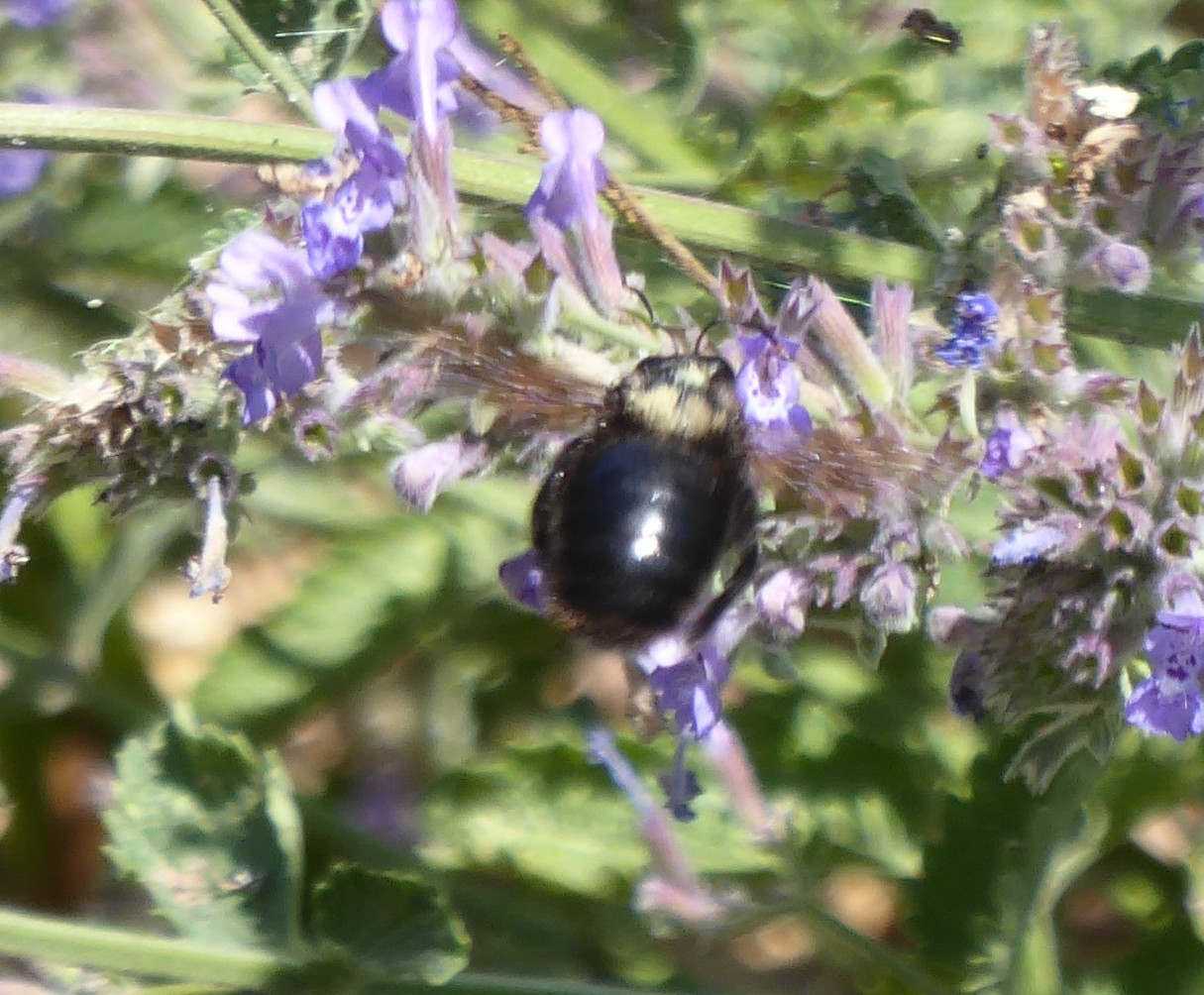
The day started at Avignon Station, where I had a bit of spare time before catching a train to Orange and noticed there was an interesting bee feeding on some lavender.

Digger Bee

I haven't managed to dig into digger bees much but a suggestion on iNaturalist 
of urbane digger bee seemed fairly definite at the time. One slight problem is that anthophora urbana occurs in North and Central America so I think digger bee is as near as I'll get.

At Orange the idea was to launch North to Uchaux but ultimately I didn't fancy the road and turned back.  Before I did, I discovered another flower meadow, this time quite a large one, where several butterflies could be seen.  I very quickly found some dingy skipper (yet again after a near blank last summer) but also a skipper that was different.  Past experience in the Camargue (and for a change my memory) came in handy and I soon realised it was a mallow skipper.
Dingy Skipper
Mallow Skipper
There were a good few spotted fritillaries around and one kindly posed to allow me to get a good shot of the upper wing

Spotted Fritillary

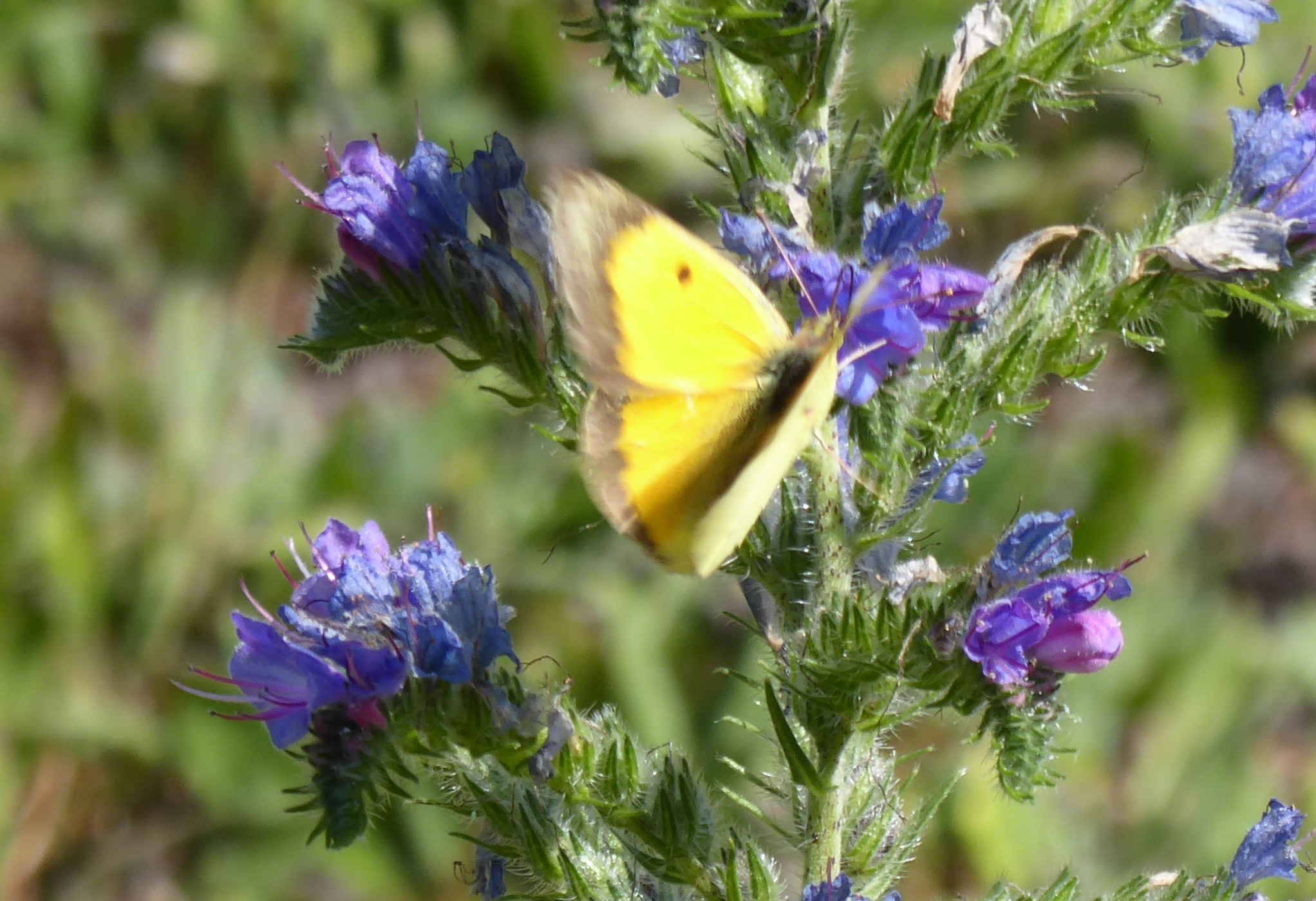
Also seen but not photographed at this sight were clouded yellow, ringlet and brimstone, plus an annoying hairstreak that I narrowly missed. I wondered about ilex hairstreak but didn't get a good enough view.

After turning back to the Arc de Triomphe in Orange (yes there is one!) I joined the Via Venaissia aiming to join the Via Rhôna North of Carpentras. About 10 km out of Orange I encountered a farm garden where there were a few marbled white (which always seemed to be a sign that others were present) and stopped to check out what looked like large fritillaries. In fact they all turned out to be wall browns, painted ladies or spotted fritillaries. In fact the spotted fritillary proved to be the only fritillary found. Anyway I did this time get a good shot of another scarce swallowtail that appeared.

Scarce Swallowtail - Upperwing

One interesting point here was that a lady exiting the farm by car stopped specially to tell me to lock the bike up (which was no more than five metres away) as the area was often patrolled by "bandits" who would escape with it high speed given the chance.

Unfortunately the remainder of the ride proved to be somewhat disappointing.  The rest of the Via Venaissia led mainly through farmland with little to note and a lively Mistral to face. At the Via Rhôna I encountered rather arid country, with the occasional outburst of painted ladies where there were a few flowers.  Otherwise the main butterfly sightings were individuals blown across my path at high speed in the wind, not to be seen again.

At one area I investigated as promising I thought that I had found an interesting moth, which actually proved to be a couple of short-horned grasshoppers caught "in flagrante delictu."  A good job I'm having an eye test shortly!

Short-horned Grasshoppers

I was beginning to reflect that the lack of moisture in most areas was having a clear effect on sightings. There was not a drop of rain the whole week as temperatures gradually rose.

A little way North of the Île de Barthelasse, I did actually find a nice looking neglected path with plenty of vegetation and a few marbled whites.  What I actually sighted was largely a repeat of those seen in the morning including, annoyingly, a repeat of mystery disappearing hairstreak.

In the end I had to settle for a cleopatra and a pretty banded demoiselle.
Cleopatra (underwing)
Banded demoiselle

Day 4

In temperatures up to 35C, Day 4 turned into more of a survival exercise.  Starting out from Tarascon, I took a run across the North of the Alpilles.  This was firmly the day of the cleopatra as both males and females turned up repeatedly especially in the morning.  They were also extremely reluctant to settle but in the end I managed to get a video capturing a bit of both and showing the colouring.

Cleopatra

Matters were made considerably worse when I realised I had an hour less than planned to catch a train at Cavaillon, and so was forced into cycling at as much pace as I could manage for the last 25+ km.

I did stop briefly for a rest and had a bit of a surprise when on a rare plant I found a stripey bee that appeared to have a bloated white abdomen. It clearly noticed me and took off towards me and started flying from right to left repeatedly in what appeared to be some sort of threatening behaviour before finally moving off.

Unfortunately the camera couldn't help with even video evidence but I was able to establish that it was  a wool carder bee.

Day 5 

Increasingly tired and interested in creature comforts I decided to roughly repeat the run from the first day as it passed through the best area for nature.  The result was perhaps inevitably that, having dispelled any notion of finding the hungarian glider, I saw pretty much the same species - white admiral, marbled white, spotted fritillary etc. but with one major difference.
Regiscola Bidens

At the spot West of Les Angles where I first stopped on Day 1, I found up to twenty massive insects circling an area of broken bushes.  They were black, about as long as a dragon fly, thicker than most caterpillars, and had two bright yellow stripes.  They also had antennae suggesting they were bees or wasps

On the way back later in the day I encountered a French Natural Biologist who told me they were regiscola bidens, i.e. mammoth wasp, a species that predates on the rhinoceros beetle.  Whilst it looks highly dangerous, it is actually very placid and rarely stings. Apologies for the poor photo.

I got chatting to the French chap who, as well as complaining about the local authority's failure to protect the area, for example by cutting it as on Day 1, told me that it held over 500 distinct species, of which over half had special protection status.

There was something about that that made me feel I had made the right decision!

Thursday, 26 June 2025

Bordeaux Day 3

With day time temperatures scheduled to hit a maximum of 36C I was a bit cautious about my plan of heading towards the sea at Lacanau and reckoned to do about half of the approximately 120km round trip.  In the event, thanks to an early start and a good day in the saddle I managed about three-quarters of it, turning back a good way past St Helene.

It was quite a long way to the National Park I wanted to suss out and the main thing I noticed meanwhile was the abundance of some yellow flowers on the outskirts of Bordeaux.

Common Evening Primrose?

Suggestions by AI favour Common Evening Primrose, though this sighting was actually timed at 8.31 a.m. Hmmm?

Meanwhile also a sign advertised the presence of a rare mammal, the 'genet commune' in the Parc des Jalles  Apparently it's totally nocturnal so i didn't look for it.

Anyway there was an early success on reaching the Park when I came across one of the target species - a pearly heath, not a great discovery but it's as near to the UK as I've ever seen one. 

Pearly Heath

Other heaths seen were decidedly common.

After that things frankly got a bit frustrating.  I stopped at a promising looking spot a few miles South of Salaunes, where there was clearly a lot of action.  A number of brown butterflies were fluttering around and arguing with some speckled wood but they refused to settle properly.  I wondered distantly about gatekeeper but could not prove my hunch.  After a while an impressive marbled white spent a long time working the path edges but without landing at all.

So the only ones things I captured on camera were small skippers and, a bit later on, some burnet moths.

Small Skipper
? spot Burnet Moth

I think all the several skippers I saw on the day were small.

From this point on it got even more frustrating.  I notice that the photos I tried to take tended to be poorly focused just as the butterflies' behaviour got extremely skittish and now wonder if these factors were the result of the increasing heat which duly exceeded the 35C mark as promised.

Having just passed Salaunes (where there was thankfully a water pump) I noticed a number of blues zooming around but couldn't manage to get anything like a decent view.  They definitely weren't commons, having a brighter shade of upper wing and dark spots on the underwing.  I wondered about nazarine blue but I think they were smaller than that.

So I rode on thinking to stop at St Helene, seeing continued brimstone, the odd clouded yellow and occasional annoying marbled white until I could smell the sea air and eventually realised I'd overshot the turnaround point.

It was worth it though as my last stop was for another group of fast-flying blues.  After much patience, 
I finally did see one settle for several minutes.  So I managed to identify it as I sat sprawled in the roadside grass with the thing virtually between my feet!  

In the end it was nothing special or new - a short-tailed blue and my only disappointment now was that I didn't get a better shot of it.

Short-tailed Blue

So mystery solved - always assuming that they were the same as the ones at Salaunes! We will never know.

Wednesday, 25 June 2025

Bordeaux Day 2

As temperatures rose to the mid thirties, I thought a tour of the parks of Bordeaux would be my easiest option, though I managed to make it less easy by making a series of navigational errors en route.

Of eight parks visited by bike, the two most fruitful were definitely the Parc de la Béchade and the Jardin Public though almost all had some attraction to offer.

I hadn't yet managed to tangle with any bees of insects but the Parc de la Béchade quickly turned up an interesting new bug - a sulphur beetle - and later on, poorly photographed, an old friend from the Dolomites, the violet carpenter bee, was found in the Parc Bordelais though this time not with its head totally dowsed in pollen.

Sulphur Beetle
Violet Carpenter Bee

In flight the sulphur beetle looked as if a small yellow flower petal had taken to the wing - quite weird.

Geese weren't particularly on my hitlist but there were a couple of strange looking items amongst the canada geese at Parc de la Béchade:

Mystery Goose

I spent sometime wondering what it was but probably just some sort of hybrid.

I always have a soft spot for egyptian geese (seen at Parc Bordelais) but got a serious shock to see the next couple at the Jardin Public.

Egyptian Geese
Barnacle Goose

So yes, there were a couple of barnacle geese, natives of Svalbard in the Arctic Circle and winter visitors to Northern Britain strutting around in 30C + temperatures in a Bordeaux park.

And there were some butterflies. After seeing one male brimstone yesterday, it was good to see several  at Parc de la Béchade.  In fact there were about 10 of them flying around the same plant.

Brimstone

They were seen every day afterwards in all locations.
Speckled Wood

Speckled Wood were seen on two or three occasions in the Southern aegeria variant also in Spain this February.

While offering some lovely flower beds the Parc de l'Ermitage only produced a frustrating chase to reveal a single common blue.  In fact I couldn't understand why thjere were so many flowers and so few pollinators.

However the biscuit was again duly taken by the Jardin Public, which produced my first ever sighting of a geranium bronze.

At first I thought it was a pea blue until I saw the photo.

Geranium Bronze

These are no longer rare in Europe but it definitely made the day for me.

The Jardin Public produced one other sighting which is still under investigation:


Under Investigation

Initial suggestion is that it belongs to the genus of blue-banded and digger bees, of which I have never heard.  It's not a very revealing photo so I doubt if a more precise description will emerge.

Tuesday, 24 June 2025

Bordeaux Day 1

Having reached Bordeaux in sunny weather, I noticed that it was far bigger and the River Garonne far wider than I had anticipated. 

My first cycle was to to the Réserve écologique des barails to the North of the city, where the bike proved its use in enabling me to find a large flower meadow relatively quickly.  First sightings were of a number of clouded yellow, this one just about to fly off:

Clouded Yellow

The clouded yellow was to prove one of the most sighted non-whites of the whole holiday and appeared again on my way back via the lake, this time providing a good view of the underwing:

Clouded Yellow (underwing)

The Barails site also produced two first sightings of the year with painted lady (several) and small copper:
Painted Lady
Small Copper

Neither species re-occurred during my stay. Notably almost everything was landing with wings closed, possibly due to the ever-rising temperature which touched 30C as the day drew on.

Thee was a frustration in that I also spotted a number of much smaller blue butterflies and a hyperactive day-flying moth that refused to settle - a theme that was to recur throughout the week.

The day should also have included a trip to the Parc du Majolan which was mysteriously closed, though I did catch sight of a male brimstone and the only peacock I was to see all week in the nearby woddland.

Also closed was a park and woodland area on the Western side of the lake.  And this is supposed to be the tourist season!

I ended up having a much-needed beer in the popular Darwin area of Bordeaux, which led to an interesting variation of thieving sparrow behaviour:

Thieving Sparrow


Thursday, 9 September 2021

Staycation Time

 As if to prove the wisdom of my last post, a speckled wood came sunbathing on the garden furniture on Sunday but departed again without showing any interest in the buddleia.

Speckled Wood

The same could not be said of the small tortoiseshells, who increased in number as a not especially warm day went on. At one point I counted nine in total on the three buddleia bushes in the back.

Small Tortoiseshells

Apart from (mainly large) whites, only one red admiral showed up.

The day after I set off for planned staycation in Lincolnshire,  Apart from a much-needed change of scenery, I was hoping to find some butterfly and bird species not available on my home patch.

The plan got off to a good start when I rode along the track into Southrey Woods in a heatwave and quickly noticed some brimstone butterflies nectaring on blue flowers that looked like snall cornflowers.  At first I thought they were the pale version of the drimstone but his may have been down to the brightness of the sunlight.  There were about 20 seen in the total time I was there.

Brimstone

There also a good piece of fortune when a single silver-wsshed fritillary started to fly around at speed near where I was having lunch.  Unfortunately it never settled and an attempt to video it in flight didn't come off.  Although I had seen brimstones near my grandparents' house as a kid, that was definitely my first UK silver-washed fritillary sighting,  Also observed were a good number of green-veined whites, small tortoiseshells and red admirals - and this time a couple were feeding near to a peacock - a few small white and a single comma.

There was also a very large fly that looked like a hornet with a yellow hood but I think from facebook posts of similar sightings in Dumfries and Galloway, it is some form of horsefly.

All around the drains there are common darters and I managed to get a photo of one that settled at Southrey.

Common Darter

Things went less well later and on the following day when I was looking for two sites that are known to have the brown hairstreak as I couldn't find either of them!  Apart from a lack of signposting, in one case it was down to a major navigational error on my part.

After seeking creature comforts in Bardney, I decided to ride back very slowly along the Witham with my eyes open and was frankly dissappointed by how little I saw,  A couple of whites, a few swallows and very little else.  It was a bit like the Canal du Midi two years ago.

One minor positive was that I managed to catch an example of the larger dragonflies that crazily landed in a hawthorn bush. It's a southern hawker.

Southern Hawker

I'm pleased with this from a photographic point of view, shot from six metres away in dense foliage.

Wednesday, 20 June 2012

Wednesday 20th June

Holiday in Mayrhofen, Austria

Arrived around lunchtime after overnight stay in Kufstein.  Decided to go for walk to Brandberg as weather good.  Not a lot seen apart from a black redstart, a butterfly like a grayling and a red deer.

21st June

Very long (too long!) walk on and down Penkenberg.  Saw an obscure warbler singing single note like tsit from pine trees.  Looked most like arctic warbler and not bonelli's - maybe greenish warbler? Did not behave or sing like willow warbler.

Almost immediately after got a clear sighting of two nutcrackers including characteristic tail feathers before they made off.  Have been hoping to see one in Germany since 2004, so well-pleased.  On getting up to restart walk at Penkenjoch a black bird landed directly infront of me on the grass. Although it had its back turned you could see the white band on its chest so clearly a ring ouzel.  Sat down to try to minimise disturbance but immediately it flew off leaving me feeling disappointed at such a fleeting encounter with one of my main targets and certainly the top-listed one for this holiday. Kept a careful eye open on the way down but all suspects proved to be blackbirds.

Also saw a profusion of flowers and butterflies, many of which are hard to identify as they are local species not known in the UK.  Those identifed were (or were similar to) small tortoiseshell, speckled wood, painted lady, small pearl bordered fritillary, brown argos, alpine blue, dingy skipper, plus some strong-flying yellows that never settled - suspect brimstone, clouded yellow plus one that had a slight swallow tail.