Friday, 26 July 2019

Thursday 25th July

On Tuesday I decided to do my bit for the Big Butterfly Count and set off along the Tyne looking for
promising spots. I eventually decided on an area by the main way up to the Spetchells where there was a good stand of thistles and other flowers and managed a total of 13 small tortoiseshells, 9 small whites, 4 meadow browns, 2 ringlet and 2 small skipper.  I couldn't be sure about all the whites as they weren't settling much but it confirms that it must be a good year for small tortoiseshells.  I haven't seen as many for a very long time indeed.

Small Tortoiseshell
I cycled on to Bywell Bridge where occasional white letter hairstreaks have been reported, but by the time I had done a bit of research on what vegetation to look for, the sun had started to disappear.  In retrospect I should maybe have checked out one or two items that floated across the road more carefully rather than assume they weren't significant.

At other spots on my little tour a couple of red admirals and speckled wood turned up.  The speckled woods don't seem to be coming in the same numbers as last year and I still haven't seen a peacock since Spring.

On Wednesday evening the temptation to confirm the purple hairstreak sightings of last week took hold and I ended up scouring the viaducts at Hamsterley once again, eventually having a slice of fortune. I had no sooner got off the bike when the first suspect appeared but overall appearances in the oak crowns were not as frequent as last Thursday.  So I moved around more, looking for other likely oak clusters and spending a bit of time on each.

Eventually I got back to the Eastern viaduct, where I peered down on what I thought was an oak tree.  it wasn't, it was a sycamore. At the very moment I was about to move on, a butterfly landed on one of the lower leaves.  Luckily the binoculars focussed on it straight away and I was clearly able to identify a male purple hairstreak.

I have read that they can frequent sycamores and the next tree along was an oak.  As I scoured it for further action, a comma butterfly flew over the bridge a few times and landed on a nearby rowan.

There were also several good sightings of red kites gliding around the area.

Monday, 22 July 2019

Monday 22nd July

I decided to make a definite assault on the purple hairstreak nearer to home, starting off with a wander along The Avenue at Gibside.  There are certainly a prestigious number of oak trees there, but they are so old and large it would be very difficult to make out any butterflies so far overhead. There were about three red admiral flying long distance, a few ringlet and several meadow brown.

On spec I passed through the walled garden where I noticed a strange looking bumble bee I couldn't get a decent photo of, followed by three small skipper and a single small tortoiseshell. The bee just didn't strike me as atypical garden bumblebee but buff-tailed bumblebee doesn't seem quite right either.  I wondered if it had a growth just behind its head.

Pausing for a rest, there was a very dark looking wagtail running around under the chairs outside.

           
Bumblebee
Wagtail
Then I moved on to the viaducts past Hamsterley and spent all my time observing a good cluster of oak crowns visible from the far end of the second one, observed by a cruising red kite.  The reason for the long stay was that there were clearly small butterflies of greyish appearance darting in and out of the treetops, but it was very hard to get a positive sighting of any of them.  This time I was sure they weren't speckled woods, which would have been more leisurely at times.  There was the occasional flash of violet blue so my belief is that they were purple hairstreaks though they were never still enough to identify the actual wing pattern positively.

I tried making a brief video of them but it didn't produce any conclusive evidence either.  There must have been at least ten of them, even allowing for double sightings.

Purple Hairstreaks


Wednesday, 17 July 2019

Wednesday 17th July

I did a bit of a double hit on Monday, taking advantage of a nice warm day when only a visit to the dentist was scheduled.

Cycling slowly down cycle track 14, I kept a look out for places where there might be butterflies.  At first all I encountered was a grey wagtail and a few speckled wood.  Then right at the bottom end of the Derwent just west of the confluence of the Tyne (and very near the edge of the industrial estate) I found a flower meadow.

Here the results were very similar to those encountered at Blaydon just over a week previously - plenty of meadow brown and small skippers, several burnet moths and common blues and a few ringlet. I had a suspicion that one or two of the skippers might be large skippers but the suspect I checked was a small.

On the way back I saw a female roe deer with two foals drinking at the riverside.  They had a very reddish look and at first I thought they were red deer.  Research however shows that there are no red deer in the area.

The session was nicely capped off when I got off the bike at home to see a small tortoiseshell on the wee buddleia in the front garden.  There were three more sightings later on in the day.

Small Tortoiseshell

In the evening, I decided to go to Waldridge Fell in search of purple hairstreaks, my current number one target.  I did see three seperate willow warblers and after a longish period of staring at various oak trees, of which there are many, I did on four occasions see some buitterflies circling the oak crowns.

Unfortunately they were all speckled woods!

Sunday, 14 July 2019

Saturday 14th July

Last Saturday, I took a slow cycle along the banks of the Tyne from Newcastle westwards, looking for butterflies.  Interestingly, the best area was the lower meadows alongside the cycle track just before
Shaded Broad Bar
Scotswood Bridge.  Common blues, small skippers, meadow browns, ringlets and six-spot burnet moths were all to be seen in good numbers. Once again there was no small copper but I did spot the shaded borad bar moth I previously saw at Spetchells last year.

My attempts to cut down the number of jackdaws and magpies hogging the feeders in the garden have met with a degree of success.  At least I'm making it more difficult for them but unfortunately they have not been replaced by more visits from smaller birds.

Orange moth
So there hasn't been much to see apart from a couple of red admirals and the odd speckled wood.  But one
interesting occurrence was when a moth flew into the summerhouse during a coffee break a couple of days ago. I still find moths quite puzzling.  Research suggests it should be some kind of orange underwing but there are a couple of problems with that theory.  Firstly both species of orange underwing fly much earlier in the season and secondly, the wing pattern as far as you can make it out doesn't match up to the website illustrations.  So I don't really know.

Today I took a non-nature trip to Hexham and wasn't sure for what reason I decided to take a camera with me.  However, on approaching the Wentworth Cafe, I happened to notice this tree.  Following on from earlier dicussions about types of oak tree, I'm fairly confident it is a red oak.  What struck me first was the size of the leaves.  The acorns have started to fruit and look like they will be far smaller than those of other oaks.

Red Oak


Friday, 5 July 2019

Friday 5th July

I forgot to mention last time that things have deteriorated in the garden as the larger birds are now hogging the feeders and I've had to put them on half rations to at least discourage them a bit.  The only bright spot has been the appearance of a squirrel who had a good nose around the garden and the feeders before deciding to retire to a safe distance. And there was a brief red admiral on Wednesday.

Wednesday turned out nice and I was glad to make a repeat trip to Havannah Nature Reserve while my car was getting fixed, this time together with Malcolm and Arthur the Retriever.

This time the ringlets were present in force and outnumbered the speckled woods. There were a good number of meadow browns and we managed to see a dozen or so common blues and a handful of six spot burnet moths.  A noticeboard indicates that there also narrow-winged five spot burnet moths on the site but this time I checked carefully the ones we managed to catch up with and they were definitely six spot.  There was also a couple of small tortoiseshells, a few painted ladies, two small skippers and one red admiral but only a few small heath and again no small copper.  They aren't mentioned on the noticeboard so maybe aren't present, though I would find that rather surprising.  Given the presence of Malcolm's dog, few birds came near aside from a pair of bullfinches. And again the red squirrel area looked uninhabited.

Meadow Brown
Small Tortoiseshell
Common Blue
Siz Spot Burnet
We spent some time at the West end of the reserve where we found quite a number of oak trees, but reckoned that the smaller trees I had seen near the middle car park weren't oaks at all.  So I think I have a better idea where to try for the purple hairstreak. Malcolm reckoned that one of the oaks could have been a red oak, which isn't infeasible if there has been replanting as in other former mining areas.  He also identified some clusters of loganberry in a nearby hedgerow that I wouldn't have spotted at all.

Loganberries

Saturday, 29 June 2019

Saturday 29th June

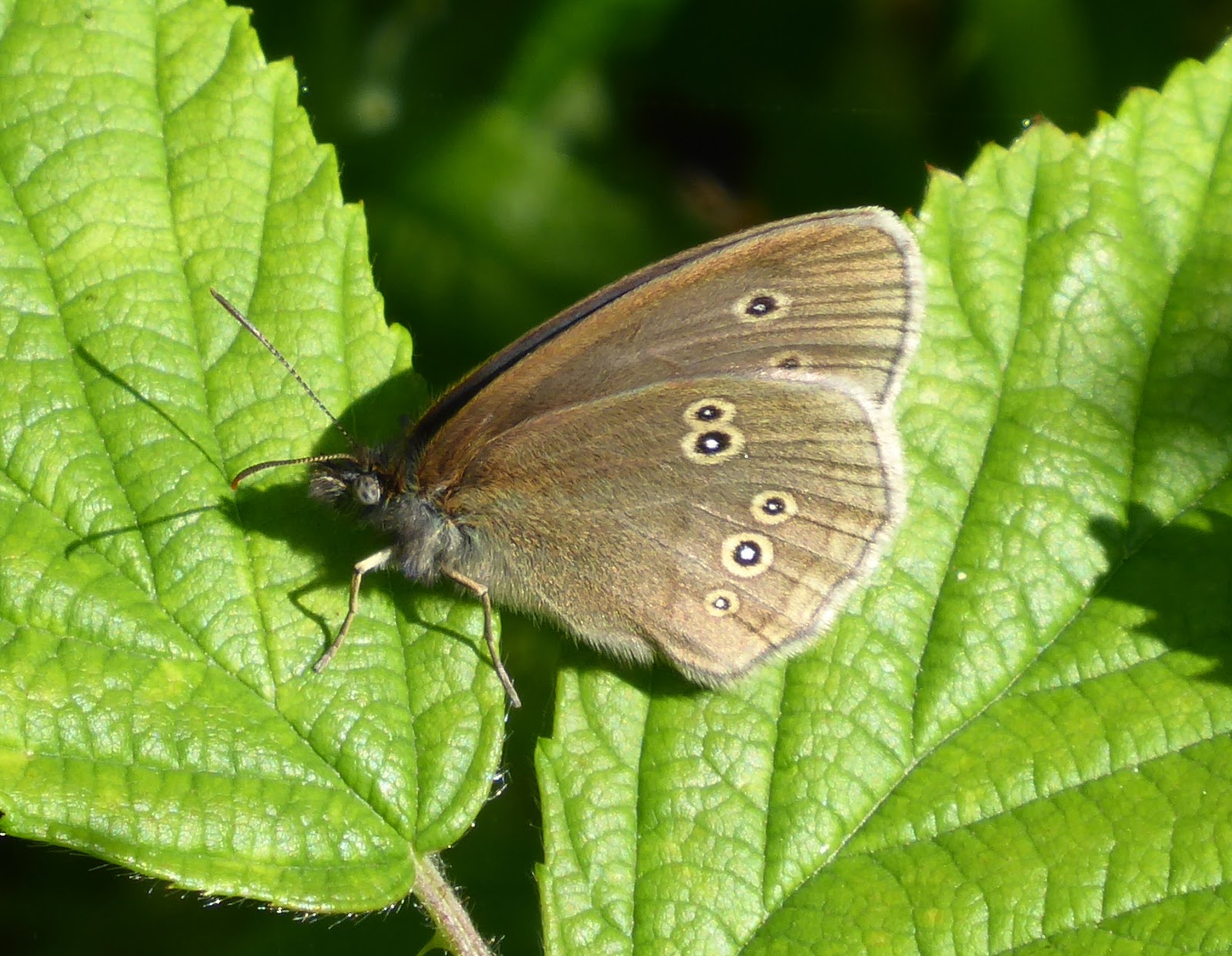
Ringlet
The week just gone has been very rewarding in terms of nature spotting.

On Wednesday I took advantage of being in Northumberland to make a late afternoon diversion to Cresswell Pond.  Striking out along a path I erroneously thought would lead to the bird hide, I was soon seeing painted ladies and red admirals, together with a few speckled wood and a single ringlet, the first I have seen this summer.

Eventually finding the right way to the hide, the sightings continued and there was briefly half a dozen painted ladies visible at the same time.  Maybe it's going to be a painted lady year?
Faded Lady
I noticed that one or two of them had much lighter colouring on the upper forewing and vaguely wondered about an obscure variation but I think in fact it was just the result of wear. They were all of a large size.  In the end the totals were 25 painted ladies and 13 red admirals but zero peacocks.

Quite a lot of bird life was visible around the pond but the main thing that caught my eye was a couple of avocets preening themselves amongst a distant group of gulls.  They have recently worked their way up the East coast and have been seen a few locations recently.  I was also pleased to identify a few sedge warblers buzzing around the bushes as well as a few singing reed buntings.

Avocets (2) on left of sand bank

Walking back to the car along the dunes, I noticed that there were some static brown birds I couldn't readily
Linnet
decide on.  It turned out they were female linnets as was confirmed when a male posed nicely on the fence at the end of the field.

Yestreday I decided to go along on the U3A walk to the Spetchells, hoping to see some common blues. There were a couple of bonuses when I saw a grey wagtail cycling to the meeting place and my first meadow brown of the year as we ambled along the banks of the river.

There were good numbers of ringlet but once up the chalk hills, it took a while before some common blues turned up on bank of scrub sloping down into the sunshine.  There were also some small skippers, a couple more meadow browns and also a number of burnet moths.

Meadow Brown
Common Blue
Small Skipper
Here issues of identification started to creep in as the markings on the skipper were quite similar to that of a large skipper.  I don't think anyone was clued in about the differences between the six spot and five spot burnet moths. I checked one at close quarters and to my eye it had four wing spots.  Unfortunately, I didn't get a photo that was clear enough to settle the matter.

We also found quite a nice cluster of  spotted purple orchids. On the way back down speckled wood were about, including one couple that were mating.

Orchids

Saturday, 22 June 2019

Saturday 22nd June

Baby blue tits and some baby great tits have been dominating the scene in the garden, with occasional visits from woodpeckers of either gender and a greenfinch again visiting the niger seed feeder.

There hasn't been a reappearance of the marsh tits since the heavy rain last week.  I coudn't replace the fatballs they seem to like and the ones I did use were of superior quality, attracting bigger numbers.  I sense
Red Admiral on horse dung
that one or both of these factors have put the marsh tits off for the time being.

On Monday I took a long bike ride to Fenwick Pit via Ponteland and back via Percy Main.  Red admirals appeared at various points on the route, though never more than two at once.  There were no peacocks though, reinforcing my developing idea that a good year for one might be less good for the other.

At Fenwick Pit itself there was a very large painted lady and five more to my surprise by the track just North of the Shiremoor bypass.

Painted Lady at Fenwick Pit
Yesterday I took my first trip to the Havannah Nature Reserve since visiting the former drift mine there in 1974.  I immediately took to it, liking the variety of paths it is possible to follow through woods and undergrowth and the level of management which ensured both tidiness and strong vegetation. 

I don't know if it is something to do with the proximity to the airport but birds there seem to be quite tame.  Even though there are no feeders I spotted two willow (presumably) tits moving through the bushes, as well as a blackcap, a couple of willow warblers, a pair of bullfinches and a few long-tailed tits.

My main purpose in visiting was to see where reports of purple hairstreak sightings last year may exactly have come from.  Although there were relatively few mature oak trees, there are a number of immature ones so I still wasn't sure where to look when I come back.

There were however a couple of great areas for butterflies and I saw 15 speckled wood, 10 small heath and, interestingly, another seven painted ladies that were equally as large as the ones I saw on Monday.  I suppose that the size - positively massive compared to the ones I saw in Cyprus in April - suggests that they have overwintered but maybe it will be a painted lady summer. Also spotted were two large whites, one green-veined white and a single red admiral.

Small Heath

Speckled Wood
Although I scanned the heathland area quite carefully, meadow brown and dingy skipper were not seen.  Neither was common blue, in spite of an abundance of bird's foot trefoil.

One nice surprise near a ditch was a large brown dragonfly, which I have proudly identified as a male four-spotted chaser.

Four-spotted Chaser