My other ploy to extend the summer was a cycle ride along the Danube from Passau to Vienna, of which the first half was a partial success and the second half a major failure.
It started with a couple of days in Munich, during which it was good to see that some areas of the English Garden (e.g. the Werneckwiese) have been preserved as flower meadows. After a warm day on arrival it had however clouded over and hopes of late butterfly sightings were restricted to numerous small whites, and a fleeting sighting of a possible brown argus.
There were any number of common darters and following the stream southwards, I also encountered a few beautiful demoiselle damselflies and, momentarily re-awakening my fishing instinct, a number of chub, some of which were of a nice size.
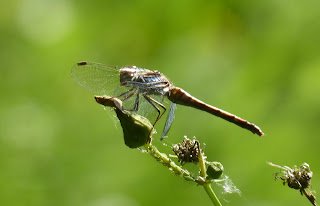 | | Common Darter |
| 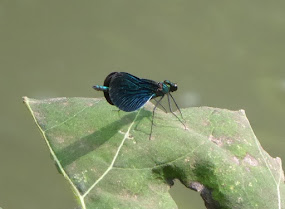 | | Beautiful Demoiselle |
|
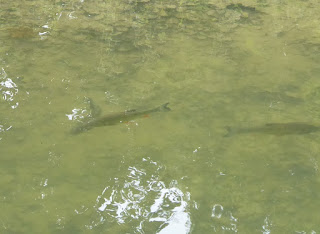 |
| Chub |
Amusingly, elsewhere in the Garden, a game of coarse cricket was underway.
I also visited the Isarinselfest where there were some mammals behaving in an inappropriate manner.
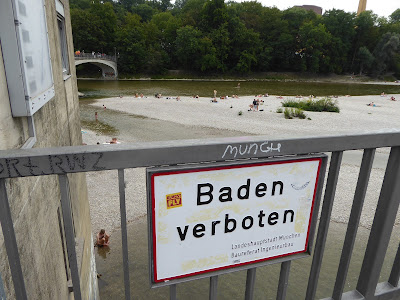 |
| Mammals behaving badly |
Having made it to Passau the next day and sorted out a couple of 'technical difficulties', I set off to the first overnight stay at Schlögen. The scenery was pleasant but conditions remained overcast I wasn't optimistic about seeing much at all apart some fawns that were in a pen next to the track.
The one flower in bloom that was at all frequent was european goldenrod, which eventually proved productive on closer inspection. I think the main bee that I was seeing was a furrow bee, though I wouldn't like to speculate as to which kind.
 |
| Furrow Bee? |
In view of the overcast conditions I was quite pleased to find a common blue nearby, even if slightly tatty.
It rained briefly, but then even then more goldenrod proved a home to a stoical small white waiting for better weather.
 |
| Small White |
Further along the track, I saw something on another patch that mystified me, having never seen the like before. Research suggests that it may be form of potter wasp.
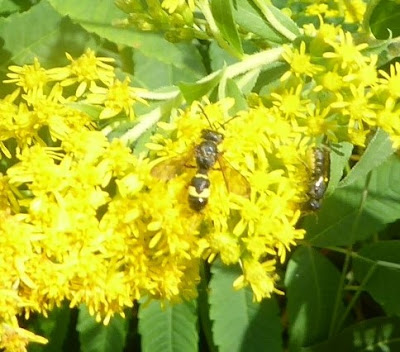 |
| Potter Wasp? |
As far as I can find out, potter wasps only occur in the south of Britain.
The Danube at the
Schlögener Schlinge looked extremely calm as I set out the next day in reasonable weather. Progress was however halted by a Forestry official who asked me to stop. The reason for this was soon clear as a medium sized pine tree was felled, partially blocking the road.
Here she is clearing up the debris:
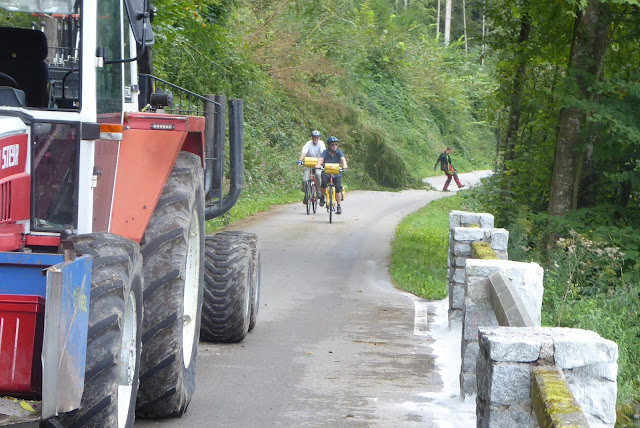 |
| Försterin |
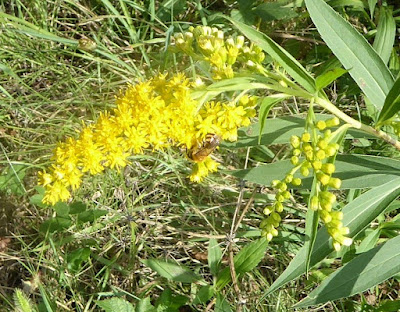
European goldenrod was again productive. I think this one may be one of the colletes bees, although aware there are other things it could be.
.JPG) |
| Colletes Bee? |
This turned out to be the only sunny day of the whole tour and, after crossing the river at Aschach, I quickly encountered a lovely butterfly meadow with much still in flower. Here, as well as the small whites that were everywhere (and I don't think I saw any other white species during the whole trip), there were common blues and a number of clouded yellow males, although they never settled.
Most significantly for me was getting some sort of photo of a small blue, having missed out on one in Slovenia in June.
 | | Flower Meadow |
| 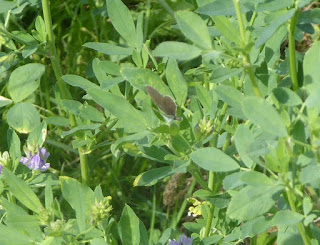 | | Small Blue |
|
There was then a long stretch on the left bank which was bordered by a narrow area of grassland down a bank from the raised cycle track. Bird's foot trefoil started to crop up and for some while I enjoyed numerous sightings of the same species (though only one more small blue) and a good few appearances by peacock and red admiral, elsewhere infrequent.
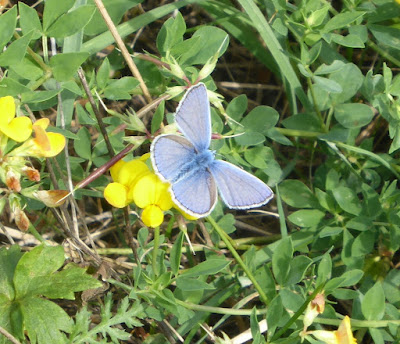 |
| Common Blue |
It was interesting that all the common blues I saw were males.
European goldenrod managed to throw up another surprise before we hit the outskirts of Linz in the form of (presumably) another obscure wasp and, while taking a break, I thought I had a mini-miner on my knee. Perhaps more likely it was a flying ant.
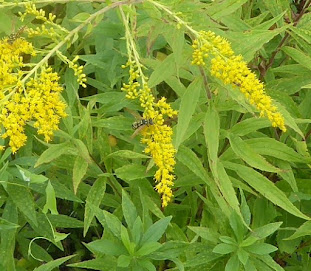 | | Wasp |
| 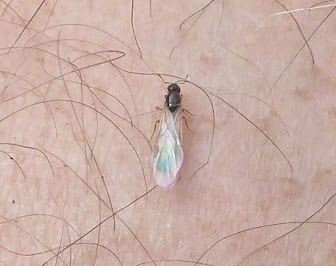 | | Ant |
|
So far, so good but by the time I left Linz the next day, it was already raining and it only stopped briefly around the area of Enns, where there was some nice woodland that might have promising. After that it just got worse and any prospect of nature watching was abandoned as I cycled on determinedly to Tiefenbach.
The next day (Tiefenbach to Melk) it rained consistently and the temperatures, which had been in the thirties the week before dropped to 9C in some locations. While I had plenty of waterproofs, it became impossible to dry things overnight. I had reckoned with the rain but not the low temperatures and frequent coffee stops were essential just to keep my hands warm.
By this time I had decided, by way of a diversion really to see if I could identify at least one bird or butterfly of any kind. Before Melk I managed one bird - a goosander.
The fifth day was one of increasingly rain and flood barriers had started to appear. Others gave up the ride altogether and headed for the train stations. I however continued and was amazed to see that there will still swallows flying low over the swollen Danube, which was lapping at some points no more than a foot below the cycle track. At one point a sculpture I thought I saw above a directional sign transformed into a sparrowhawk and flew off when I was five yards away.
I eventually reached the destination of Traismauer in a storm, disorientated and struggling to find a poorly signposted guesthouse. I was so cold I couldn't sign the hotel registration forms before having a shower. In the evening, my phone received an emergency alert from the Austrian fire brigade warning that the River Krems, which I had fortunately passed, was about to burst its banks.
What should have been a pleasant ride through attractive scenery had turned into an extreme weather event and survival exercise. On the last day the cycle route was closed on both sides of the Danube for the final stage to Vienna and it became apparent that no trains were running. It was largely down to the incredibly helpful lady hosting the appropriately named
Gasthof zum Schwan,who contacted all the tour organisers, that we managed to hitch a lift via detours to Vienna with the bike rental van.
I think this will be the last long distance cycling tour I do. As well as this incident, increasing signs of climate change (e.g. also the forest fire that threatened my arrival in Carcasonne in 2019 and the major anticyclone on my trip to Bulgaria) show you cannot rely on predictable weather any more.


.JPG)


