Showing posts with label swallow. Show all posts

Monday, 23 September 2024

Danube Disaster

My other ploy to extend the summer was a cycle ride along the Danube from Passau to Vienna, of which the first half was a partial success and the second half a major failure.

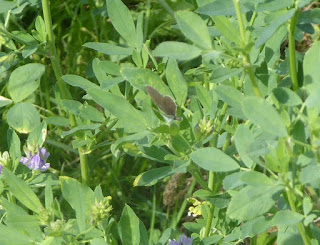
It started with a couple of days in Munich, during which it was good to see that some areas of the English Garden (e.g. the Werneckwiese) have been preserved as flower meadows.  After a warm day on arrival it had however clouded over and hopes of late butterfly sightings were restricted to numerous small whites, and a fleeting sighting of a possible brown argus.

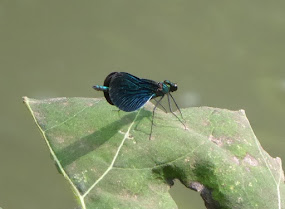
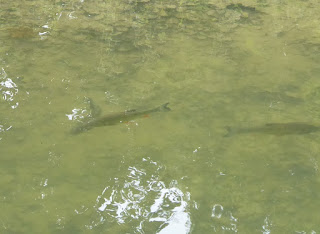
There were any number of common darters and following the stream southwards, I also encountered a few beautiful demoiselle damselflies and, momentarily re-awakening my fishing instinct, a number of chub, some of which were of a nice size.
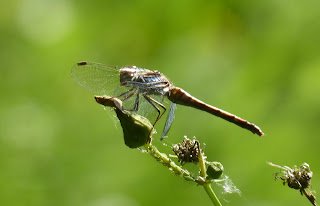
Common Darter
Beautiful Demoiselle

Chub

Amusingly, elsewhere in the Garden, a game of coarse cricket was underway.

I also visited the Isarinselfest where there were some mammals behaving in an inappropriate manner.
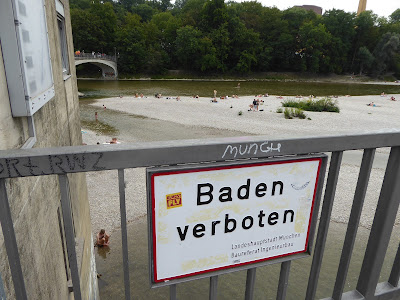
Mammals behaving badly

Having made it to Passau the next day and sorted out a couple of 'technical difficulties', I set off to the first overnight stay at Schlögen.  The scenery was pleasant but conditions remained overcast I wasn't optimistic about seeing much at all apart some fawns that were in a pen next to the track.

The one flower in bloom that was at all frequent was european goldenrod, which eventually proved productive on closer inspection.  I think the main bee that I was seeing was a furrow bee, though I wouldn't like to speculate as to which kind.

Furrow Bee?

In view of the overcast conditions I was quite pleased to find a common blue nearby, even if slightly tatty.

It rained briefly, but then even then more goldenrod proved a home to a stoical small white waiting for better weather.
Small White

Further along the track, I saw something on another patch that mystified me, having never seen the like before.  Research suggests that it may be form of potter wasp.
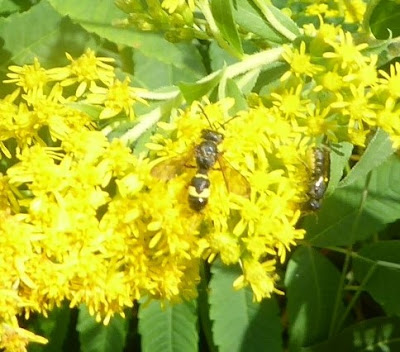
Potter Wasp?

As far as I can find out, potter wasps only occur in the south of Britain.

The Danube at the Schlögener Schlinge looked extremely calm as I set out the next day in reasonable weather.  Progress was however halted by a Forestry official who asked me to stop.  The reason for this was soon clear as a medium sized pine tree was felled, partially blocking the road. 

Here she is clearing up the debris:
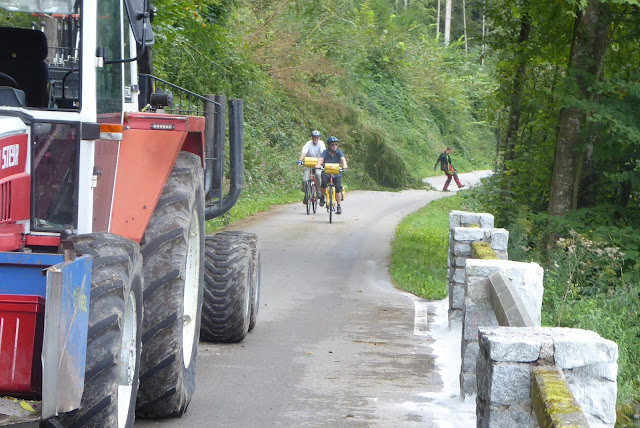
Försterin

European goldenrod was again productive.  I think this one may be one of the colletes bees, although aware there are other things it could be.
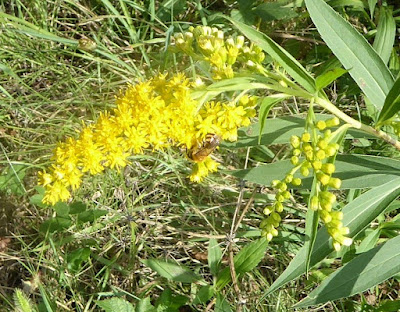
Colletes Bee?

This turned out to be the only sunny day of the whole tour and, after crossing the river at Aschach, I quickly encountered a lovely butterfly meadow with much still in flower.  Here, as well as the small whites that were everywhere (and I don't think I saw any other white species during the whole trip), there were common blues and a number of clouded yellow males, although they never settled.

Most significantly for me was getting some sort of photo of a small blue, having missed out on one in Slovenia in June.
Flower Meadow
Small Blue
There was then a long stretch on the left bank which was bordered by a narrow area of grassland down a bank from the raised cycle track.  Bird's foot trefoil started to crop up and for some while I enjoyed numerous sightings of the same species (though only one more small blue) and a good few appearances by peacock and red admiral, elsewhere infrequent.
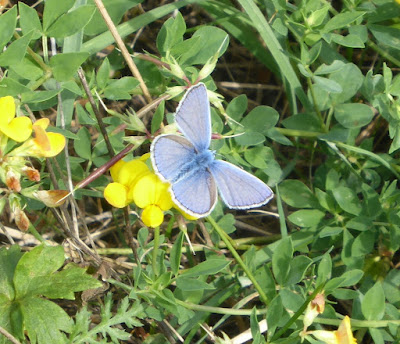
Common Blue

It was interesting that all the common blues I saw were males.

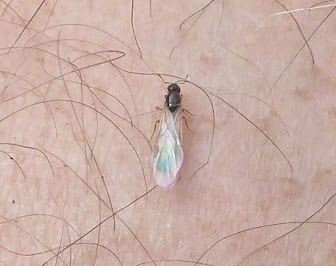
European goldenrod managed to throw up another surprise before we hit the outskirts of Linz in the form of (presumably) another obscure wasp and, while taking a break, I thought I had a mini-miner on my knee.  Perhaps more likely it was a flying ant.
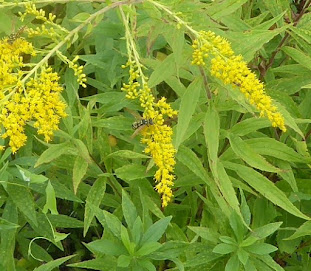
Wasp
Ant
So far, so good but by the time I left Linz the next day, it was already raining and it only stopped briefly around the area of Enns, where there was some nice woodland that might have promising.  After that it just got worse and any prospect of nature watching was abandoned as I cycled on determinedly to Tiefenbach.  

The next day (Tiefenbach to Melk) it rained consistently and the temperatures, which had been in the thirties the week before dropped to 9C in some locations.  While I had plenty of waterproofs, it became impossible to dry things overnight.  I had reckoned with the rain but not the low temperatures and frequent coffee stops were essential just to keep my hands warm.

By this time I had decided, by way of a diversion really to see if I could identify at least one bird or butterfly of any kind.  Before Melk I managed one bird - a goosander.

The fifth day was one of increasingly rain and flood barriers had started to appear.  Others gave up the ride altogether and headed for the train stations. I however continued and was amazed to see that there will still swallows flying low over the swollen Danube, which was lapping at some points no more than a foot below the cycle track.  At one point a sculpture I thought I saw above a directional sign transformed into a sparrowhawk and flew off when I was five yards away. 

I eventually reached the destination of Traismauer in a storm, disorientated and struggling to find a poorly signposted guesthouse.  I was so cold I couldn't sign the hotel registration forms before having a shower.  In the evening, my phone received an emergency alert from the Austrian fire brigade warning that the River Krems, which I had fortunately passed, was about to burst its banks. 

What should have been a pleasant ride through attractive scenery had turned into an extreme weather event and survival exercise.  On the last day the cycle route was closed on both sides of the Danube for the final stage to Vienna and it became apparent that no trains were running. It was largely down to the incredibly helpful lady hosting the appropriately named Gasthof zum Schwan,who contacted all the tour organisers, that we managed to hitch a lift via detours to Vienna with the bike rental van.

I think this will be the last long distance cycling tour I do.  As well as this incident, increasing signs of climate change (e.g. also the forest fire that threatened my arrival in Carcasonne in 2019 and the major anticyclone on my trip to Bulgaria) show you cannot rely on predictable weather any more.

Monday, 20 May 2024

Getting Around

I got out on a couple more trips this week.

On Monday the U3A Nature Watchers made it to the Low Barns Reserve next to the River Wear, which looks quite promising and certainly produced several pleasant if not unexpected sightings.

Straight away we caught my first sighting this year of a swallow in the typical 'bird on a wire' pose.

Swallow

Of course there were a couple of pairs of Canada Geese, one of which had some charming chicks, the other distinctly amusing in their mating activities.

Canada Geese mating
...and having mated...

Also we found the more obvious members of the grebe family:
Great-crested Grebe
Little Grebe

I was also quite amused to spot what I take to be a pair of immature greylag geese.  I think they look rather stately.

Greylag geese

Then at one point, something out of the ordinary happened when a bird appeared briefly on the fence and bushes in front of the hide - and appeared to be sporting a definite red breast,  Unfortunately, I had turned away briefly to check the feeders and couldn't get a photo of it.  But I did see it later in flight, which was noticeably rapid and again got a clear flash of red breast. The only conclusion I could come to was that it might have been a red-breasted flycatcher, a relatively rare passage bird.

Unfortunately the only photo that someone did manage to take was inconclusive and looked more like a reed warbler and no further reports have followed.

As it happened I had to content myself with a shot of the first speckled wood butterfly I have seen settle this year.

Speckled Wood

In fact there's been remarkably few of them around this year.  Perhaps something to do with the cool, damp spring?

Monday, 19 September 2022

Chance Autumn Encounters

A week ago on Sunday I set off on a bike ride to Corbridge, thinking as much of getting a bit of exercise as targeting any nature sightings.

It was a bit of a surprise then when I was pulled up short at Bradley Pond by the sight of a terrapin warming itself on a log near where people often congregate to feed the ducks.

Terrapin

I don't think this is particularly abnormal.  I remember a couple of years back a young lad at Killingworth Lake told me he had caught one while fishing for carp and I'm sure they have been reported elsewhere.

Last Tuesday I decided to take a trip to the walled garden at nearby Gibside, where again the results weren't quite as expected.  I'd hoped I might see some less common bees and thought there would be some queens around and almost certainly a number of butterflies - especially when I noticed that some of the flower beds were still flourishing well.

In fact what I got was an unexpected one-off painted lady and no other butterflies until three speckled wood turned up when I moved on from the garden.  There were any number of honey bees, a few carder bees but nothing else out of the ordinary and not a single wasp - very strange for September.

Painted Lady

It seemed hard to grasp when, only two miles up the road, I have had a mini explosion of red admirals on the buddleia bushes.  Three days ago there were as many as five and at one moment six in the garden at the same time.  Other butterflies weren't in evidence apart from occasional whites until two peacocks showed up just before the weekend.

By yesterday the daytime temperatures had dropped to 13C maximum.  Setting out for another bike ride I wondered to myself whether it would still be possible to see a swallow or a butterfly.  In fact I saw one of each but couldn't identify the butterfly in flight.  But two red admirals managed to brave the conditions at home again today.

The flowers at Gibside

Sunday, 5 June 2022

Up in the Highlands 2

On day three we returned for some more eagle spotting.  By now the weather, which had gradually become cooler was distinctly chilly and we spent an hour snoozing in the car when it got heavy.

The cool turn had a decided effect on the chances of seeing butterflies and during the whole trip all we saw was half a dozen ambient whites and a single orange tip.

From the point of view of eagles, it was pretty much business as day one i.e. occasional distant and often uncertain sightings.  Overall we managed around half a dozen firm sightings over the two days and did not manage to convince ourselves that any of them were white-tailed rather than golden eagles.

However there was good compensation in the form of a variety of other species.  There was already some action on the way along the valley when I spotted a chaffinch-coloured bird flying over the road.  Rather baffled by its definite white rump, I eventually worked out it was probably a juvenile bullfinch.  More puzzling was what appeared to be a blackbird with pronounced white flashes on both upper wings and I haven't worked that one out at all.  Another flypast was a female redstart - a pleasant surprise as their distribution in the area is somewhat sparse.

On arrival at the parking area, Vicki spotted a golden plover with chicks by the nearby woods, so I took a wander back to see if I could find them.  I spotted a swallow on the telegraph wires, at which point a female mallard emerged from the roadside undergrowth and scuttled off at pace through the woods towards a nearby stream.

I noticed some movement by the water and decided to investigate.  As I approached two ducks fled downstream, each followed by a number of chicks.  I assumed they were mallards but having seen the photograph I managed to get, I'm not so sure about the second group.  In fact I wouldn't like to say what they are. Possible candidates might be gadwall (not common in Highlands) or female and young goldeneye.
Duck with chicks

As you can just see, they were also accompanied by a sand martin, one of a large number of hirondelles flying over the water at speed.

Back on the eagle spot, there was what looked like a merlin perched on the craggy rocks high behind us. Photos taken weren't entirely convincing but the fast, direct flight when it moved off persuaded me it wasn't a kestrel.  

The presence of swallows was confirmed when a couple perched on a nearby bridge for several minutes.  It's not often they are near enough long enough to see the red face and neck.

Swallow

Less conspicuously, a grey wagtail turned up several times during the day.

Grey Wagtail

Vicki took a little walk upstream towards an area of trees where ring ouzels are said to appear.  I had tried the same area on day one without success but, staying nearer the river, she managed to snap a tree pipit right on the edge of the riverbank.

We also saw red deer on several occasions and I got a glimpse of a mountain hare, but no mountain goats.

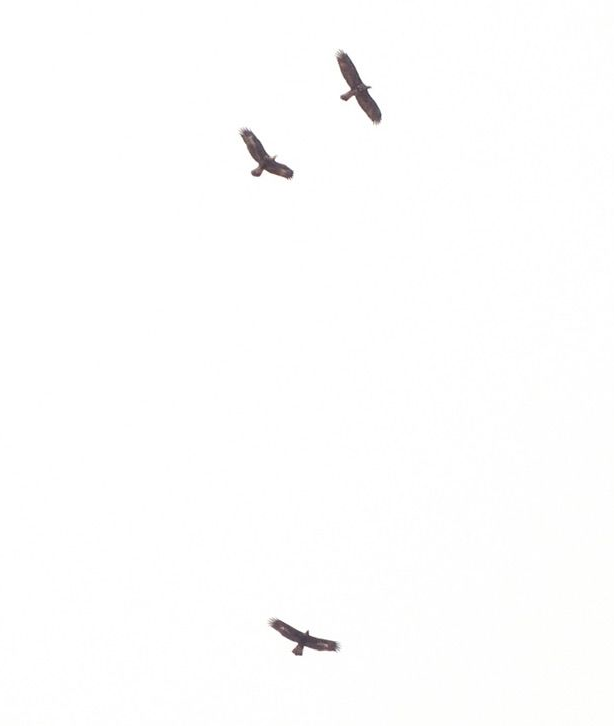
In spite of a late change of location to an area where white eagles can occur, we did not manage anything as spectacular as this photo Vicki took she and Alex visited in April:

Golden Eagles


Friday, 20 May 2022

Hairstreaks Record Broken

Because of the uncertainty about the nomad bee (see last post) I decided to capture another the day after to study it more closely.  Typically it became evident that I had trapped a different species of nomad altogether, so I had the job of making a separate identification.  I think this one might be Marsham's Nomad Bee though it was smaller than I expected and so I wasn't altogether certain.

Marsham's Nomad Bee?

The main event of this week was an outing to Dipton Woods on the e-bike to check for green hairstreaks on the first available day that promised consistent sunshine.  For a while I thought I'd misjudged badly as there was little sun to speak of when I finally got to the area around 11.30.  I was also considerably hampered by the fact that the rough and wet track I was trying to cycle up was blocked by a couple of fallen tree trunks.

Discouraged, I considered giving the whole thing up but checked a few bilberry bushes for remaining flowers and quite by chance came across a single green hairstreak on one of them in spite of the murky light.

Morale suitably bolstered, I evaded the fallen trees by walking the bike through some rough stuff and headed for the known 'hot spot' at the other end of the track, a south-facing slope that is sheltered from the wind by a wall.  I quickly spotted a couple more hairstreaks, then the sun finally did emerge for around 40 minutes stimulating a good deal more activity.  In the end I counted a total of 25 sightings, narrowly beating the 24 I saw on my first visit three three years ago.

Green Hairstreak

In the same area a large butterfly that looked unfamiliar flew straight past me without landing, a large flying bug landed in my hair and there was a small moth I couldn't identify.

Moth

On the way to Dipton Woods I saw my first swallows of the summer near Hedley and on the way back a red kite being pursued by crows between Bywell and Wylam, the furthest West I've seen one so far.

I'm getting a bit fed up with feeding the birds at the moment as all I seem to be achieving is enabling the jackdaws and magpies to have a blowout.  So it was good to have a couple of visits in between times from this lady woodpecker.

Woodpecker

Yesterday one particular bee spent a lot of time flying low over the lawn, as if looking for something.  I suspected a chocolate mining bee but narrowly failed to trap it in the bug box.  There have been one or two honey bees too, but not as many as last year.

Thursday, 9 September 2021

Staycation Time

 As if to prove the wisdom of my last post, a speckled wood came sunbathing on the garden furniture on Sunday but departed again without showing any interest in the buddleia.

Speckled Wood

The same could not be said of the small tortoiseshells, who increased in number as a not especially warm day went on. At one point I counted nine in total on the three buddleia bushes in the back.

Small Tortoiseshells

Apart from (mainly large) whites, only one red admiral showed up.

The day after I set off for planned staycation in Lincolnshire,  Apart from a much-needed change of scenery, I was hoping to find some butterfly and bird species not available on my home patch.

The plan got off to a good start when I rode along the track into Southrey Woods in a heatwave and quickly noticed some brimstone butterflies nectaring on blue flowers that looked like snall cornflowers.  At first I thought they were the pale version of the drimstone but his may have been down to the brightness of the sunlight.  There were about 20 seen in the total time I was there.

Brimstone

There also a good piece of fortune when a single silver-wsshed fritillary started to fly around at speed near where I was having lunch.  Unfortunately it never settled and an attempt to video it in flight didn't come off.  Although I had seen brimstones near my grandparents' house as a kid, that was definitely my first UK silver-washed fritillary sighting,  Also observed were a good number of green-veined whites, small tortoiseshells and red admirals - and this time a couple were feeding near to a peacock - a few small white and a single comma.

There was also a very large fly that looked like a hornet with a yellow hood but I think from facebook posts of similar sightings in Dumfries and Galloway, it is some form of horsefly.

All around the drains there are common darters and I managed to get a photo of one that settled at Southrey.

Common Darter

Things went less well later and on the following day when I was looking for two sites that are known to have the brown hairstreak as I couldn't find either of them!  Apart from a lack of signposting, in one case it was down to a major navigational error on my part.

After seeking creature comforts in Bardney, I decided to ride back very slowly along the Witham with my eyes open and was frankly dissappointed by how little I saw,  A couple of whites, a few swallows and very little else.  It was a bit like the Canal du Midi two years ago.

One minor positive was that I managed to catch an example of the larger dragonflies that crazily landed in a hawthorn bush. It's a southern hawker.

Southern Hawker

I'm pleased with this from a photographic point of view, shot from six metres away in dense foliage.

Friday, 7 May 2021

Friday 7th May

 As if to prove my point a minor extreme weather event hit the area not long after I finished the last post.

Spring?
There were a few rolls of thunder, a flash of lightning and the village was suddenly bombarded by a heavy strafing of hailstones at least the size of marrowfat peas, which quickly covered the roads and gardens.  Who'd want to be a butterfly in that? 

Today a fortunate set of circumstances led to a more fortunate outcome.

I was supposed to be going cycling but my friend cancelled.  A recent cricket injury to my thigh was feeling tight anyway and I was worried I might do myself more harm than good by getting the bike out.

At breakfast I noted that a yellow wagtail had been reported at Bothal Pond and a ring ouzel at Nebiggin.  So I decided that chasing them up would be a healthier thing to do with not too much walking involved.

Flukily I turned up at exactly the right location at Bothal, as what was in fact a black-headed wagtail turned out to be in a horses' field on the other side of the road from the pond. An extensive band of twitchers had already custered by the hedge.  At first all I could see was a couple of swallows.

Amusingly the wagtail was spending its time following the horses to pick up whatever they were turning over in the field.  At first it was favouring the horse furthest away but when a woman entered that part of the field it switched horses and came gradually nearer.  Meanwhile one of the twitchers drew my attention to a wheatear on a dungheap and a couple of horses came over as if to ask what all the fuss was about.

Wheatear

At times the wagtail got really close to either end of a horse and on one occasion, looked like it was in danger of being eaten by one.  It was as if it was a matter of luck that the bird was hungrier than the horse!

Black-headed Wagtail - with horse

Among the twitchers there was some talk about a mockingbird having been seen but I decided to move on to Newbiggin to see if I could catch up with the ring ouzel. Before I moved on a quick glance at the pond revealed some tufted ducks, lapwing and greylag geese, so relative small beer.

At Newbiggin I missed my way slightly trying to find the path to the links when a couple of women in a car stopped to ask me what bird everyone was looking for.  I assumed the ring ouzel was meant but they showed me a picture of another large gathering of twitchers at a rather run down looking location.

I got to the relevant bit of waste ground just off the main street where apparently the bird had been showing all morning before moving off.  It then reappeared briefly on someone's shed just long enough for me to get a hurried shot before disappearing again.

Mockingbird

I waited for half an hour eating an apple but it didn't show up before rain moved in ahead of forecast.

Overall it was a remarkable morning.  The black-headed wagtail does turn up in Northumberland but is one of the rarest wagtails and the mockingbird was several thousand miles away from its normal haunts.  Plus it was complete chance that I found out it was at Newbiggin.

I owed both sightings to the activities of twitchers, who in particular pointed out where to look for the wagtail.  But another mystery must be:  What an earth inspired someone to check out a piece of waste ground in the centre of Newbiggin in the first place?

Wednesday, 5 May 2021

Wednesday 5th May

Last Thursday I decided to brave the weather and take a fishing trip to Brenkley Pond, partly as I still had some usuable maggots from several weeks ago and was happy enough to catch a few smaller fish on waggler in view of the ongoing near-freezing temperatures at night.  That was exactly what I got - 6 small perch and 6 small roach, some of which rivalled the ones at Milkhope for minuteness.

Even on fine tackle bites were infrequent and finicky and had a knack of arriving at inconvenient moments when I was pouring a coffee or fiddling with gear, so I should probably have caught more.  At least the presence of perch is likely to weed out some of the smaller fish over time.

Covid travel restrictions having been relaxed I took the opportunity to meet up with Alex and Vicki at a certain Scottish moorland last Friday in search of birds of prey.  Maximum temperature forecast 9C, actual temperature on arrival 3C, enlivened by strongish wind and a squally shower.

Within half an hour of arrival, we spotted what we thought was a barn owl hunting and soon there were two or three on the go.  Then hen harriers started to appear, both male and female, overall about a dozen sightings though some may have been the same birds returning.  Some of the males were displaying by zigzagging up and down on the horizon.

Not really dressed for the  cold, I was more interested in fiddling with a flask of tea and a pork pie than the camera, so left it to Vicki to provide the photos.  

Male Hen Harrier
Short-Eared Owl

It transpired on closer inspection that the photos were of short-eared owls, though I suppose it's just about possible that both were present.  At one point two owls were together and there was a clear size difference and all sightings were at some distance.  However the habitat certainly makes short-eared owl a good deal more likely.  We had also hoped for peregrine falcon or merlin but neither showed up, not even on returning later in the day.  Still, having only ever seen one male hen harrier before, it was great to see several on the same day.

Meanwhile, on a brief walk up a nearby valley, we encountered numerous meadow pipits, the first two swallows I have seen this year, a few pied and and one grey wagtail.  I had a notion there might have been a white wagtail but it didn't hang about, neither did one larger pipit on the stream which I suppose was a rock pipit.  On the return walk, there were a number of willow warblers around and one reed bunting as well as a pair of stonechats back on the moor.

I suspect this Spring will turn out to have been a disaster for butterflies and there have been remarkably few on the wing these last ten days.  Today a white landed that was either a female orange tip or a green-veined white.  After it departed a male orange tip appeared.  Otherwise there has been nothing apart from a single speckled wood at the tennis club on Sunday.

Orange Tip

Tuesday, 25 August 2020

Tuesday 25th August

Not so much going on this week...

I did get out fishing last Wednesday to Wydon Water, an attractive venue at Hexham that took me a while to find.

Apparently it has been fishing well but on the day in question was distinctly 'off'.  Two anglers in the end swims did OK in an easterly breeze but everyone else was scratching around.  Slightly further along, my swim basically livened up for an hour around lunchtime when I caught five small roach and a small male tench on more or less in succession but that was about it for the day.  I gambled for more tench in the margins on sweetcorn but didn't get a touch and could see the bait lying untouched when I packed up in drizzle a bit after 5.00 p.m.  The roach were on double maggot and the tench on maggot and caster.  It seemed to me the roach were taking from midwater but nothing happened when I reduced the depth from 6.5' to 4'.

Tench

My initial impression is that Wydon is a small fish water.  Everyone seems to measure success in terms of weight and even the tench I got was nowhere near 1lb.  Still it was the first I've had since the two seven pounders I got at Kelhead Quarry, predating this blog.  And as far as I gathered there were only two caught on the day, so still worthy of minor celebration.  Quite pretty too.

A bike ride followed on Wednesday, when I rested at Ebchester watching several swallows hunting in the fields below.  It struck me how few I've seen this year.  Also it sort of had the feeling they were getting ready to migrate.  I didn't notice much more as I was feeling slightly unwell and headed for home a bit earlier than planned.  Still there were a few peacocks, small tortoiseshells and small whites around.

Small tortoiseshells were in the garden this week too but I haven't seen peacocks for a few days.  Large whites have been around a fair bit, mainly males.  In fact it struck me that I wasn't sure if I was misidentifying the females.  I noticed one in particular and saw it was a bit different to the small whites.  A little research showed it was indeed a female.

Female Large White
One rare gardening side note is that I seem to have rescued  the rhodedendron I was given two years ago.  It was struggling when planted out and getting heavily bitten.  The solution has been to repot it in compost dowsed in vinegar to remove the alkaline content.

I'm afraid though that I'm going to have to give up feeding the birds for a while.  The titbits they leave behind are attracting rats too frequently and I think they must be breeding nearby.

Monday, 6 July 2020

Monday 6th July

Well my first fishing trip for three years didn't work out too brilliantly.  I fished swim 9 at Dissington Pond on the short pole, so pretty much what I used to do at Brooms near Annan.  It was a bit weird as I couldn't remember how to handle the tackle and was a bit short of bait, not wanting to make unneccessary shopping trips.

After a some while I caught a small perch on worm and could have had more but decided to stick out for better fish on heavier tackle.  It was probably a mistake as all I got was a few nips and nibbles and swirls from an obviously large carp foraging in the swim after I added some old halibut pellets to the feed.

I think I need to get out of the old methods and try different ideas, ideally with less tackle to cart around.

In spite of some iffy weather I did a nature walk with a friend at Big Waters, where we quickly saw a number of ringlets and a couple of fine looking and large red admirals, as well as meadow brown and speckled wood.

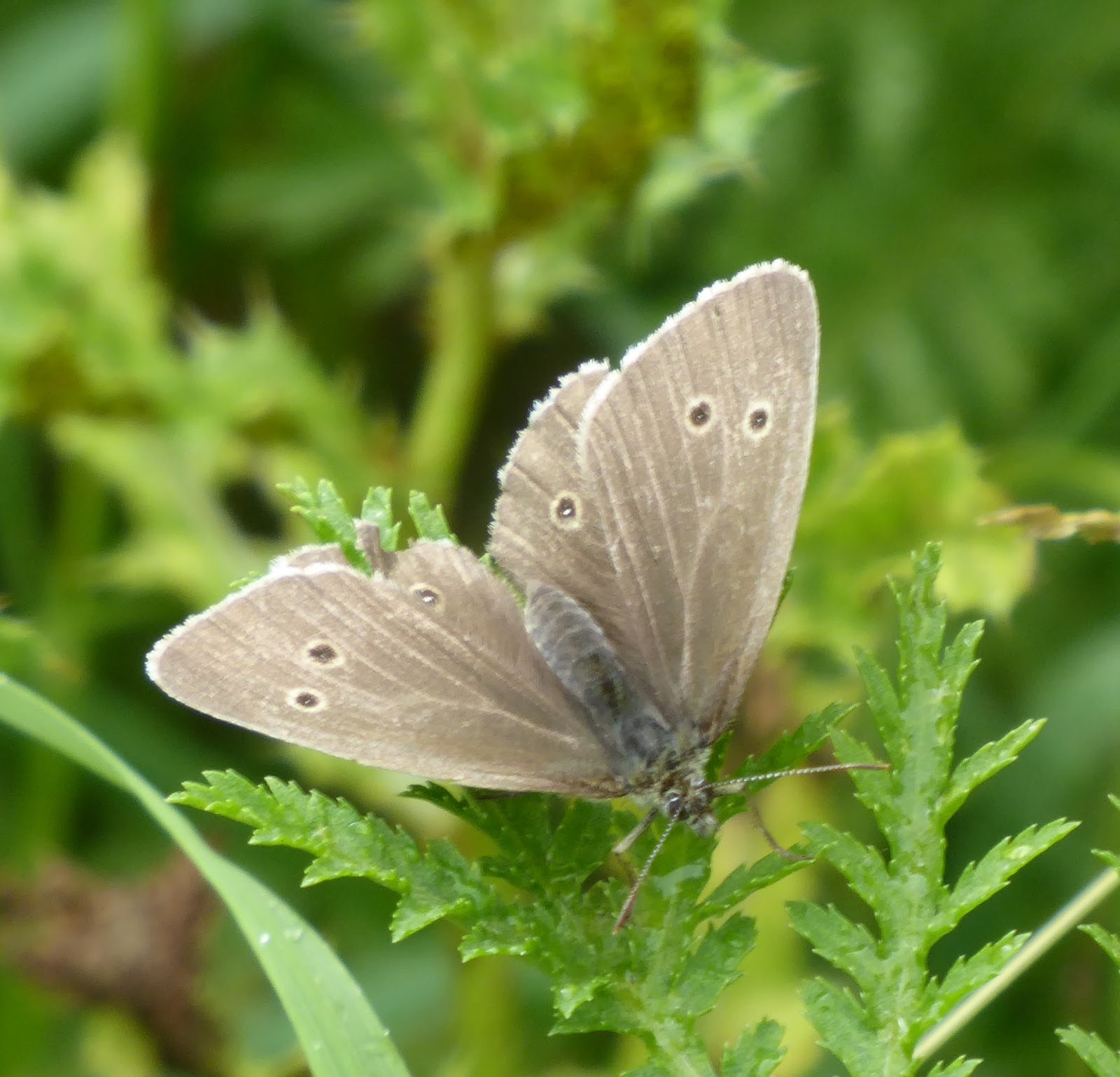
Ringlet
Red Admiral
A pleasant surprise was to see a trio of baby swallows as they waited to be fed by the parent bird.

Baby Swallows

Almost better than that I managed to actually identify a flower - agrimony.


Agrimony
Today I made my first attempt to track down the white-letter hairstreaks at Bywell, spurred on by an optimistic weather forecast.  But when I got to the bridge by bike, it was the usual murk tht we are calling summer this year.  I hung around for a while during a brief bright spell. Then it started to drizzle and I decided to push off, cursing the weather forecast.  When I think of the days this year when I've stayed in because rain was forecast that never arrived...

I did however discover that there are also a few wych elm in the Wylam area, one of which was directly opposite a local hostelry. It was open.