Showing posts with label small blue. Show all posts

Monday, 23 September 2024

Danube Disaster

My other ploy to extend the summer was a cycle ride along the Danube from Passau to Vienna, of which the first half was a partial success and the second half a major failure.

It started with a couple of days in Munich, during which it was good to see that some areas of the English Garden (e.g. the Werneckwiese) have been preserved as flower meadows.  After a warm day on arrival it had however clouded over and hopes of late butterfly sightings were restricted to numerous small whites, and a fleeting sighting of a possible brown argus.

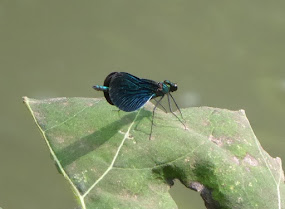
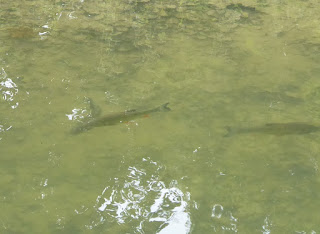
There were any number of common darters and following the stream southwards, I also encountered a few beautiful demoiselle damselflies and, momentarily re-awakening my fishing instinct, a number of chub, some of which were of a nice size.
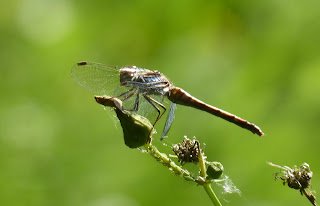
Common Darter
Beautiful Demoiselle

Chub

Amusingly, elsewhere in the Garden, a game of coarse cricket was underway.

I also visited the Isarinselfest where there were some mammals behaving in an inappropriate manner.
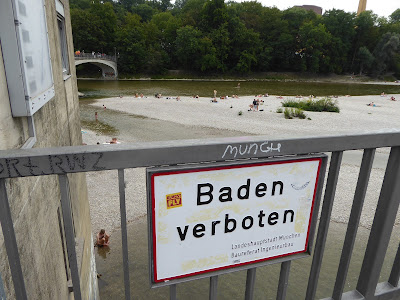
Mammals behaving badly

Having made it to Passau the next day and sorted out a couple of 'technical difficulties', I set off to the first overnight stay at Schlögen.  The scenery was pleasant but conditions remained overcast I wasn't optimistic about seeing much at all apart some fawns that were in a pen next to the track.

The one flower in bloom that was at all frequent was european goldenrod, which eventually proved productive on closer inspection.  I think the main bee that I was seeing was a furrow bee, though I wouldn't like to speculate as to which kind.

Furrow Bee?

In view of the overcast conditions I was quite pleased to find a common blue nearby, even if slightly tatty.

It rained briefly, but then even then more goldenrod proved a home to a stoical small white waiting for better weather.
Small White

Further along the track, I saw something on another patch that mystified me, having never seen the like before.  Research suggests that it may be form of potter wasp.
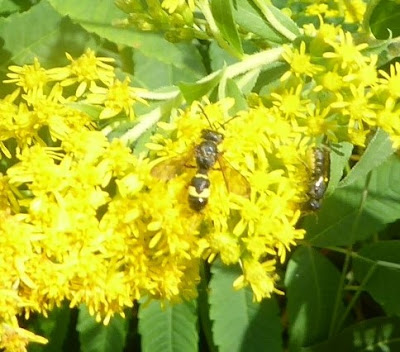
Potter Wasp?

As far as I can find out, potter wasps only occur in the south of Britain.

The Danube at the Schlögener Schlinge looked extremely calm as I set out the next day in reasonable weather.  Progress was however halted by a Forestry official who asked me to stop.  The reason for this was soon clear as a medium sized pine tree was felled, partially blocking the road. 

Here she is clearing up the debris:
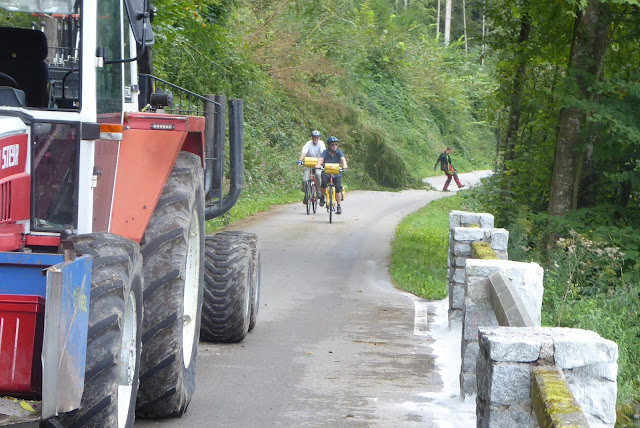
Försterin

European goldenrod was again productive.  I think this one may be one of the colletes bees, although aware there are other things it could be.
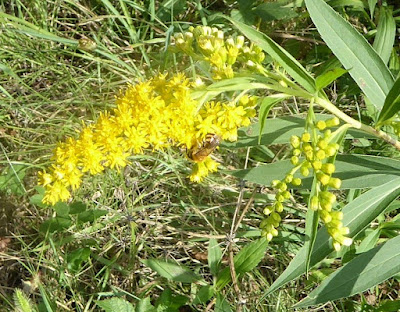
Colletes Bee?

This turned out to be the only sunny day of the whole tour and, after crossing the river at Aschach, I quickly encountered a lovely butterfly meadow with much still in flower.  Here, as well as the small whites that were everywhere (and I don't think I saw any other white species during the whole trip), there were common blues and a number of clouded yellow males, although they never settled.

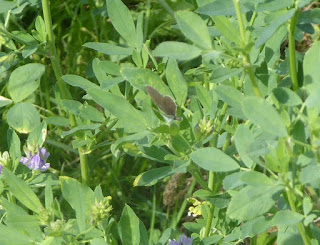
Most significantly for me was getting some sort of photo of a small blue, having missed out on one in Slovenia in June.
Flower Meadow
Small Blue
There was then a long stretch on the left bank which was bordered by a narrow area of grassland down a bank from the raised cycle track.  Bird's foot trefoil started to crop up and for some while I enjoyed numerous sightings of the same species (though only one more small blue) and a good few appearances by peacock and red admiral, elsewhere infrequent.
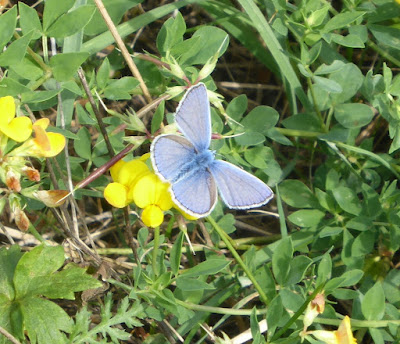
Common Blue

It was interesting that all the common blues I saw were males.

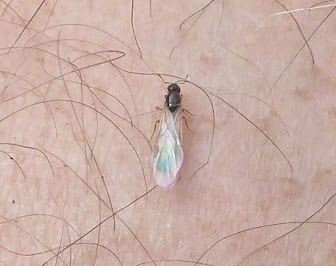
European goldenrod managed to throw up another surprise before we hit the outskirts of Linz in the form of (presumably) another obscure wasp and, while taking a break, I thought I had a mini-miner on my knee.  Perhaps more likely it was a flying ant.
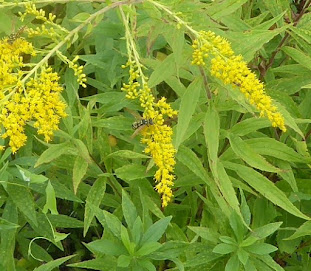
Wasp
Ant
So far, so good but by the time I left Linz the next day, it was already raining and it only stopped briefly around the area of Enns, where there was some nice woodland that might have promising.  After that it just got worse and any prospect of nature watching was abandoned as I cycled on determinedly to Tiefenbach.  

The next day (Tiefenbach to Melk) it rained consistently and the temperatures, which had been in the thirties the week before dropped to 9C in some locations.  While I had plenty of waterproofs, it became impossible to dry things overnight.  I had reckoned with the rain but not the low temperatures and frequent coffee stops were essential just to keep my hands warm.

By this time I had decided, by way of a diversion really to see if I could identify at least one bird or butterfly of any kind.  Before Melk I managed one bird - a goosander.

The fifth day was one of increasingly rain and flood barriers had started to appear.  Others gave up the ride altogether and headed for the train stations. I however continued and was amazed to see that there will still swallows flying low over the swollen Danube, which was lapping at some points no more than a foot below the cycle track.  At one point a sculpture I thought I saw above a directional sign transformed into a sparrowhawk and flew off when I was five yards away. 

I eventually reached the destination of Traismauer in a storm, disorientated and struggling to find a poorly signposted guesthouse.  I was so cold I couldn't sign the hotel registration forms before having a shower.  In the evening, my phone received an emergency alert from the Austrian fire brigade warning that the River Krems, which I had fortunately passed, was about to burst its banks. 

What should have been a pleasant ride through attractive scenery had turned into an extreme weather event and survival exercise.  On the last day the cycle route was closed on both sides of the Danube for the final stage to Vienna and it became apparent that no trains were running. It was largely down to the incredibly helpful lady hosting the appropriately named Gasthof zum Schwan,who contacted all the tour organisers, that we managed to hitch a lift via detours to Vienna with the bike rental van.

I think this will be the last long distance cycling tour I do.  As well as this incident, increasing signs of climate change (e.g. also the forest fire that threatened my arrival in Carcasonne in 2019 and the major anticyclone on my trip to Bulgaria) show you cannot rely on predictable weather any more.

Sunday, 14 July 2024

Slovenia - Day 2

On our second day the early risers in the group saw quite a few birds around the hotel and I did manage my first ever definite photo of a white wagtail while waiting for off.

White Wagtail

Generally though I couldn't see much of what the others saw in the way of birds during the whole trip and took a mental note to get an overdue eye test once back home again.

Eventually we set out to look for fresh meadows near the village of Hrastovalje, not far from the farm where the previous night's impromptu birdwatching session took place.

Obviously the main target was butterflies and on and after an upland walk, we found plenty to look at including clouded yellow, plenty of scarce swallowtail, holly blue, more skippers, wall brown, mallow skipper and grizzled skipper.  Particularly pleasing for me was my first encounters with Reverdin's Blue and Eastern Short-tailed Blue: 


Several grizzled skippers were seen near a puddle in the path we used, where there also there were a large number of wood whites puddling. The interesting thing here is that their black spots have shown up far larger than they appear to the naked eye:


Wood Whites puddling

I had mixed feelings when we came across the first small blue I've ever spotted but arrived on the scene late and only got very blurred and useless shots of it...

However the most spectacular photo opportunity, possibly of the whole trip, was presented by the newly-hatched European Swallowtail that flattered around the van when we got ready to move on and hung about for ages as if posing for the cameras.

European Swallowtail

While moving on to the afternoon venue, we saw a couple of white storks from the bus that even I couldn't fail to see.

White Stork

The next venue proved to be a disappointment.  The meadows looked promising and one or two butterflies briefly appeared but after twenty minutes the clouds moved in and, although it never properly rained and stayed warm, butterflies were scarcely to be seen at all.

I think the only one a I noted was a marbled white that remained stoically attached to the same bit of knapweed for ages with wings closed:

Marbled White

When in such circumstances others turn to birds I turn these days to insects but would be hard put to name any of the ones I saw apart from the nine-spot and red wave moths.

Various Bugs

I feel I should be able to identify the bee, which I first thought was a nomad but, having considered colletes and yellow-faced bees, I don't have a clue.

Amongst other animals we came across during the day were a pool frog, a green lizard and a wall lizard.   
Pool Frog
Green Lizard
Wall Lizard
After dinner we returned to the farm area to look for Scops Owls, which duly did not turn up, though we did see a kield skimmer (dragonfly), raven and dulbentan bat and, learning from past experiences, I decided video was the best media to catch the non-stop flight of the hummingbird hawk moth.

Humming Bird Hawk Moth

Altogether quite a productive day the talk at dinner was already about the relative shortage of butterflies compared to previous years due to poor weather throughout Europe..

Monday, 6 November 2023

Mission Accomplished

It's a pity the weather in the middle weeks of October was so rubbish as one of my junior buddleia bushes actually produced a couple of decent sprigs during that period that could potentially have attracted a late butterfly or two.

Buddleia - the last blooms

Anyway persistent rain meant it wasn't to be.  The last butterfly I saw passed over the car park at Washington Sports Centre on 20th October.  It was brown so presumably a small tortoiseshell or comma, I couldn't tell.

One nice surprise was however a visit from a tree sparrow to the reduced offerings in the feeders.  Not a rare but nevertheless an infrequent occurrence.

Tree Sparrow

As you can maybe tell, it proved to be a bit of a poser.

After various postponements, we decided that the monsoon season was finally over at the weekend and I drove over to Alex and Vicki's for a visit to the massive reed bed on the River Tay between Port Allen and Errol.  The key target, the bearded tit, is supposed to inhabit the area but we didn't really rate the chances of success.  In particular I reckoned bearded tits might not fancy the extreme cold that can be experienced north of the Firth of Forth.  In fact it turned out to be a lovely day.  The trees were at their most colourful and bathed in sunshine.

After a fleeting encounter with a red squirrel, Vicki thought she heard some bearded tits. Then, on a pathway out through the reeds, we hit gold.  I saw one straight away but wasn't totally sure.  A twitcher turned up, himself sporting a magnificent russet beard, and soon they - the tits - were all over the place, at least a good few dozen of them.

We were snapping away busily as they mostly didn't stay in the same place for long.  And I was quite pleased that I even managed a couple of videos with my fancy new camera.

Bearded Tits

I realise there may have been some unconscious gender bias going on there as I seem to have zoomed in on the males, so here in the interests of balance are a couple of shots of the females.
Female Bearded Tit
Female Bearded Tit?

As you can see and maybe would have expected, they are clean shaven.  We did wonder though whether the second one might be a juvenile.  It was the first time I have seen bearded tits since I visited Minsmere 12 years ago.

After a most pleasant session and no sign of a marsh harrier, we gave ourselves the 'job done' sticker,  and spurning the chance to pursue a mandarin duck at Scone, we headed south for Loch Leven.

This was actually a good deal less rewarding as there wasn't too much going on in the first hide we visited and by the time we got to the second hide, the light was getting tricky so that I, at least found it tricky to see the colouration of the ducks.

In fact the best shots I got weren't of ducks at all:
Stonechat
Little Egret

The others we observed were a lot of coots, some teal, wigeon and a few goldeneye.  

I was a bit disappointed not to see any pink footed geese as there had been plenty around but days earlier and, on trying to perform alchemy on some distant greylags with the camera, I can now see that I actually captured a few whooper swans even further away.  The shot is unfortunately too blurry to publish - even on here!

Otherwise I did dryly remark that there was more wildlife on the steps going down to the trails - which you actually can't see on descending them.

The wildlife steps

Another visual did however catch my interest though.  It was a sign on the butterflies and moths present, which included a picture of a small blue.  Clearly a strong case for a revisit one summer...

There's an interesting sequel to our trip of a non-nature variety.  As we got ready to go home from Loch Leven, I wanted to check a couple of sightings on my mobile phone and discovered to my horror that I no longer had it. Vicki and Alex phoned it several times and got a ringing tone and I realised I had probably lost it somewhere on the woodland trail by the Tay earlier.

As we drove back there frantically to beat the dusk, Vicki got a call from Mr Huang, a (we think) Chinese tourist who'd picked it up and were able to meet him as he reached his airbnb in Errol.  Apparently he'd heard the alarm going off that I had set to remind me to text a friend.  

Bearded tits AND getting a phone back you lost on a woodland trail!  How much luckier can I get?

Tuesday, 12 November 2019

Monday 11th November

Autumn has moved in with increasing severity.

Merveille du Jour
Towards the end of October I went to the Butterfly Conservation North East AGM.  It started with a moth trap emptying, which had unfortunately been adversely affected by heavy overnight rain but did produce this nice specimen. There was also some useful information, notably about the small blue introduction on Teesside, which sems to be very near the RSPB site, as well as the precise location of the graylings at Cambois. There was also an explanation the variation of size in the speckled wood.  Apparently research has shown that the ones with larger wings migrate further.  It's thought that wing-shape and colouration are altering as a result of the movement north.

A week or so later I went on a bike ride to Ryal, which didn't produce much in the way of nature though I
Clouded Funnel?
rather liked the 'footpath' of toadstools trailing its way out of the woodland near Stamfordham.  And one pleasant surprise was the appearance of a roe deer shambling along the hedgerow between two roads just north of the A695 at Crawcrook.

In the garden long-tailed tits have come onto the feeders in large numbers on a couple of occasions and several grey squirrels have been seen making their way over to the oak tree, which presumably has produced a lot of acorns this year.  A couple have even ventured into the garden itself briefly.

The other day I saw a (presumably second brood?) jackdaw trying to beg food from the others.  One of them took umbrage and attacked it, forcing it onto its back on the lawn - at which point a magpie immediately swept down, presumably anticipating an easy kill.  Anyway, the victim jackdaw was strong enough to escape on the third or fourth attempt.  Quite a spectacle.

Yesterday, Naturewatchers' trip to Big Waters provided some interesting sightings in addition to the normal fare such as wigeon, shoveler, gadwall etc.  Amongst several hundred canada geese, the twitchers had spotted a white-headed canada goose, pictured below next to the real thing.  Apparently it is the result of hybridisation rather than a separate species.

White-headed Canada Goose (r)
The area to the rear of the hide was under water but the feeders were heavily visited, particularly by tits. I spent a lot of time photographing an elusive willow tit so we could confirm it wasn't a marsh tit but the big surprise for us was when a warbler briefly visited the willow trees on either side.  It seems, according to a local expert, that a small number of chiffchaffs are now overwintering at Big Waters.