Showing posts with label common darter. Show all posts

Sunday, 6 September 2026

Between Summer and Autumn

I did a couple of trips this week as meteorological summer came to an end.

On Bank Holiday Monday I revisited Wallington Hall Walled Garden and made an early common sighting - a common darter.  More interesting however was one of those bumblebees that just doesn't look right and was eventually confirmed as a field cuckoo bee.  It was also nice to catch up with a red-tailed bumblebee worker as one hasn't appeared for a while when I've been out.

Field Cuckoo Bee
Common Darter
Red-tailed Bumblebee

There wasn't quite as much around as last year, when the weather was noticeably better.

However, I did take the opportunity to check for ivy bees at Wylam Bridge on the way home.  At first sight it seemed quiet but on checking it became clear that they were there in force, probably over 100.

Ivy Bees

They were all males apparently so probably hadn't been out long.

On Friday, I was on a bee walk at Allenheads where heavy winds emphasised the change in the seasons though it at least remained reasonably warm. Here we saw over ten broken-belted bumblebees but my understanding of the species was rather shattered by the information that they don't always have an interruption to the upper yellow band on the abdomen.  Otherwise bee sightings were restricted to white-tailed bumblebees plus one buff-tailed bumblebee and several common carder bees (rather than the moss carder bee we'd hoped for).

There were also a coupe of sightings of the fox moth caterpillar and isolated butterflies including a single, very small common blue.
Broken-belted Bumblebee
Fox Moth caterpillar

Perhaps more exciting was that we (rather than I) discovered a couple of flowers that are known to be rare.  These were the autumn gentian and the grass of parnassus.
Autumn Gentian
Grass of Parnassus

It seems the latter is a Cumbrian emblem.

Meanwhile it has been business as usual in the garden but still with one or two surprises.

I found an interesting fly I am provisionally guessing to be tetanocera ferruginae (common buff snailkiller) and the hornet mimic hoverfly has turned up again on two successive days.
Tetanocera Ferruginae
Hornet Mimic Hoverfly

Then frustratingly yesterday I encountered a large, dark bumblebee but just could not get a decent shot of it.  From observation I think it might be a tree bumblebee queen.

Tree Bumblebee Queen?

Maybe another day...


Wednesday, 15 July 2026

Some Hits and Some Misses - Part 2

On the Sunday we headed down to Finglandrigg Wood in Cumbria. 

This was the latest in a series of attempts we have made to see the marsh fritillary there and once again we missed out, mainly seeing more of the butterflies from yesterday.

Two of three times we got excited, only to find we had been deceived by other brown species, namely comma and painted lady. Once when I lagged behind the others all that remained at a bushy area was a peacock.

Comma
Peacock

Part of the delay was that I had come across a honey bee and realised with surprise that it was the first one I've seen this summer.  We later had a discussion about the lack of bees observed.

There was also a marshy area where I kept an eye open for the large heath, this time with no success at all.

We moved on to Campfield Marsh where the objectives were slightly different, as marsh harriers and an osprey nest had been reported.  This time we were successful with both as they were visible from the hide. After many attempts, I did eventually get a clear shot of the osprey with the chicks peering from the nest.  With the marsh harrier I was less lucky but managed to observe it through the binoculars several times.
Osprey and chicks
Marsh Harrier

Not much was seen on the nearby pool - some lapwings and a few greylag geese. Later on we observed some young willow warblers moving through the trees with parental supervision.

There were also quite a few dragonflies around but the only one that settled was this common darter:

Common Darter

An added bonus was a pair of roe deer that were feeding on a farmer's field:

Roe Deer

By the time we made our way back to the car it was early evening but it remained warm and the butterflies were coming out in force.  Here there were more meadow brown than ringlet, but also red admiral, small tortoiseshell and painted lady.
Small Tortoiseshell
Red Admiral
Painted Lady

In fact we must have seen going on for 20 painted ladies, confirming the impression that this may go down as a 'painted lady year.'

Tuesday, 2 September 2025

More Landmark Sightings

The day after I finished writing the last post, I saw something I'd never seen before - in the dining room.

Apparently this is a moth fly (also known as a drain fly) of the pericomini genus but apparently you'd need to be a serious expert to identify one more closely.  It was tiny and had a wingspan of about 3/8".

Another pleasant surprise occurred on 30th August, when a painted lady was finally spotted in the garden and reappeared several times until the sun clouded over.  With the weather now on the change I doubt if it'll be seen again...

Unlike the bullfinches, which will probably keep turning up while sunflower hearts are available. This time I managed to capture the male.  You can't quite see the sunflower heart in its beak.

Male Bullfinch

Today I took a trip to the Big Waters Reserve, where something interesting has been reported.  I have mainly known it as a fishing and birdwatching venue, but was quite impressed on wandering around that there's quite a fair amount of invertebrate-friendly territory in the form of meadows (now mostly dead) and woodland clearings.

Near the Little Waters area there were a good few speckled wood and a few dragonflies.  I think the ones that actually landed were common darters.

Speckled Wood
Common Darter
There were also some large blue dragonflies - possibly emperor dragonflies.

Moving further around the area, I was pleased to come across some small coppers.

Even more were to turn up when I searched an area by the path near the track to the bird eyes, probably about twenty and also a good number of common blues, both male and female.
Common Blue
Small Copper
I wished I had taken the trouble to get a better photo of the small copper.  There were plenty of opportunities but they didn't land for long.

I was heading back to the car park when I bumped into a chap who said he knew where I could find what I was originally after.  We went back to the same area a bit further along where the farm fields have a good covering of bird's foot trefoil and after a fair bit of messing around (and me starting to head for the car park again) we found it.

Clouded Yellow

I'd never heard of the clouded yellow being observed this far North and had thought it might be rare here.  This isn't so as there have been scattered sightings in the past but it is distinctly scarce locally and I don't think I've seen one elsewhere in the UK.

There was actually a very large amount of farmland with a good covering of bird's foot trefoil, so who knows whether there are more of them at Big Waters?

Monday, 23 September 2024

Danube Disaster

My other ploy to extend the summer was a cycle ride along the Danube from Passau to Vienna, of which the first half was a partial success and the second half a major failure.

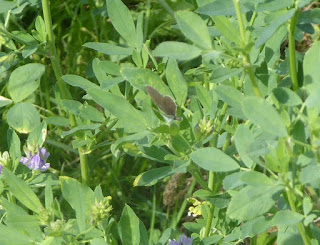
It started with a couple of days in Munich, during which it was good to see that some areas of the English Garden (e.g. the Werneckwiese) have been preserved as flower meadows.  After a warm day on arrival it had however clouded over and hopes of late butterfly sightings were restricted to numerous small whites, and a fleeting sighting of a possible brown argus.

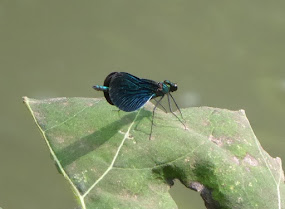
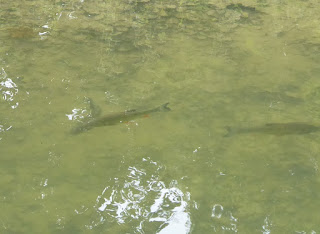
There were any number of common darters and following the stream southwards, I also encountered a few beautiful demoiselle damselflies and, momentarily re-awakening my fishing instinct, a number of chub, some of which were of a nice size.
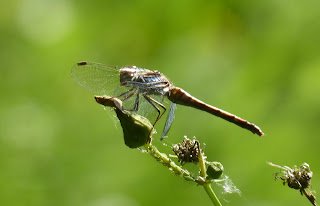
Common Darter
Beautiful Demoiselle

Chub

Amusingly, elsewhere in the Garden, a game of coarse cricket was underway.

I also visited the Isarinselfest where there were some mammals behaving in an inappropriate manner.
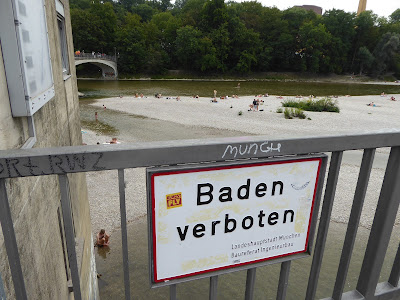
Mammals behaving badly

Having made it to Passau the next day and sorted out a couple of 'technical difficulties', I set off to the first overnight stay at Schlögen.  The scenery was pleasant but conditions remained overcast I wasn't optimistic about seeing much at all apart some fawns that were in a pen next to the track.

The one flower in bloom that was at all frequent was european goldenrod, which eventually proved productive on closer inspection.  I think the main bee that I was seeing was a furrow bee, though I wouldn't like to speculate as to which kind.

Furrow Bee?

In view of the overcast conditions I was quite pleased to find a common blue nearby, even if slightly tatty.

It rained briefly, but then even then more goldenrod proved a home to a stoical small white waiting for better weather.
Small White

Further along the track, I saw something on another patch that mystified me, having never seen the like before.  Research suggests that it may be form of potter wasp.
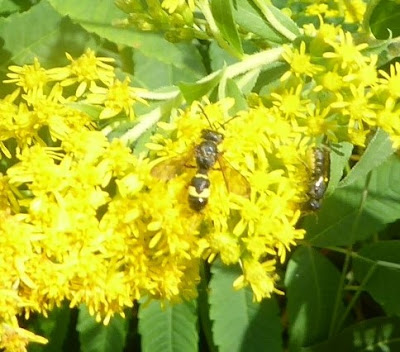
Potter Wasp?

As far as I can find out, potter wasps only occur in the south of Britain.

The Danube at the Schlögener Schlinge looked extremely calm as I set out the next day in reasonable weather.  Progress was however halted by a Forestry official who asked me to stop.  The reason for this was soon clear as a medium sized pine tree was felled, partially blocking the road. 

Here she is clearing up the debris:
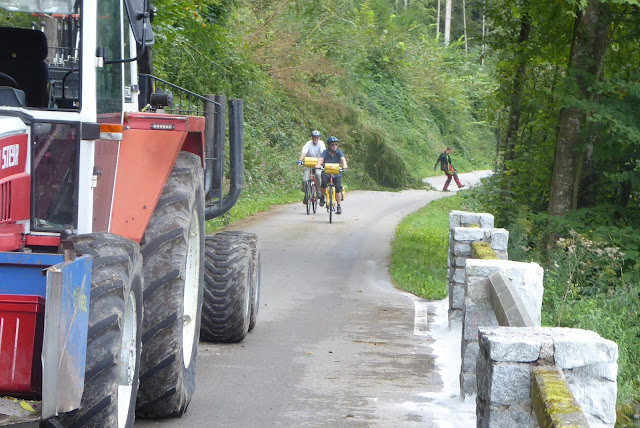
Försterin

European goldenrod was again productive.  I think this one may be one of the colletes bees, although aware there are other things it could be.
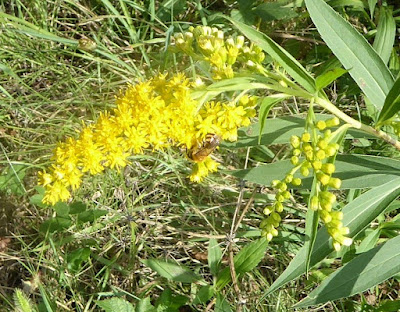
Colletes Bee?

This turned out to be the only sunny day of the whole tour and, after crossing the river at Aschach, I quickly encountered a lovely butterfly meadow with much still in flower.  Here, as well as the small whites that were everywhere (and I don't think I saw any other white species during the whole trip), there were common blues and a number of clouded yellow males, although they never settled.

Most significantly for me was getting some sort of photo of a small blue, having missed out on one in Slovenia in June.
Flower Meadow
Small Blue
There was then a long stretch on the left bank which was bordered by a narrow area of grassland down a bank from the raised cycle track.  Bird's foot trefoil started to crop up and for some while I enjoyed numerous sightings of the same species (though only one more small blue) and a good few appearances by peacock and red admiral, elsewhere infrequent.
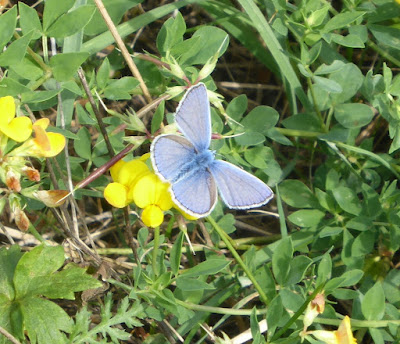
Common Blue

It was interesting that all the common blues I saw were males.

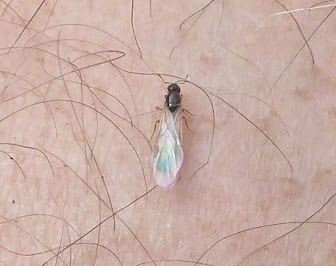
European goldenrod managed to throw up another surprise before we hit the outskirts of Linz in the form of (presumably) another obscure wasp and, while taking a break, I thought I had a mini-miner on my knee.  Perhaps more likely it was a flying ant.
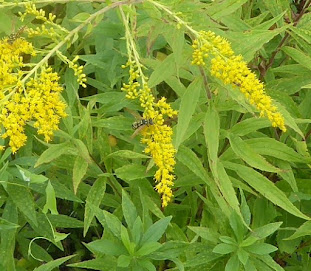
Wasp
Ant
So far, so good but by the time I left Linz the next day, it was already raining and it only stopped briefly around the area of Enns, where there was some nice woodland that might have promising.  After that it just got worse and any prospect of nature watching was abandoned as I cycled on determinedly to Tiefenbach.  

The next day (Tiefenbach to Melk) it rained consistently and the temperatures, which had been in the thirties the week before dropped to 9C in some locations.  While I had plenty of waterproofs, it became impossible to dry things overnight.  I had reckoned with the rain but not the low temperatures and frequent coffee stops were essential just to keep my hands warm.

By this time I had decided, by way of a diversion really to see if I could identify at least one bird or butterfly of any kind.  Before Melk I managed one bird - a goosander.

The fifth day was one of increasingly rain and flood barriers had started to appear.  Others gave up the ride altogether and headed for the train stations. I however continued and was amazed to see that there will still swallows flying low over the swollen Danube, which was lapping at some points no more than a foot below the cycle track.  At one point a sculpture I thought I saw above a directional sign transformed into a sparrowhawk and flew off when I was five yards away. 

I eventually reached the destination of Traismauer in a storm, disorientated and struggling to find a poorly signposted guesthouse.  I was so cold I couldn't sign the hotel registration forms before having a shower.  In the evening, my phone received an emergency alert from the Austrian fire brigade warning that the River Krems, which I had fortunately passed, was about to burst its banks. 

What should have been a pleasant ride through attractive scenery had turned into an extreme weather event and survival exercise.  On the last day the cycle route was closed on both sides of the Danube for the final stage to Vienna and it became apparent that no trains were running. It was largely down to the incredibly helpful lady hosting the appropriately named Gasthof zum Schwan,who contacted all the tour organisers, that we managed to hitch a lift via detours to Vienna with the bike rental van.

I think this will be the last long distance cycling tour I do.  As well as this incident, increasing signs of climate change (e.g. also the forest fire that threatened my arrival in Carcasonne in 2019 and the major anticyclone on my trip to Bulgaria) show you cannot rely on predictable weather any more.

Tuesday, 27 June 2023

Trip to Tübingen

This wasn't a dedicated nature holiday, the main aims being cultural and relaxation in various forms.  Some of the sightings I did make were annoyingly fleeting, making identification tricky.

One day though, I visited the University Botanical Gardens with its impressive array of gardens and trees.  On the way from the nearest bus stop there were a couple of butterflies and an elusive black redstart.

Once there, I had my first sighting of a common blue in an area of rewilding and a spectacular stripey bug on an exotic plant.

Common Blue
Minstrel Bug

Apparently it's an Italian Striped Bug or Minstrel Bug.  Also fleetingly sighted for the first time this year were common darter and marbled white.  On some steps a nomad bee was so active that I couldn't get a picture of it.  This was a pity as all the bees I saw afterwards were honey bees or obvious forms of bumblebee.

On the way to a bike hire place, I had a couple of forays along the River Ammer, where there were a few trout rising and this slightly puzzling duck with a blue sheen on its head feathers.

There is a thing called the Blue-headed Mallard in America and the beak certainly looks mallardy but on balance I think this is probably some sort of hybrid.

Mallard Hybrid?

Another teaser occurred during my one bike ride on a decrepit city bike.  At the edge of a farm field I happened on a couple of large pipits of a long thin body shape and a palish chest marking.  Of course, they moved on soon after I stopped.  It was hard to make them out properly against the light but I reckoned that tawny pipit was likely.

A couple of days later, I caught sight of a butterfly flying along the hedgerow that had all the signs of being a brown hairstreak, my first ever, but of course it did not land.  Later on I was amused to find a pair of Egyptian Geese casually surveilling the punts and  sunbathers by the Neckar.  

Egyptian Goose

I ended up in a Biergarten by the river, feeding fragments of bread to a decent sized carp - almost as satisfying as catching one.

The last day of my holiday was a dedicated nature outing.  I took a bus to Bebenhausen, which offers a number of walks on the southern tip of the Naturpark Schönbuch.  

The first thing I saw, before even leaving the village was a small white butterfly - except something about it struck me as unusual.  I think in fact it was a Southern Small White.  If so it was pretty much right on the Northern edge of its established range but I'm pretty confident about this one.  The giveaway is that the black edging extends slightly down the outer edge of the upper forewing.

Southern Small White

Although the forecast was for very hot weather, it took a while for the clouds to disperse.  When they did, another white appeared by the side of the Fohlenweideweg - a fair number of wood whites, always nice to see as they do not occur in the North of Britain.

Wood White

Their weak, erratic flight means that wood white sites are very precious as the butterflies are unlikely to relocate over any distance.

Ironically the real fun butterflies started when I took a wrong turn and went down a wee overgrown lane.  I was surprised to find that the dominant butterfly here was the pearly heath.

Pearly Heath

I'd seen the pearly heath several times when I was in Bulgaria but did not know it extends across mainland Europe.  

Several expected items turned up including another common blue, and, looking smart, meadow brown and ringlet.
Meadow Brown
Common Blue
Ringlet

I also spent some time confirming that the small skipper I saw was a small skipper, as Essex or Lulworth Skipper were also feasible.  Anyway, it is.

Small Skipper

More troublesome was a very small and worn female blue that kept fluttering around the path track without settling more than briefly.  My feeling is that it may be a Silver Studded Blue but without better images, it's hard to be sure, 

Silver Studded Blue?

Then there was the one that completely defeated me, as I couldn't find anything that resembled this rather smart-looking black moth.  Or maybe it's not even a moth at all?

Unidentified Flying Object

It almost looks like the translucent wing tips are reflecting the treetops above.

Last of all. the most joyful appearance went completely undocumented when a massive purple emperor came down and flattered briefly in front of my midriff.  I waited around for half an hour for it to return but there was no further sign.