Showing posts with label griffon vulture. Show all posts

Friday, 28 February 2025

Spain Day 6

The day started well with another (for me) significant sighting when this cirl bunting was spotted in the garden.

Cirl Bunting

Once again the early morning light made the colouration hard to see but this bird does not occur in the North and was a definite a 'lifetime first.'  Again it's not looking in the right direction.

But today was principally the day when we were scheduled to meet the griffon vultures at the Sierra de Guarra where they are regularly fed in large numbers by an elderly Spanish chap and a younger woman I assumed to be a relative of his.  The gen was that the vultures would have no qualms about taking the lamb carcasses offered and there would also be Lämmergeier that would hover above before moving in to eat up the bones.

Unfortunately we were delayed by an hour, having been sent on a massive diversion to avoid a landslip and by then almost of the Lämmergeier had given it up as a bad job.

The temperature was up to around 15-16C and so there were a couple of butterflies sunning themselves on the track towards the feeding spot - a silhouette of a green hairstreak and a speckled wood.

Green Hairstreak
Speckled Wood

The speckled wood is the darker aegeria form rather than the lighter tircis form generally seen in the UK.

Once into the reserve, there was evidence of the bait put out for the Lämmergeier with the uneasy appearance of a pagan offering.

Lämmergeier bait

When we got there we had to sit down and stay silent and then:

An everyday story of vulture folk

Of course it wasn't all harmony and light:

A squabble

As the hungry hordes gradually ran out of  dead meat to fight over, some opportunist ravens took the opportunity of hoovering up the scraps.
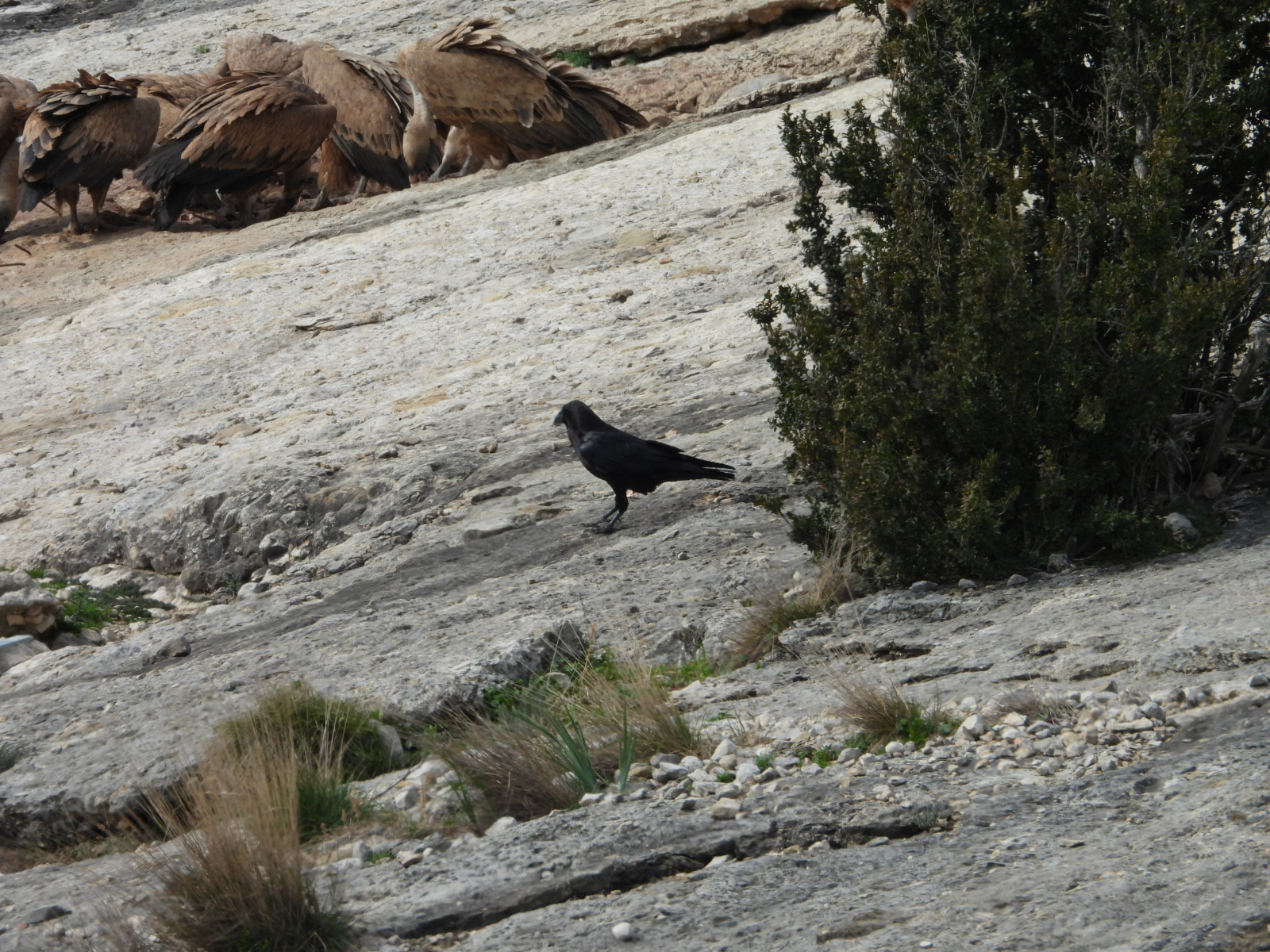
Raven

After the excitement we headed for lunch near Calla Unica where I foraged a bit in the car park finding the first buff-tailed bumblebee I've seen this year, some beeflies that were notably smaller than the one I see in the garden (dark-edged beefly) and the one seen on Day 1. There were also some mini-mining bees, though as ever identifying them would be completely another story.

The spot we chose offered a view back over the vulture feeding zone in the hope of sighting the Lämmergeier and, just when it looked like we wouldn't succeed, a few eagle-eyed (no pun intended) members of the group found a couple, one showing up nicely in the distant sunlight.

Lämmergeier

Near our next destination we came across another bird I had never even heard of before, let alone seen - a black wheatear.

Black Wheatear

It followed the trend set by earlier sightings in presenting a view from the rear.

The next stop was in the heights at the Castillo Montearagon, on top of which there were a lot of chough, which mainly flew off as we drove in.

I got a nice but unnewsworthy photo of a meadow pipit and more interestingly a nutmeg moth and what i believe to be a long-horned bee:

Nutmeg Moth
Long-horned Bee

I've submitted the bee photo to a couple of local experts but neither has responded.

While all this was going on, I hadn't realised that the others had found a couple of dartford warblers and scrambled around a bit to at least get a fleeting sighting of yet another bird I hadn't seen before.

All in all, a pretty profitable day.

Tuesday, 25 February 2025

Spain - Day 4

Last night one of the group leaders noticed there was an egyptian grasshopper sitting on the fence outside the hotel.

Having turned down another early hours search for Dupont's Lark in even colder conditions, I took a look this morning and it hadn't moved, very large and looking like something out of a nightmare.

Egyptian Grasshopper

Today we were on the move to our second hotel in Huesca. En route we stopped at a wee lake, where a large numbers of chiffchaffs were indulging in flycatching activities from the reed beds.  You can just about see them in this video:

Chiffchaffs

I must say I've not seen them in numbers in such a location or behaving like this.  Maybe it's a European thing?

At another brief stop I got a brief spot I got a shot of a calandra lark, which would have been great if it had been polite enough to face in the right direction.

Calandra Lark

We were heading for the reserve at El Planeron by which time we could see the changed scenery looming up like a moon landscape ahead.

The Sierra

We were now 1000 metres lower than Gallocanta and the change in temperature was noticeable, also bringing large numbers of butterflies - all of them whites.
  
Once we stopped, I got a nice view of an early season small white as well as the predominant flower common stork's bill according to Google Lens..
Small White
Common Stork's Bill

On going up a hill on the other side of the road I noticed a butterfly that I thought might be a blue.  In fact what I was seeing was the greenish underwing of the bath white, which were present in good numbers though extremely mobile.  I also spotted large white at distance as did another group member.

I was wondering about the possibility of southern small white, which are definitely possible in Northern Spain but saw none.  It makes me think how lucky my sighting north of Tübingen was a couple of years back although they have now been reported in the Southern UK. 

Further along the reserve we stopped again and someone spotted an Iberian Grey Shrike far off on the other side of the road.  I didn't see it until it moved.  

The group then concentrated on a Dupont's Lark audible to the South East of us but I reckoned it was moving more to the South and headed that way along a rough track. 

Noticing a marshy area and having heard some frogs to my right I took a look and saw the (or another) Iberian Grey Shrike perched in the branches, looking like an elongated version of the great grey shrike we sometimes see at home. I carefully got the camera ready and... the only other car we saw there that session rumbled down the dirt track and flushed the shrike!

It flew around a bit and returned briefly to its obvious favourite perching area a couple of times but was obviously spooked and didn't settle.

Huesca Emblem
Meanwhile some of the group who had followed down the track caught sight of the Dupont's lark
hovering at height near some raptors and eventually diving back down.  I took two or three looks through the binocs but couldn't see a _______ thing.

Further on again there was a short-toed lark near Belchite and I was quite concerned to see this huge aggressive-looking horned creature on the horizon entering the Huesca region.

Apparently it's quite common as we saw images of several others.

Nearing the hotel, a flying raptor was identified as red rather than a black kite and I at last got an image of a raptor in flight as well as a shot of a cerin in a tree with some others.

Griffon Vulture
Cerin

Frankly I doubt if I would have identified the cerin from the photo but the photo needed tweaking as the light was pretty dodgy and it was the first one I'd seen since visiting Austria several years ago.

More of vultures later... 

Sunday, 8 July 2018

Bulgaria Day 6

Unfortunately that was the end of the good weather.  While it sweltered in the UK we found it distinctly chilly at our new base at Moravsko Selo 500 metres higher between the Pirin and Rila mountains.  From here on, our opportunities were increasingly limited by wet weather.  This isn't the complete disaster one might expect as some butterflies simply sit it out with wings closed but remain visible.

Corn Bunting
I ventured out before breakfast and saw a red-backed shrike and, pleasingly, a corn bunting in full song at the rear of the hotel.  Others managed to hear and see a common rosefinch, but it ceased to appear  once the rains set in after the first two days and I missed it.

We visited a fast-flowing river in a deep gorge where numerous short-tailed eagles and several other birds of prey flew by, including a griffon vulture.  At distance it would have been very easy to mistake it for a buzzard.

The accent was a little more on birds here. Great for me was my first sighting of the golden oriole, albeit at distance.  We were to hear them on numerous occasions during the rest of the holiday.  We also tried to tempt a middle-spotted woodpecker to show itself but without real success and a spanish sparrow turned up on a telegraph post.

On the river there was a group of cormorants behaving in typical fashion, but with notably whiter chests than the North European version.

I did manage to photograph some butterflies (see inevitable slideshow video below), of which the most exotic were probably the female chequered blue and Rippart's anomalous blue.  I missed some others - meleager's blue, false eros blue and balkan marbled white, although the latter is apparently hard to distinguish from the normal form.

Also prominent was the appearance of one of the two very large tortoises that live in the Balkans but I forgot the exact name.

We moved not far away to a rather unpromising looking riverside spot where there was a good bit of litter.  Apart from clouded yellows and a few lizards, the scarce swallowtail was sighted but was not settling.

We did eventually managed to catch up with it after following a longish path, nectaring on some large thistles. This area was also quite good for skippers, including lulworth and Oberthür's grizzled skipper (apparently) and we also got a sighting of Lang's short-tailed blue.

On the way back, it was nice to see some common gliders in the low trees at the top of the bank.  Apart from painted lady, this is the only butterfly that I also saw in Sri Lanka where it is known as the common sailer.

We did attempt another expedition but this had to be abandoned quite quickly when the rain closed in and we huddled under a mulberry tree,  As it was in fruit, I got my first ever chance to eat a couple.