Showing posts with label hawthorn mining bee. Show all posts

Monday, 13 May 2024

Dazed and Confused

Eventually the weather had to perk up, resulting in an increase in activity both in the garden and elsewhere.

One of the first signs of this about ten days ago was finding a large number of nomad bees swarming around my forget-me-nots.  I've never seen so many together and hardly any were actually settling, so a bit of a scunner.

I was fairly comfortable identifying Gooden's nomad bee and in subsequent days reckoned I'd identified male and female Panzer's nomad bees, one of which also turned up (I think) at Bolam Lake on Friday.

Gooden's Nomad Bee
Panzer's Nomad bee

The presumed female I caught in a bug box at home had entirely red and black bands on the underside, which tallied with a photo on the internet.

Then much more recently, this item turned up and also fell victim to brief imprisonment the bug box.

Nomad Bee

For reasons that are hard to define too closely, I'm not convinced that this is a panzer's.  Perhaps it's a bit too large, particularly in the thorax area.  So I started to wonder about flavous nomad as the nearest alternative but a bit of research show's that Marsham's and Kirkby's nomad bees are possible locally.  So I'm now unsure about nomad bees with any red markings...

Also, as there are so many nomad bees, where are the mining bees they predate?

Also confusing has been the continuing lack of butterflies settling in the garden. The couple that have were both green-veined whites but I had to take a bike trip along the Tyne before I could get a snap of an orange tip - a rather bedraggled female.
Green-veined White
Orange Tip

Now orange tips are everywhere including five in the garden yesterday, but still not settling or only briefly.

One clear certainty is that the red mason bee is back in big numbers and the wee bug hotel (more like a bug B&B really) is doing a roaring trade.

Red Mason Bees

I was also fairly confident of identifying a Hawthorn Mining |Bee at Bolam Lake...

Hawthorn Mining Bee

... unless it's Gwynne's Mining Bee, or something completely different?

For a few days now, I've puzzled over this small bee that landed on a californian poppy:

Chocolate Mining Bee

After careful consideration, I think chocolate mining bee.  I saw one last year I believe.

And again on bees, I definitely saw a garden bumblebee the other day.

Garden Bumblebee

Okay the tail looks a bit weird but I got a really good look at the double stripe around the waist.  You can just about make it out.

Lastly on a quick tour of a few lakes in Northumberland, it really looked like our small group was not going to see anything beyond standards like tufted duck, canada goose, common tern and great crested grebe.
Great Crested Grebe
Common Tern
Then, just as I was turning to go back to the car, someone someone spotted on osprey flying close overhead with a large fish between its claws.

Dazed and confused indeed!

Friday, 3 May 2024

Butterflies by Bike

I did think while writing my last post a couple of days ago that things could only get better and it proved to be the case.

Anticipating a fearsome 18C forecast I decided to make my weekly trip to Washington Sports Centre by bike on Tuesday, hoping that Cycle Track 7 would yield a few promising spots in spite of some gusty blasts of wind. 

It was only in the Pelton area that I came across a junction with a footpath that was surrounded by dandelions and immediately stopped to have a nose around.  Almost immediately I was elated to catch sight of my first orange tip of the year. During the whole trip I counted eight of them, all males and none of them settling as presumably on the hunt for females. Some of them were extremely small, suggesting under-nourishment. Also spotted later were a single red admiral and a single small tortoiseshell warming themselves on the path.

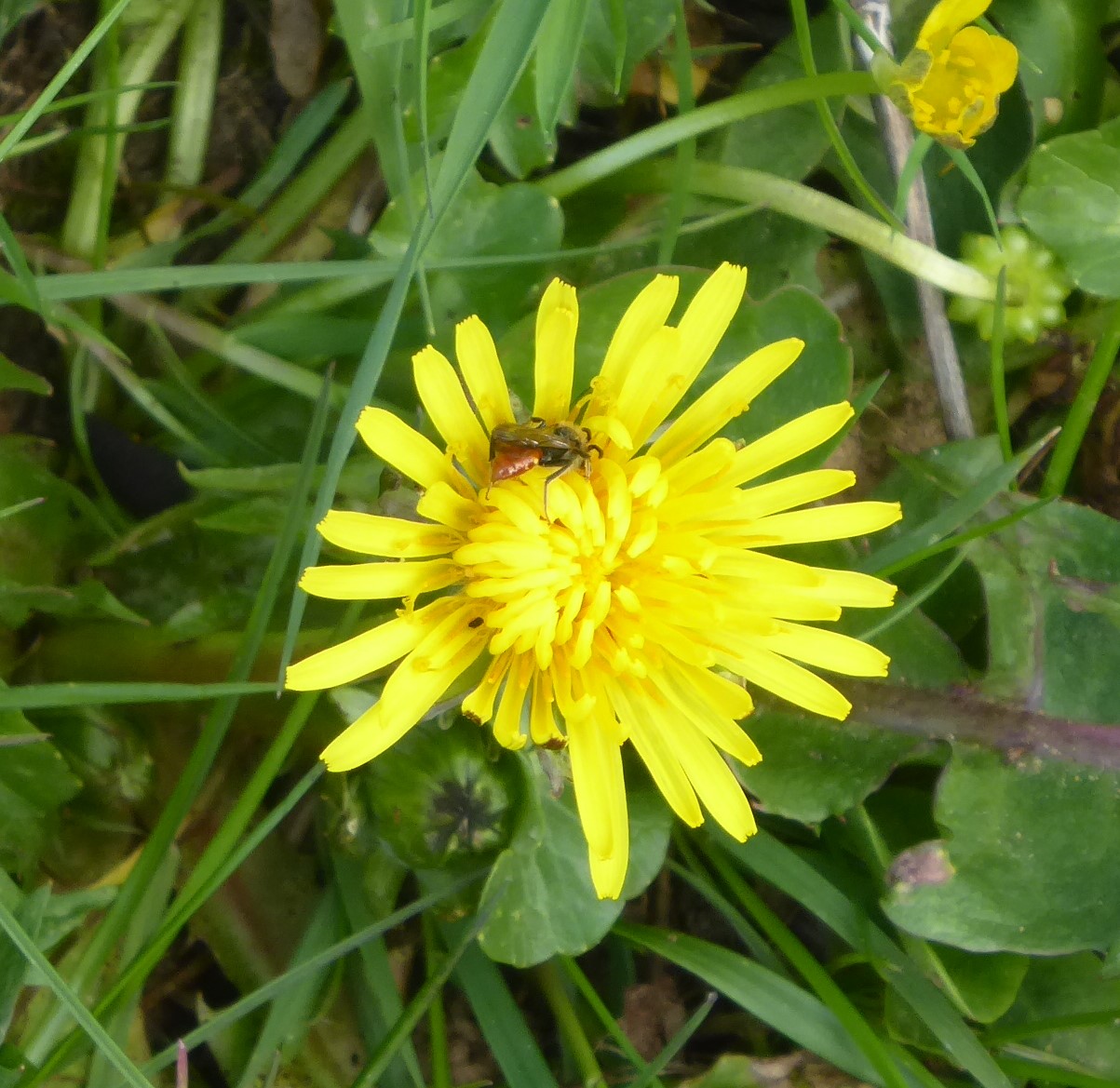
Anyway it was more the thought of bees that caused me to stop at Pelton and I soon found about five hawthorn mining bees nectaring on the dandelions.  The i-record website where I posted photos of them doesn't believe that an amateur like me can reliably identify a hawthorn mining bee.  Having however  seen them on a guided walk by the River Wansbeck, I'm confident I was right... and anyway there were at least three hawthorns nearby!

On the other side of the footpath, I caught sight of a massive bumblebee on the dandelions.  Dim memories of past years recurred and I reckoned it might be a cuckoo. Research in my trusty bee book suggested that it was indeed a gypsy cuckoo bumblebee though it would have to be admitted that the vestal cuckoo bumblebee is extremely similar.

Hawthorn Mining Bee
Gypsy Cuckoo Bumblebee

As you can see the size difference is fairly apparent. I actually saw some smaller bumblebees with similar markings to the cuckoo but dismissed them as buff-tailed bumblebees without an abdominal yellow stripe, which can sometimes happen.

After wrongly thinking I'd seen a rare ladybird, the next stop was by a bridge nearing Washington, where a good head of campions appeared.  However it was again the dandelions that produced something notable in the form. I think, though again disputed by the i-record website, they were a group of mini miners.


Mini Mini Miners?

Now the only mini miner that is mentioned by the trusty bee book as occurring in this area of the North East is the impunctate mini miner, so it could well be that these are they. However you can see that they are so small that they are almost totally buried by the wee dandelion petals and it is only the occasional antenna sticking up that suggests they might be bees at all.  But wasps also have antennae...

Perhaps inspired by all this I spent a fair bit of time in the garden yesterday.

Buffish mining bee turned up again as did tree bumblebee.  I may also have seen a single red mason bee but the photo I got is too blurry to tell. Slightly more exciting was rescuing a green shield bug from a bucket of water and even more exciting than that was seeing my first nomad bee of the year.
Green Shield Bug
Gooden's Nomad Bee

Again in conflict with i-record, I am confident about identifying Gooden's nomad bee, as several photographs showed no sign of red on the abdomen that would have suggested other locally occurring nomads - and it predates on the buffish mining bee.

Still no sign of butterflies here though. 

Wednesday, 27 April 2022

Loads of Bees

The sun has been out and the sightings have continued to pile up.

Last Tuesday (19th)  I went to the Spetchells, partly hoping that the buffish mining bees wouldn't be out in force enabling me to search for other species such as ashy or tawny mining bees.  In fact they were out in their usual tens of thousands making it hard to concentrate on much else and Gooden's Nomad Bee was again the only non-bumblebee seen.  Both were up to their usual tricks.

Buffish Mining Bees
Gooden's Nomad Bee

In fact the main other species of note were a nice small tortoiseshell and the first speckled wood I have seen, which meandered out of some woodland when I was on my way back to the bike.

Small Tortoiseshell
Speckled Wood
As suspected after seeing a few males last week, female orange tips started visiting the garlic mustard crop on my back fence, annoyingly flying off again as soon as the camera was ready to fire.  By contrast the first comma of the season to visit, much earlier than last year, hung around for a good few minutes.

Comma

But sightings and my knowledge frontier really took off on Saturday when I went on a bee and hoverfly walk with the Natural History Society of Northumbria at Morpeth. 

I knew there was a possibility of seeing a tawny mining bee but it was a bit of a surprise to find one running the line at Morpeth Rugby Club before we had even set off on the walk!

Tawny Mining Bee

Although my expertise was considerably outshone by others in the group, I can take credit for seeing the first bee after we set out - a species I'd never heard of before Saturday, the hawthorn mining bee.  I was also the first to identify a cuckoo bee crawling around some undergrowth that turned out to be a vestal cuckoo bumblebee.  In the meantime, a rather nice looking wee blood bee had turned up.  Apparently it's tricky to be sure about precisely which kind of blood bee it was as there are many varieties.

Blood Bee

However our most spectacular sighting was a fly, Ferdinandea cuprea, identified confidently by our leader Mark as only having been recorded in Northumberland on five previous occasions.  I don't do flies other than bee imitators but collected the evidence nevertheless:

Ferdinandea cuprea

By contrast this cream spot ladybird is apparently our most common UK lady bird species.  I must say I had no idea of this.  Perhaps I should get more interested in spotting ladybirds though it does seem to involve a lot of crawling around in the undergrowth.

Cream Spot Ladybird

Perhaps it was the next sighting that got me thinking the most.  I'm sure I read somewhere that there are only two nomad bees occurring in the North East - Gooden's and Marsham's - but this one was identified as a Lathbury's Nomad Bee:

Lathbury's Nomad Bee

A bit hard to see but there is a definite red stripe at the top of the abdomen.

Louise who spotted it says there are definitely five species of nomad bee in the North East and this has got me thinking that the one I've been seeing in the garden may not be a Gooden's as I have tended to assume.  I must get a closer look at it when the sun comes out again.

Another nice sighting was an early bumblebee queen, the first I've seen this year:

Early Bumblebee Queen

And another I'd never even heard of let alone seen before was the sandpit mining bee.

Sandpit Mining Bees

There's a clear lesson to be taken from this - it's amazing what you can see on a half mile walk, especially when you're with people who know what they're talking about!