Showing posts with label Gooden's Nomad Bee. Show all posts

Saturday, 2 May 2026

A Busy time of Year

Over the past ten days, the number of sightings has really exploded and it's hard to keep tabs on it all.

It started with a ride to Byker and back with sightings of a mistle thrush, cormorant and two pairs of shelduck.  More engaged with the insects, significant for me however was the first sighting I have had this year of a comma butterfly.

Comma

That was on 23rd April.

Over the succeeding days, sightings of bees accelerated still mainly led by red mason bee. I managed to get a video of one of the nomad bees which produced a better than usual image, suggesting it is either a flavous or early nomad bee. 

Flavous or early?

There has also been a couple of smaller bees turning up but proving elusive because of a prevailing wind.  I fancied one might be blue mason bee (which has turned up before) but various photos didn't show good angles and advice suggests that it is Gwynne's mining bee.  The only decent shot of the other one still wasn't great and iNaturalist's lead suggestion of hawthorn mining bee seems unconvincing.
Gwynne's Mining Bee
Unidentified Mining Bee

Around the same time there were no great problems identifying the first female orange tip to visit the garden.

Orange Tip (female)

Confusion however again reigned on a walk at MiltonRigg Wood in Cumbria last Sunday with V&A. It was quite an impressive venue with a good amount of bilberry.

I saw a few bumblebees with a red-tailed stripe and thought I might have found a red-tailed bumblebee queen at one point.  However the one very poor photo I got showed a white stripe on the thorax so I suppose could have been a bilberry bumblebee queen.  Similarly thee were a couple of fleeting visits from carder bees but so brief it was impossible to assess if either were a moss carder bee.

Meanwhile V's merlin app was reporting all sorts of birds, notably including pied flycatcher and redstart (very feasible) as well as ring ouzel (somewhat dubious).  The birds were high up in the well-established trees, and only A managed to see a couple.  All I saw was a pair of mallards on the wetland area...

More successful was double outing with AMG on Thursday.

First target was the green hairstreak at Dipton Woods Corbridge.  Last time I was there the hairstreaks had started to occur in a recently-felled area near the North Eastern end of the path and I had a suspicion things might have developed.

Sure enough, we found them in numbers there, often in groups of two or three.

Green Hairstreak

Overall I counted thirty and that was without re-foraging this new 'hotspot' on the way back to the car. We did also visit the area where they've been seen in previous years but this old 'hotspot' appeared somewhat overgrown and only accounted for two of the sightings. Incidentally someone managed to see as many as 74 somewhere in County Durham.

Other sightings were a peacock, and about six each of speckled wood and small white, in both cases the first definite sightings I have noted this Spring.

The next stop was The Spetchells at Prudhoe, where we fully expected to see vast numbers of buffish mining bees.  But first there was a pleasant surprise when a holly blue turned up next to the path along the Tyne.

Holly Blue

There's been a few sightings of holly blue this Spring (maybe a good year for them?) and one turned up in my garden this morning as I was preparing to write this entry. It flapped around in front of me as I headed for the summer house for about a minute.  Unfortunately, with a cup of coffee in one hand and a plate of biscuits in the other, I was powerless to react.

Anyway, the very dry Eastern end of the Spetchells was virtually devoid of buff-tailed mining bees.  Walking west we did manage to contact them but it was the case of a maybe a hundred rather than the thousands around at the end of last April.  Also in attendance were of course good numbers of Gooden's nomad bee, their main predator.
Buffish Mining Bee
Gooden's Nomad Bee

I must say I haven't been too impressed with my Nikkon camera in recent attempts to capture images of insects. It does fine with birds but is often out-performed by my wee Panasonic for close-ups of smaller items. I think I may need to check the settings to see what can be improved.

Approaching teatime we took a quick look for the sand martins but they haven't appeared yet.  What we did see on the way back was a couple of brown shapes that may have been dingy skippers but we couldn't be anything like certain.

So the next day I took a brief ride to Pathhead Nature Reserve and did find a couple of them messing around on the northern bank of the area.  Even with the Panasonic, it was difficult to keep up with them.  They were very small and active and closed their wings almost immediately on landing so they were heavily camouflaged in the brownfield mini-landscape.

Dingy Skipper

I decided to take a tour round the rest of the site, seeing nothing else but when I returned they were still there as before.

I sat down to eat a couple of snacks thinking that one of them would inevitably offer me a better shot - and never saw them again over the next twenty minutes. Odd!

Tuesday, 22 April 2025

Many A Slip...

 In a period of unsettled weather, yesterday looked to be the best opportunity to look for some invertebrates, so I set out for a slow ride to take in Path Head Nature Reserve, Ryton Meadows and the Spetchells.  Unfortunately some photography issues limited the possibility of confirming some sightings.

Path Head is a reclaimed recycling site and looks promising for future months and years.  During a brief outburst of sunshine, I quickly spotted a peacock, a red-tailed bumblebee queen and a carder bee.  Quite a few dandelions were out and I was looking out for mining bees but the result was a number of mini miners, as usual hard and somewhat controversial to identify.  However I captured one in my bug box and am fairly confident it was a common mini-mining bee.

Another capture I made later showed a very small bee with a lot of red on the thorax and reddish legs.  The photo however was unhelpful. Following a tip that it might be a small nomad bee, I reckon a long shot might be little nomad bee, which preys on the common mini-miner though more prevalent in the South.

Little Nomad Bee?

Later there was an opportunity to see a heron admiring the flora.

Heron
In fairness there was a drainage trench nearby.

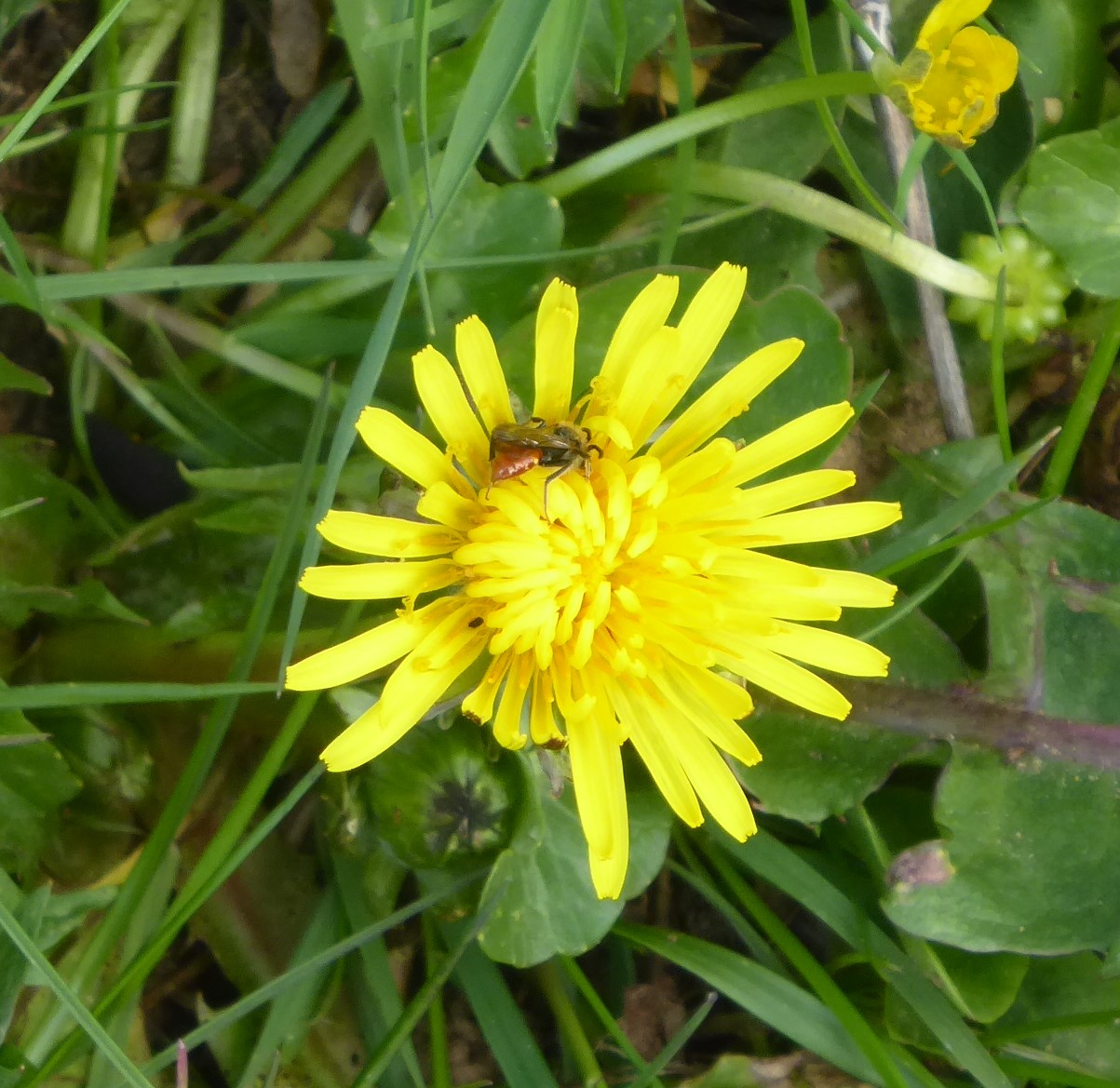
I then headed to Ryton Meadows, in the hope of perhaps seeing an early small copper.  It wasn't entirely unexpected when that hope proved forlorn (a bit early yet) but I did find another interesting bee on another dandelion.  It looked like a small nomad bee but notably had a yellow face.  I can't see any potential matches.  Maybe it was a wasp.

It was at this point that the technical problems really began to take over as a series of images I'm certain I took between arriving at Ryton and climbing up the Spetchells have simply disappeared from my little travelling camera.  As I actually had it round my neck while riding I can only assume that the delete button got pressed a few times accidentally, which seems most unlikely..

So as well as unable to get any further with the possible nomad I lost photos of a peacock and several of orange tips including females and some of suspected chocolate mining bees that I wanted to double check.

Approaching the Spetchells with the camera now back in my rucksack, I noticed a number of small nomad bees patrolling a wee area of grassland next the cycle track. They looked rather like Gooden's Mining Bee but a good deal smaller than the ones up on the chalk. Again having referred to experts for an identification, the suggestion is that it might be a male Gooden's though I must admit I'm surprised it was that much smaller. This time I got a reasonable pic.

Gooden's Nomad Bee (m)

There was about 10-20 of them flying around low and seldom settling for more than a few sedonds.

Before going up to the Spetchells I noticed another bee on a dandelion right next to where I parked my bike.  I was fairly confident it was an orange-tailed mining bee but in this case the photo was too poor to say.

The reason for heading to the Spetchells was to see if the buffish mining bees are in action yet.  Indeed they are - in their many thousands.  It looked to me that they were all males but activity was particularly intense in one small area, I suspect because of the presence of an early female (at the top of the frame in the video):

One Buffish Mining Bee


Many Buffish Mining Bees

As a bonus, I also managed to find the first  - excepting my trip to Spain - small tortoiseshell and the first speckled wood (what on earth's happening with them?)  I've seen this year, as well as a not so great photo of the last female orange tip of the day.
Small Tortoiseshell
Speckled Wood

Female Orange Tip

Thursday, 27 June 2024

More Butterflies Less Bees

Taking advantage of the very first day of a predicted dry spell, I rode to The Spetchells last Monday, hoping to at last find some butterflies on the wing, in particular the common blue

I wasn't disappointed.  Within a few minutes of mounting the chalk steps, I'd found a couple of meandering meadow browns and, wandering further, two solitary male common blues within short succession of each other.

Common Blue
Meadow Brown

There were as expected no buffish mining bees to be found but plenty of its predator, Gooden's Nomad Bee, prowling around the holes the miners have made in the paths. 

Gooden's Nomad Bee

At one point I thought I saw a blood bee entering one of the holes but it never re-emerged. Apart from that I only saw a couple of bumble bees (one red-tailed.)

Even a couple of speckled wood appeared underneath the birch trees and on the way back I happened upon four very fresh-looking ringlets. It was the first time I've seen either species this year.
Speckled Wood
Ringlet
I duly reported all to Butterfly Conservation North East and immediately got an automated message saying the ringlets were the first to be reported this year, which really surprised me but tallies with the fresh appearance. The speckled wood looks in good nick as well.

In all of this, I couldn't help noticing that there was far less bird's foot trefoil at the Spetchells than on previous visits, perhaps explaining why there was no sign of the dingy skipper or any burnet moths.  I begin to wonder if I've struck a bit lucky with the blues.

Monday, 13 May 2024

Dazed and Confused

Eventually the weather had to perk up, resulting in an increase in activity both in the garden and elsewhere.

One of the first signs of this about ten days ago was finding a large number of nomad bees swarming around my forget-me-nots.  I've never seen so many together and hardly any were actually settling, so a bit of a scunner.

I was fairly comfortable identifying Gooden's nomad bee and in subsequent days reckoned I'd identified male and female Panzer's nomad bees, one of which also turned up (I think) at Bolam Lake on Friday.

Gooden's Nomad Bee
Panzer's Nomad bee

The presumed female I caught in a bug box at home had entirely red and black bands on the underside, which tallied with a photo on the internet.

Then much more recently, this item turned up and also fell victim to brief imprisonment the bug box.

Nomad Bee

For reasons that are hard to define too closely, I'm not convinced that this is a panzer's.  Perhaps it's a bit too large, particularly in the thorax area.  So I started to wonder about flavous nomad as the nearest alternative but a bit of research show's that Marsham's and Kirkby's nomad bees are possible locally.  So I'm now unsure about nomad bees with any red markings...

Also, as there are so many nomad bees, where are the mining bees they predate?

Also confusing has been the continuing lack of butterflies settling in the garden. The couple that have were both green-veined whites but I had to take a bike trip along the Tyne before I could get a snap of an orange tip - a rather bedraggled female.
Green-veined White
Orange Tip

Now orange tips are everywhere including five in the garden yesterday, but still not settling or only briefly.

One clear certainty is that the red mason bee is back in big numbers and the wee bug hotel (more like a bug B&B really) is doing a roaring trade.

Red Mason Bees

I was also fairly confident of identifying a Hawthorn Mining |Bee at Bolam Lake...

Hawthorn Mining Bee

... unless it's Gwynne's Mining Bee, or something completely different?

For a few days now, I've puzzled over this small bee that landed on a californian poppy:

Chocolate Mining Bee

After careful consideration, I think chocolate mining bee.  I saw one last year I believe.

And again on bees, I definitely saw a garden bumblebee the other day.

Garden Bumblebee

Okay the tail looks a bit weird but I got a really good look at the double stripe around the waist.  You can just about make it out.

Lastly on a quick tour of a few lakes in Northumberland, it really looked like our small group was not going to see anything beyond standards like tufted duck, canada goose, common tern and great crested grebe.
Great Crested Grebe
Common Tern
Then, just as I was turning to go back to the car, someone someone spotted on osprey flying close overhead with a large fish between its claws.

Dazed and confused indeed!

Friday, 3 May 2024

Butterflies by Bike

I did think while writing my last post a couple of days ago that things could only get better and it proved to be the case.

Anticipating a fearsome 18C forecast I decided to make my weekly trip to Washington Sports Centre by bike on Tuesday, hoping that Cycle Track 7 would yield a few promising spots in spite of some gusty blasts of wind. 

It was only in the Pelton area that I came across a junction with a footpath that was surrounded by dandelions and immediately stopped to have a nose around.  Almost immediately I was elated to catch sight of my first orange tip of the year. During the whole trip I counted eight of them, all males and none of them settling as presumably on the hunt for females. Some of them were extremely small, suggesting under-nourishment. Also spotted later were a single red admiral and a single small tortoiseshell warming themselves on the path.

Anyway it was more the thought of bees that caused me to stop at Pelton and I soon found about five hawthorn mining bees nectaring on the dandelions.  The i-record website where I posted photos of them doesn't believe that an amateur like me can reliably identify a hawthorn mining bee.  Having however  seen them on a guided walk by the River Wansbeck, I'm confident I was right... and anyway there were at least three hawthorns nearby!

On the other side of the footpath, I caught sight of a massive bumblebee on the dandelions.  Dim memories of past years recurred and I reckoned it might be a cuckoo. Research in my trusty bee book suggested that it was indeed a gypsy cuckoo bumblebee though it would have to be admitted that the vestal cuckoo bumblebee is extremely similar.

Hawthorn Mining Bee
Gypsy Cuckoo Bumblebee

As you can see the size difference is fairly apparent. I actually saw some smaller bumblebees with similar markings to the cuckoo but dismissed them as buff-tailed bumblebees without an abdominal yellow stripe, which can sometimes happen.

After wrongly thinking I'd seen a rare ladybird, the next stop was by a bridge nearing Washington, where a good head of campions appeared.  However it was again the dandelions that produced something notable in the form. I think, though again disputed by the i-record website, they were a group of mini miners.


Mini Mini Miners?

Now the only mini miner that is mentioned by the trusty bee book as occurring in this area of the North East is the impunctate mini miner, so it could well be that these are they. However you can see that they are so small that they are almost totally buried by the wee dandelion petals and it is only the occasional antenna sticking up that suggests they might be bees at all.  But wasps also have antennae...

Perhaps inspired by all this I spent a fair bit of time in the garden yesterday.

Buffish mining bee turned up again as did tree bumblebee.  I may also have seen a single red mason bee but the photo I got is too blurry to tell. Slightly more exciting was rescuing a green shield bug from a bucket of water and even more exciting than that was seeing my first nomad bee of the year.
Green Shield Bug
Gooden's Nomad Bee

Again in conflict with i-record, I am confident about identifying Gooden's nomad bee, as several photographs showed no sign of red on the abdomen that would have suggested other locally occurring nomads - and it predates on the buffish mining bee.

Still no sign of butterflies here though. 

Wednesday, 27 April 2022

Loads of Bees

The sun has been out and the sightings have continued to pile up.

Last Tuesday (19th)  I went to the Spetchells, partly hoping that the buffish mining bees wouldn't be out in force enabling me to search for other species such as ashy or tawny mining bees.  In fact they were out in their usual tens of thousands making it hard to concentrate on much else and Gooden's Nomad Bee was again the only non-bumblebee seen.  Both were up to their usual tricks.

Buffish Mining Bees
Gooden's Nomad Bee

In fact the main other species of note were a nice small tortoiseshell and the first speckled wood I have seen, which meandered out of some woodland when I was on my way back to the bike.

Small Tortoiseshell
Speckled Wood
As suspected after seeing a few males last week, female orange tips started visiting the garlic mustard crop on my back fence, annoyingly flying off again as soon as the camera was ready to fire.  By contrast the first comma of the season to visit, much earlier than last year, hung around for a good few minutes.

Comma

But sightings and my knowledge frontier really took off on Saturday when I went on a bee and hoverfly walk with the Natural History Society of Northumbria at Morpeth. 

I knew there was a possibility of seeing a tawny mining bee but it was a bit of a surprise to find one running the line at Morpeth Rugby Club before we had even set off on the walk!

Tawny Mining Bee

Although my expertise was considerably outshone by others in the group, I can take credit for seeing the first bee after we set out - a species I'd never heard of before Saturday, the hawthorn mining bee.  I was also the first to identify a cuckoo bee crawling around some undergrowth that turned out to be a vestal cuckoo bumblebee.  In the meantime, a rather nice looking wee blood bee had turned up.  Apparently it's tricky to be sure about precisely which kind of blood bee it was as there are many varieties.

Blood Bee

However our most spectacular sighting was a fly, Ferdinandea cuprea, identified confidently by our leader Mark as only having been recorded in Northumberland on five previous occasions.  I don't do flies other than bee imitators but collected the evidence nevertheless:

Ferdinandea cuprea

By contrast this cream spot ladybird is apparently our most common UK lady bird species.  I must say I had no idea of this.  Perhaps I should get more interested in spotting ladybirds though it does seem to involve a lot of crawling around in the undergrowth.

Cream Spot Ladybird

Perhaps it was the next sighting that got me thinking the most.  I'm sure I read somewhere that there are only two nomad bees occurring in the North East - Gooden's and Marsham's - but this one was identified as a Lathbury's Nomad Bee:

Lathbury's Nomad Bee

A bit hard to see but there is a definite red stripe at the top of the abdomen.

Louise who spotted it says there are definitely five species of nomad bee in the North East and this has got me thinking that the one I've been seeing in the garden may not be a Gooden's as I have tended to assume.  I must get a closer look at it when the sun comes out again.

Another nice sighting was an early bumblebee queen, the first I've seen this year:

Early Bumblebee Queen

And another I'd never even heard of let alone seen before was the sandpit mining bee.

Sandpit Mining Bees

There's a clear lesson to be taken from this - it's amazing what you can see on a half mile walk, especially when you're with people who know what they're talking about!

Wednesday, 20 April 2022

We have lift off...

Things have really taken off on the nature front in the last few days, in particular the insect world.

Bee flies started to appear on the newly flowering plants and an increasing number of bumblebee queens passed through the garden without stopping.  Then a few days ago bees started to turn up and linger. I got a brief sighting of what looked very much like a tawny mining bee while hunting for weeds around the laurel hedge.  It didn't hang around for more than a couple of seconds but the bright orange coat was pretty much a giveaway.

Yesterday I went down Blaydon Burn to a meeting in town and caught a glimpse of a male orange tip and another small orange butterfly out of my eye.  I wondered about a very early small copper but dismissed it as unlikely.  Anyway I vowed to take a much more careful look on my way back.

As soon as I reached the Burn there was another male orange tip and about sixty yards up the track a struggling queen bee that puzzled me considerably as I couldn't match it at first to any known UK species.  It was only when I looked at the photos I gradually spotted it was a buff-tailed bumblebee with an almost non-existent thorax band.  You can barely see the band at all.

Buff-tailed Bumblebee Queen

As I moved up the burn the number of male orange tip sightings reached five, none of them showing any sign of settling.  My guess is that they were on the lookout for females and this was partially confirmed when a couple of them made overtures to other whites, who quickly saw them off.  I suppose that if you are a male orange tip, it makes sense to get on the wing a bit before the females hatch so you can catch them early.

There were also a couple of peacocks and I got the typical early season shot of a nice new specimen sunning itself on the track.

Peacock

I think that most of the whites I have seen flying past to date have been large whites and this was partially confirmed when I found one trapped in my summerhouse this morning.  It happily sat on my finger for thirty seconds while I escorted it from the premises.  It was clearly a female.

Large White

They don't usually have such a creamy body colour, perhaps the result of struggling on the window pane.

A healthy number of bees and some imitators are now visiting the forget-me-nots and garlic mustard at the bottom of the garden.  There have been tree bumblebees, carder bees, buff-tailed bumblebees and one garden bumblebee, most but not all of them queens.  Possibly the most numerous of the rest have been male red mason bees.  One was even sighted crawling out of a hole in the summer house planks.

Red Mason Bee

But there have also been a couple of bees that I have struggled to identify for certain. The trouble with insects is their seasonality so that you have a large part of the year to forget all you've learned about them.  

A nomad bee has been turning up over the past few days and it looked smaller than the Gooden's Nomad Bees I have seen before.  The plot thickened when I saw what I first thought was a fly but on inspection may well be a chocolate mining bee, which would suggest the nomad was in fact a Marsham's.

Using my latest field guide however, I think the answer is that the nomad was a male Gooden's (hence the smaller size) but that chocolate mining bee may well be a correct identification.
Gooden's Nomad Bee
Chocolate Mining Bee?

A couple of further yellow invaders have also occurred.  One is clearly a queen wasp but the stray yellow plant unaccountably growing in one of my plant pots had me wondering a bit.  On phoning a friend, we think it must be oil-seed rape!
Queen Wasp


Oil-seed Rape

Incidentally I also have a sweet pea in the front garden that has survived the winter and started flowering again about a fortnight ago.

Last of all I wondered into the kitchen to see a spherical object lying on the bird table that was promptly removed by a jackdaw, leaving me to wonder whether it was the jackdaw or another bird that left the egg there in the first place.