I seem to remember I did a post in April a couple of years ago entitled "Loads of Bees." Well the ongoing cold and damp spell has met that the exact reverse has been true and only now looks likely to improve.
There was a single small tortoiseshell on a group bike ride up the coast (cut short due to muddy conditions) but the only sighting in the garden has been a single red admiral fly past several weeks ago. Elsewhere there was one unidentified white by the Tyne on Saturday and that's all.
Apart from the odd honey bee, bees have fared scarcely any better and this all in spite of forget-me-nots being in full flower and a reasonable recovery by the garlic mustard, which seems a pity.
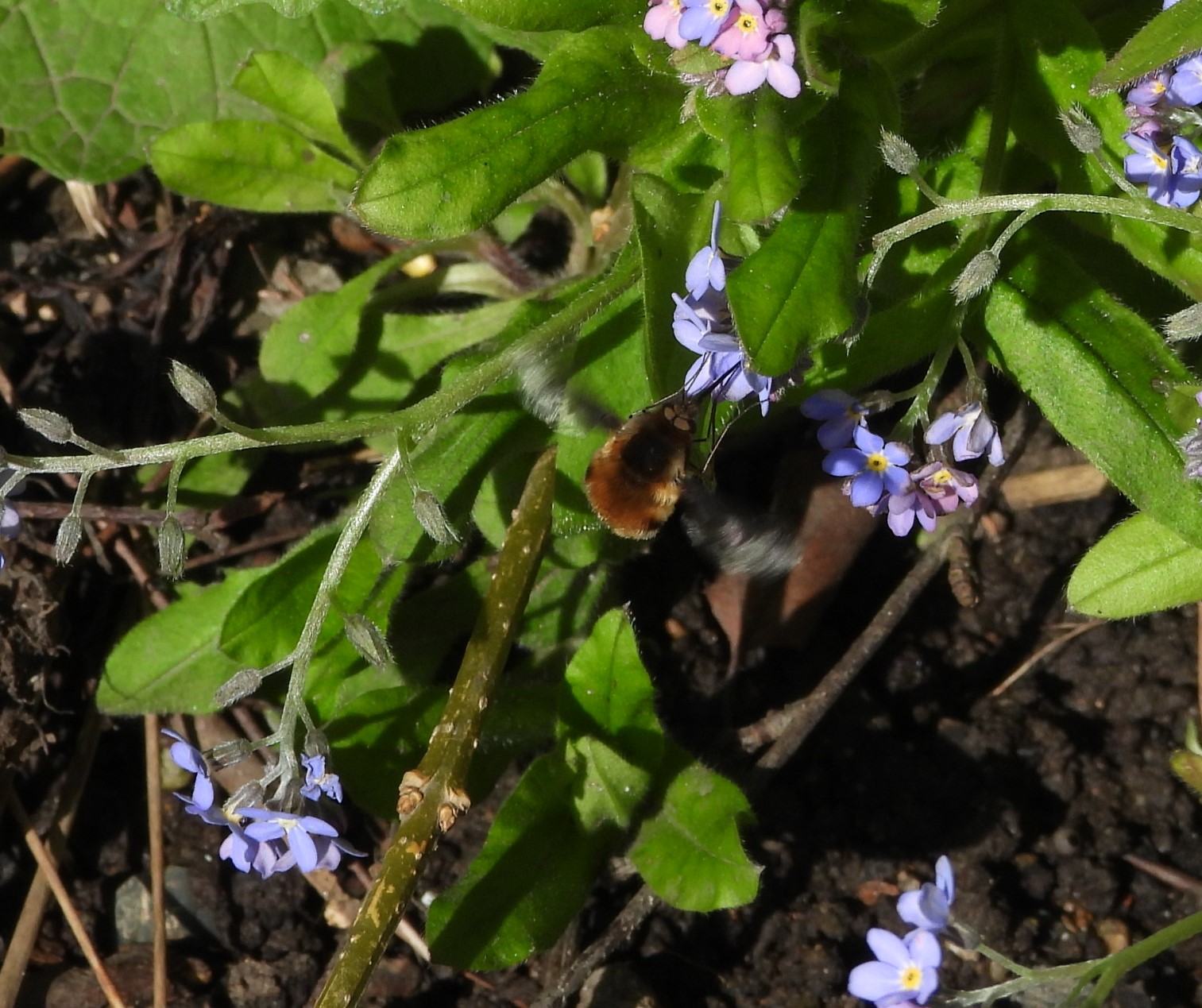
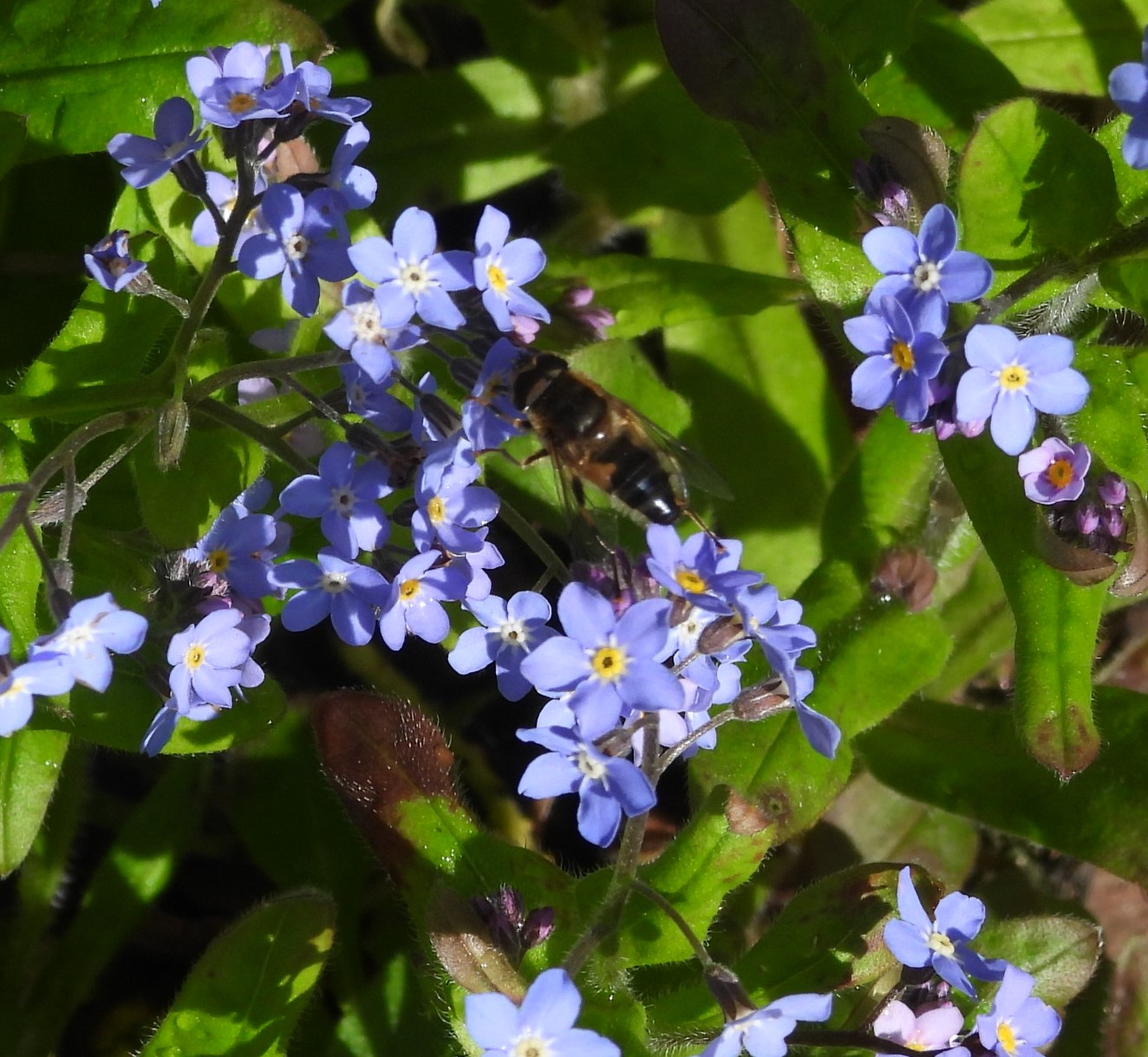
Up until Friday last week all I had seen worth noting was a queen wasp which took up brief residence in the summer house and a couple of visits from bee imitators.
Queen Wasp
Beefly
Tapered Dronefly
I think I'm right about the tapered dronefly, also having had a common dronefly to compare it with.
Then of Friday, a little rare sunshine produced a bit of a turnaround. As well as usual visitors in the shape of tree bumblebee, common carder bee and buff-tailed bumblebee, I was particularly pleased to see a tawny mining bee on garlic mustard a couple of times. I did think I'd seen one in the front garden last year but it was too brief a sighting to be certain.
Tawny Mining Bee
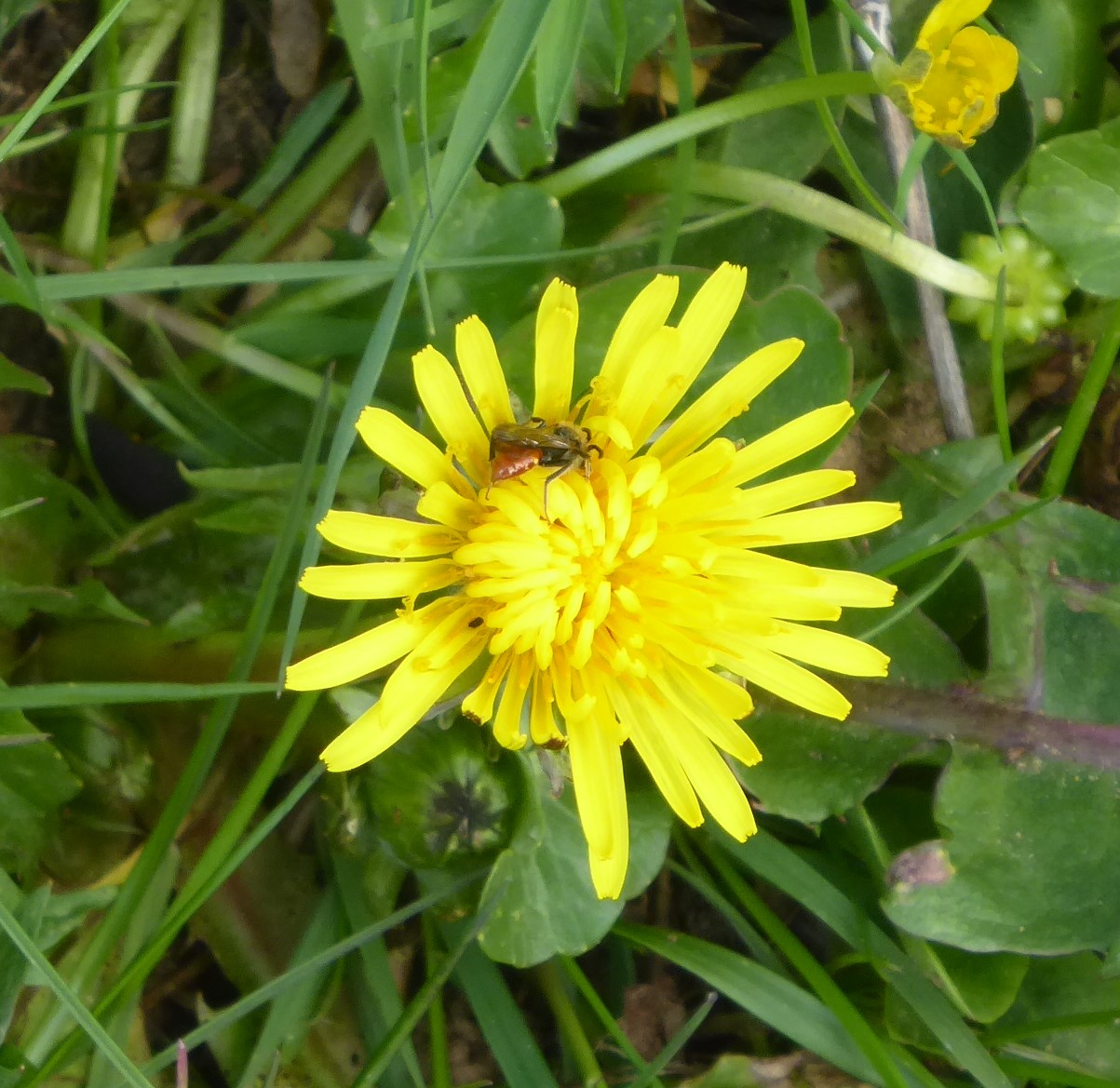
I thought I'd seen a buffish mining bee on dandelion about a week ago but the mobile phone photo was too poor to be sure but one turned up in the garden on Friday. It is of course the most common mining bee.
Also notable was a large early bumblebee.
Buffish Mining Bee
Early Bumblebee
It is interesting to think that in spite of the overall paucity of bee species, early bumblebee has turned up more often than usual. I reckon I've seen four already.
The obvious missing party in all this however is the red mason bee, which was around in big numbers last year when I was confident several nested in my bug hotel. Maybe it's not checkout time yet.
The sun has been out and the sightings have continued to pile up.
Last Tuesday (19th) I went to the Spetchells, partly hoping that the buffish mining bees wouldn't be out in force enabling me to search for other species such as ashy or tawny mining bees. In fact they were out in their usual tens of thousands making it hard to concentrate on much else and Gooden's Nomad Bee was again the only non-bumblebee seen. Both were up to their usual tricks.
Buffish Mining Bees
Gooden's Nomad Bee
In fact the main other species of note were a nice small tortoiseshell and the first speckled wood I have seen, which meandered out of some woodland when I was on my way back to the bike.
Small Tortoiseshell
Speckled Wood
As suspected after seeing a few males last week, female orange tips started visiting the garlic mustard crop on my back fence, annoyingly flying off again as soon as the camera was ready to fire. By contrast the first comma of the season to visit, much earlier than last year, hung around for a good few minutes.
Comma
But sightings and my knowledge frontier really took off on Saturday when I went on a bee and hoverfly walk with the Natural History Society of Northumbria at Morpeth.
I knew there was a possibility of seeing a tawny mining bee but it was a bit of a surprise to find one running the line at Morpeth Rugby Club before we had even set off on the walk!
Tawny Mining Bee
Although my expertise was considerably outshone by others in the group, I can take credit for seeing the first bee after we set out - a species I'd never heard of before Saturday, the hawthorn mining bee. I was also the first to identify a cuckoo bee crawling around some undergrowth that turned out to be a vestal cuckoo bumblebee. In the meantime, a rather nice looking wee blood bee had turned up. Apparently it's tricky to be sure about precisely which kind of blood bee it was as there are many varieties.
Blood Bee
However our most spectacular sighting was a fly, Ferdinandea cuprea, identified confidently by our leader Mark as only having been recorded in Northumberland on five previous occasions. I don't do flies other than bee imitators but collected the evidence nevertheless:
Ferdinandea cuprea
By contrast this cream spot ladybird is apparently our most common UK lady bird species. I must say I had no idea of this. Perhaps I should get more interested in spotting ladybirds though it does seem to involve a lot of crawling around in the undergrowth.
Cream Spot Ladybird
Perhaps it was the next sighting that got me thinking the most. I'm sure I read somewhere that there are only two nomad bees occurring in the North East - Gooden's and Marsham's - but this one was identified as a Lathbury's Nomad Bee:
Lathbury's Nomad Bee
A bit hard to see but there is a definite red stripe at the top of the abdomen.
Louise who spotted it says there are definitely five species of nomad bee in the North East and this has got me thinking that the one I've been seeing in the garden may not be a Gooden's as I have tended to assume. I must get a closer look at it when the sun comes out again.
Another nice sighting was an early bumblebee queen, the first I've seen this year:
Early Bumblebee Queen
And another I'd never even heard of let alone seen before was the sandpit mining bee.
Sandpit Mining Bees
There's a clear lesson to be taken from this - it's amazing what you can see on a half mile walk, especially when you're with people who know what they're talking about!
Things have really taken off on the nature front in the last few days, in particular the insect world.
Bee flies started to appear on the newly flowering plants and an increasing number of bumblebee queens passed through the garden without stopping. Then a few days ago bees started to turn up and linger. I got a brief sighting of what looked very much like a tawny mining bee while hunting for weeds around the laurel hedge. It didn't hang around for more than a couple of seconds but the bright orange coat was pretty much a giveaway.
Yesterday I went down Blaydon Burn to a meeting in town and caught a glimpse of a male orange tip and another small orange butterfly out of my eye. I wondered about a very early small copper but dismissed it as unlikely. Anyway I vowed to take a much more careful look on my way back.
As soon as I reached the Burn there was another male orange tip and about sixty yards up the track a struggling queen bee that puzzled me considerably as I couldn't match it at first to any known UK species. It was only when I looked at the photos I gradually spotted it was a buff-tailed bumblebee with an almost non-existent thorax band. You can barely see the band at all.
Buff-tailed Bumblebee Queen
As I moved up the burn the number of male orange tip sightings reached five, none of them showing any sign of settling. My guess is that they were on the lookout for females and this was partially confirmed when a couple of them made overtures to other whites, who quickly saw them off. I suppose that if you are a male orange tip, it makes sense to get on the wing a bit before the females hatch so you can catch them early.
There were also a couple of peacocks and I got the typical early season shot of a nice new specimen sunning itself on the track.
Peacock
I think that most of the whites I have seen flying past to date have been large whites and this was partially confirmed when I found one trapped in my summerhouse this morning. It happily sat on my finger for thirty seconds while I escorted it from the premises. It was clearly a female.
Large White
They don't usually have such a creamy body colour, perhaps the result of struggling on the window pane.
A healthy number of bees and some imitators are now visiting the forget-me-nots and garlic mustard at the bottom of the garden. There have been tree bumblebees, carder bees, buff-tailed bumblebees and one garden bumblebee, most but not all of them queens. Possibly the most numerous of the rest have been male red mason bees. One was even sighted crawling out of a hole in the summer house planks.
Red Mason Bee
But there have also been a couple of bees that I have struggled to identify for certain. The trouble with insects is their seasonality so that you have a large part of the year to forget all you've learned about them.
A nomad bee has been turning up over the past few days and it looked smaller than the Gooden's Nomad Bees I have seen before. The plot thickened when I saw what I first thought was a fly but on inspection may well be a chocolate mining bee, which would suggest the nomad was in fact a Marsham's.
Using my latest field guide however, I think the answer is that the nomad was a male Gooden's (hence the smaller size) but that chocolate mining bee may well be a correct identification.
Gooden's Nomad Bee
Chocolate Mining Bee?
A couple of further yellow invaders have also occurred. One is clearly a queen wasp but the stray yellow plant unaccountably growing in one of my plant pots had me wondering a bit. On phoning a friend, we think it must be oil-seed rape!
Queen Wasp
Oil-seed Rape
Incidentally I also have a sweet pea in the front garden that has survived the winter and started flowering again about a fortnight ago.
Last of all I wondered into the kitchen to see a spherical object lying on the bird table that was promptly removed by a jackdaw, leaving me to wonder whether it was the jackdaw or another bird that left the egg there in the first place.