In anticipation of a decent plum harvest this autumn, I decided to remove the peanut feeders from the plum tree and hang them temporarily on the washing line to prevent the birds from nibbling at the ripening plums.
They took a bit of getting used to the feeders zipwiring along the washing line and I thought it would be amusing to take a photo of the new set-up in action.
By total chance what I actually got was a shot of a marsh tit sharing one feeder with a blue tit.
Marsh Tit(l) and Blue Tit
That was really quite a chance as visits from a marsh tit are particularly seldom and I didn't see one at all last year.
The loser in this adjustment was the cheeky nut-stealing squirrel who spent a couple of days trying to work out how get onto the feeder and eventually giving up after crashing through the buddleia bush a couple of times.
Last Friday I led a Naturewatch walk around Wingate Quarry Nature Reserve, which I'm pleased to say impressed those present with its variety of butterflies (once the sun got out) and abundant flora. There weren't as many marbled white about as I had expected but there were good numbers of large and small white, common blue and small heath. In terms of flowers, knapweed, pussy willow and ragwort but I left it to our resident experts to identify numerous rarities including fragrant orchid.
Common Blue (f)
Common Blue (m)
Marbled White
Small Heath
Small Skipper
Painted Lady
The painted lady was a bit of a bonus, the first one most of us thought we had seen this summer.
Even before the sun came out, bumblebees were plentiful, in particular red-tailed bumblebees of both genders. I hadn't noticed the males so far this year. Some bees had been considerably blanched by the sun during the recent hot weather.
I spotted one particularly corpulent bee which I believe was a gypsy or vestal cuckoo bee, remembering that they are hard to separate in the field.
The sun has been out and the sightings have continued to pile up.
Last Tuesday (19th) I went to the Spetchells, partly hoping that the buffish mining bees wouldn't be out in force enabling me to search for other species such as ashy or tawny mining bees. In fact they were out in their usual tens of thousands making it hard to concentrate on much else and Gooden's Nomad Bee was again the only non-bumblebee seen. Both were up to their usual tricks.
Buffish Mining Bees
Gooden's Nomad Bee
In fact the main other species of note were a nice small tortoiseshell and the first speckled wood I have seen, which meandered out of some woodland when I was on my way back to the bike.
Small Tortoiseshell
Speckled Wood
As suspected after seeing a few males last week, female orange tips started visiting the garlic mustard crop on my back fence, annoyingly flying off again as soon as the camera was ready to fire. By contrast the first comma of the season to visit, much earlier than last year, hung around for a good few minutes.
Comma
But sightings and my knowledge frontier really took off on Saturday when I went on a bee and hoverfly walk with the Natural History Society of Northumbria at Morpeth.
I knew there was a possibility of seeing a tawny mining bee but it was a bit of a surprise to find one running the line at Morpeth Rugby Club before we had even set off on the walk!
Tawny Mining Bee
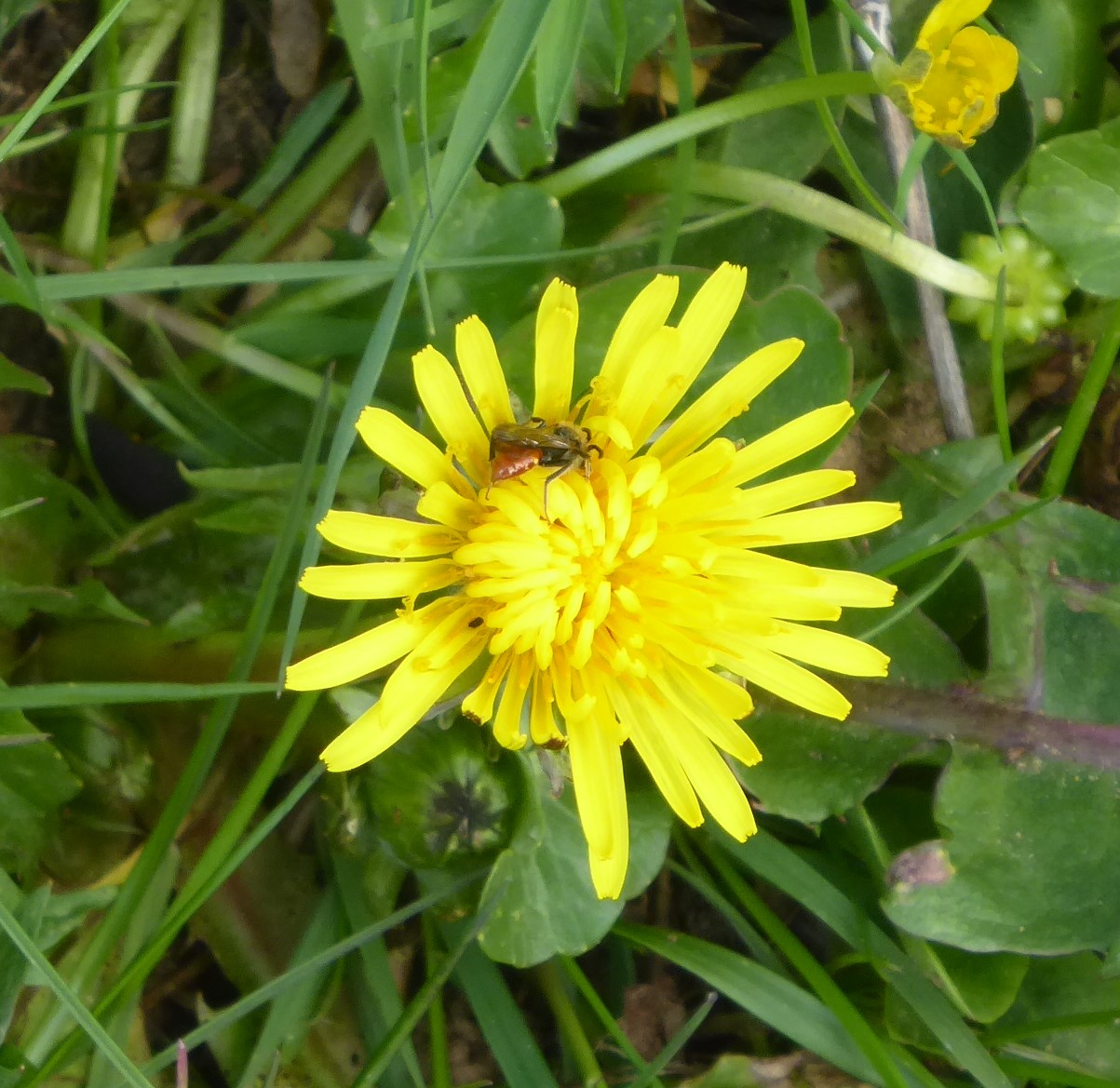
Although my expertise was considerably outshone by others in the group, I can take credit for seeing the first bee after we set out - a species I'd never heard of before Saturday, the hawthorn mining bee. I was also the first to identify a cuckoo bee crawling around some undergrowth that turned out to be a vestal cuckoo bumblebee. In the meantime, a rather nice looking wee blood bee had turned up. Apparently it's tricky to be sure about precisely which kind of blood bee it was as there are many varieties.
Blood Bee
However our most spectacular sighting was a fly, Ferdinandea cuprea, identified confidently by our leader Mark as only having been recorded in Northumberland on five previous occasions. I don't do flies other than bee imitators but collected the evidence nevertheless:
Ferdinandea cuprea
By contrast this cream spot ladybird is apparently our most common UK lady bird species. I must say I had no idea of this. Perhaps I should get more interested in spotting ladybirds though it does seem to involve a lot of crawling around in the undergrowth.
Cream Spot Ladybird
Perhaps it was the next sighting that got me thinking the most. I'm sure I read somewhere that there are only two nomad bees occurring in the North East - Gooden's and Marsham's - but this one was identified as a Lathbury's Nomad Bee:
Lathbury's Nomad Bee
A bit hard to see but there is a definite red stripe at the top of the abdomen.
Louise who spotted it says there are definitely five species of nomad bee in the North East and this has got me thinking that the one I've been seeing in the garden may not be a Gooden's as I have tended to assume. I must get a closer look at it when the sun comes out again.
Another nice sighting was an early bumblebee queen, the first I've seen this year:
Early Bumblebee Queen
And another I'd never even heard of let alone seen before was the sandpit mining bee.
Sandpit Mining Bees
There's a clear lesson to be taken from this - it's amazing what you can see on a half mile walk, especially when you're with people who know what they're talking about!