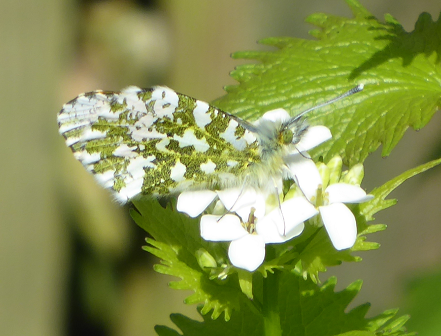
Showing posts with label garlic mustard. Show all posts

Saturday, 29 March 2025

A Slow Spring

We are already experiencing summery days but I have so far seen little of much interest.

About a week ago people started reporting occasional buff-tailed bumblebees and the odd butterfly.  I noticed three of the buff-tailed bumblebee queens in the garden on Monday and a couple more since but no sign yet of the red mason bees that live in the bug hotel and so far no butterflies at all.  Interestingly several records of the brimstone have been registered in the Darlington area and one as far North as Sunniside.  It would be great if one of those turned up on my travels

Again I'm regretting the lack of garlic mustard in the garden, once prolific and a food plant for the orange tip and green-veined white until I decided it was getting out of hand and uprooted virtually the whole lot.

Apart from an increase in blackbirds and robins, collar doves have been fairly frequent visitors, fleeing into the trees at the back if they caught my attention.

Collar Dove

I remember being excited when they first turned up as a mystery in our garden in Blyth in the early eighties, having only recently established a presence in the area.

A bike ride to Matfen a fortnight ago produced a sighting of a yellowhammer and hearing my first chiffchaff, which are now singing out all over the place as they do.  On several occasions I have also heard greenfinches in the tree tops but so far haven't seen one.

Perhaps the most interesting thing I did see was crawling around in the summer house rather than in the garden itself.

Green Lacewing

Nothing special and I have had lacewings before in the Spring, but I rather like them and daresay the trout in the Derwent like them too.

Monday, 29 April 2024

Hardly Any Butterflies or Bees?

I seem to remember I did a post in April a couple of years ago entitled "Loads of Bees."  Well the ongoing cold and damp spell has met that the exact reverse has been true and only now looks likely to improve.

There was a single small tortoiseshell on a group bike ride up the coast (cut short due to muddy conditions) but the only sighting in the garden has been a single red admiral fly past several weeks ago.  Elsewhere there was one unidentified white by the Tyne on Saturday and that's all.

Apart from the odd honey bee, bees have fared scarcely any better and this all in spite of forget-me-nots being in full flower and a reasonable recovery by the garlic mustard, which seems a pity.

Up until Friday last week all I had seen worth noting was a queen wasp which took up brief residence in the summer house and a couple of visits from bee imitators.

Queen Wasp
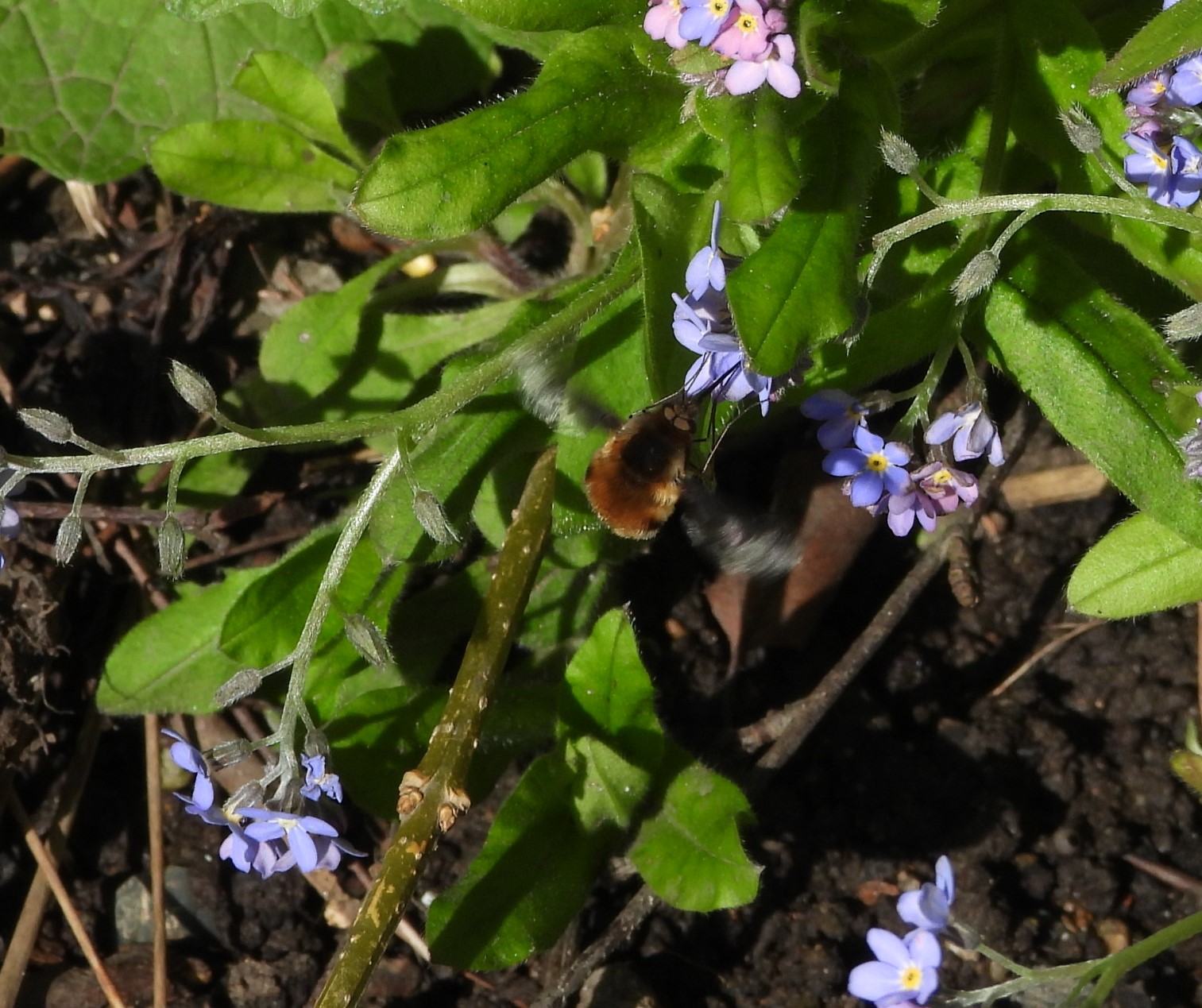
Beefly
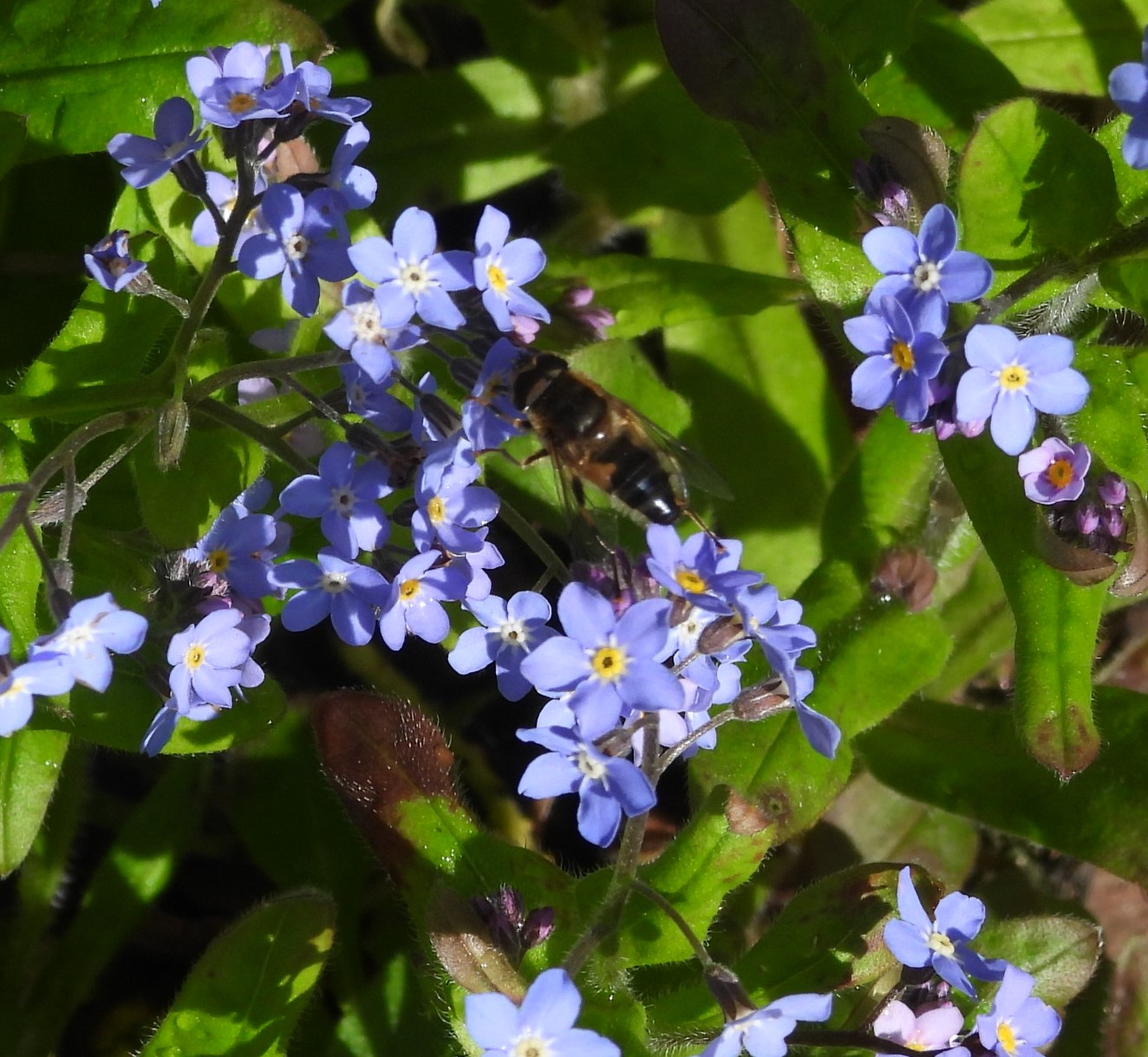
Tapered Dronefly

I think I'm right about the tapered dronefly, also having had a common dronefly to compare it with.

Then of Friday, a little rare sunshine produced a bit of a turnaround.  As well as usual visitors in the shape of tree bumblebee, common carder bee and buff-tailed bumblebee, I was particularly pleased to see a tawny mining bee on garlic mustard a couple of times.  I did think I'd seen one in the front garden last year but it was too brief a sighting to be certain.

Tawny Mining Bee

I thought I'd seen a buffish mining bee on dandelion about a week ago but the mobile phone photo was too poor to be sure but one turned up in the garden on Friday.  It is of course the most common mining bee.

Also notable was a large early bumblebee.
Buffish Mining Bee
Early Bumblebee

It is interesting to think that in spite of the overall paucity of bee species, early bumblebee has turned up more often than usual.  I reckon I've seen four already.

The obvious missing party in all this however is the red mason bee, which was around in big numbers last year when I was confident several nested in my bug hotel.  Maybe it's not checkout time yet.

Wednesday, 26 April 2023

Mainly About Bees

The first honeybees have started to show in the garden but so far no butterflies.  This is partly down to bad weather but partly because I chopped back the garlic mustard extensively last year expecting it to grow back quickly.  It hasn't and so little reason for any orange tips or green-veined whites to visit.  In fact I have only seen two orange tips so far this Spring - one from the bus at Winlaton Mill and one yesterday on the path up to the wood from Blackhall Mill.  

Honey Bee

I forgot to mention last time that I have seen a treecreeper climbing the birches at the back - about three times now - and there was a jay briefly in the trees. A greenfinch and a regular chiffchaff have been heard but not seen.

Last week I took a trip up to Edinburgh, where the weather was a good bit more favourable if a bit breezy.

I made straight for the Royal Botanic Gardens as it was known that a good number of flowers would already be in bloom.  In fact I was quite surprised to see that most of the rhododendrons were already in full bloom. 

Apart from buff-tailed bumblebee queens, there were a few carder bees around possibly including the paler form and a red-tailed bumblebee queen.  In the woodland garden, there were a few flying around a form of broom that seemed to have very white tails.

Doubling back North of the cafe, there were about 20 male hairy-footed flower bees nectaring on a plant called Munstead Blue.  Then I noticed that there was one that appeared to have an azure blue spot on its thorax.  After some effort I managed to capture it and it proved to be a small blue sticker bearing the number 12.

Hairy-footed Flower Bee
Same with sticker

How that can have happened is anybody's guess.  Maybe it had just come off the subs' bench?  Anyway it was still flying around quite happily when I visited the spot again two days later.

A visit to Malleny Garden at Balerno the next day looked less promising as there was very little that was already in bloom.  However the first tree bumblebee I have seen this year was rooting around in some undergrowth and was shortly followed by a flypast by my first comma butterfly this year.  Even better, I managed to capture this item, which proved as I had guessed to be a garden bumblebee.

Garden Bumblebee

So not at all a bad result - even though the noted doocoot was totally deserted - before I returned early to sample the entertainments of the City Centre.  Incidentally the comma was the only butterfly apart from an unidentified white I saw on the whole trip - a testament to the unfriendly weather up to now.

Here on a brief ice cream stop, I caught up with another red-tailed bumblebee nectaring on the dandelions near Princes Street.

Red-tailed Bumblebee

It looks like a male.

On my last day in Edinburgh I went back to the Royal Botanic Gardens and got into some more interesting parts of the Woodland Garden.

Here I spotted a goodish number of small bees working a flower border.  They were quite nippy and tricky to catch.  On investigation, I was surprised to find one of the bees trapped has a clear blue luminescence, which would seem to point to blue mason bee.  This is a species I've never seen before but does occur in the Edinburgh area, so I'm seeking expert confirmation.


Blue Mason Bees?


Male Blue Mason Bee?
I revisited the spot where I thought I might have seen white-tailed bumblebees two days before and managed to trap a suspect.

White-tailed Bumblebee?

Well it certainly has a white tail but I'm not entirely convinced by this not great photo.  It was bigger than the others I saw and the stripes aren't unambiguously 'lemony'.  My field guide says sometimes best to record them as bombus locurum agg, i.e. not too sure.

Lastly, I was quite amused on my way back to the guest house by the antics of this crow by the Water of Leith. It has obviously learned to pan for insects in the shallows as well as to ignore the anguished cries of owners of disobedient dogs.


Sunday, 5 June 2022

Up in The Highlands 1

 After several attempts, I managed to catch up with a male orange tip visiting the garden - actually a notably small specimen, suggesting it hasn't been feeding well.

Orange Tip

This may however be one of the last orange tips to visit as I have started clearing out the garlic mustard, which had become far too dominant and was starting to die off anyway.

Last weekend I was on a nature break in the Highlands with Alex and Vicki.  We started with a full day at a location known for eagles and managed a few sightings, though all were at considerable distance.  Not long after entering the valley I could see an obviously large bird from the car window and did get one good sighting through the binoculars, when I managed to track a bird across the heather and could make out its tail feathers.

The rest of the day we spent trying to work out whether distant flyers were eagles or buzzards, mostly the latter, some of which may also have been kestrels but mainly to my eye buzzards that managed to hover against the breeze.  I was a bit surprised to find that the commonest bird otherwise was house martin, swooping around in large numbers in the afternoon.  Oystercatchers and gulls were also present in good numbers, as well as occasional lapwing and curlew.

It was a reasonably summer day so I undertook a couple of forages in the gorse next to the river and was pleased to find a first sighting - the bilberry bumblebee.  There was also what I think to be a moss carder bee, rather than a common carder bee.  I reckoned I saw one in Cumbria last June, but didn't get close enough to confirm.
Bilberry Bumblebee
Moss Carder Bee?

A slight doubt on the latter is that gorse isn't listed as a favoured flower.

On the second day, we took advantage of the time of year to visit Loch Ruthven during the mating season of the slavonian grebe.  This is one of the few locations for slavonian grebe and we had instant success as it was the first bird we saw.  Several pairs were clearly visible from the hide, passing through the weed. Again there were a lot of house martins swooping over the water and I think some sand martins too.

Slavonian Grebe

Our afternoon walk around the area of Loch Garten was however a disappointment.  Hoping perhaps for crested tit or crossbill variations, all we saw was a couple of siskins and chaffinches, a couple more bilberry bumblebees and lots of pine trees as well as bilberry bushes that had barely started to flower.

Here the seasons probably played to our disadvantage as we learned later that crested tits and crossbills are a good deal harder to find in the nesting season.  Loch Garten itself is known for hosting birds of prey including osprey and goshawk but it seems you're better off viewing the webcam images rather than trying to see them live.

Monday, 8 March 2021

Monday 8th March

Recent paucity of nature news can be blamed on poorish weather and continuing lockdown, hopefully better is soon to follow.

A slightly bright nore has been offered by several appearances of a male nuthatch in the garden and, on one sole occasion that of a woodpecker.  Yesterday I planted some wild flower seeds at the back of the garden as it is only now that frosty nights are starting to look less likely.  Part of the thinking here is that the copious amount of garlic mustard that used to grow in the same area hsn't yet appeared.  Maybe I was too radical when knocking it back last summer.

I've done a couple more walks in Chopwell Woods, whose main success lay in finding further routes that avoid the heavily-used car park and ice-cream van.  During the first one, there was at least some birdsong to be heard and evidence of jays in the trees, but that was all apart from a grey squirrel, the odd robin and a single wren.  Last week the second one was a return to the baffling near total absence of birds.  I can't understand it.  You'd think among so many trees there'd be treecreepers and even a crossbill or two.

One thing I did come across on the way in was a heron on nearby farmland.  This evokes the question I wondered about often in Dumfries.  Why do herons visit farmland in winter - to seek out worms and insects or because of fishmeal compost?

Heron

This one is obviously next to some flooded land but I can't imagine it would hold fish and it seems to be looking elsewhere.

More interesting was a visit with Malcolm to check out some of the lakes maintained by Wansbeck and Cramlington Angling Club during a brief warmer spell.  Walking up to Milkope Lake there were a good number of skylarks in the fields.  They were flying low in pairs rather than soaring alone and it looked like this was some sort of pre-mating activity.  On actually reaching the pond, a good number of people were fishing and catching small stuff.

On Horton Lake nearby, one elderly angler took about half an hour to land a near 6lb bream on fine pole tackle and a visit to Brenkley Lake established that it had recently produced a 19lb carp.  We've taken out membership and I hope to report on some fishing activity before the end of the month.  I had wondered if it would soon get warm enough for butterflies to be seen early but the weather quickly deteriorated over the weekend

A bike ride the Monday after started in mist temperatures of 3C rather than the anticipated 9C but at least led to the sighting of a group of tree sparrows huddling in a tree,  I was out riding again today in warmer but windy weather and did get a closer than usual view of some tufted ducks at Bradley Pond on the way home.
Tufted Ducks


Monday, 4 May 2020

Monday 4th May

One of the features of my activities is sudden and often fleeting surprises. Sometimes it's not so much the sighting as the location of the sighting that defines the surprise.

So it was no surprise to catch sight of a jay on a recent bike ride through the North end of Chopwell Woods last week but I was considerably surprised when one landed on the patio corner unit earlier this week.  In fact it was the closest view of a jay I've ever managed.

I also wouldn't be surprised to spot a marsh tit in certain locations but it certainly did surprise me when one turned up in the hedgerow of the Hadrian's Cycleway right where it passes by Leamington Centre last Friday. A good amount of mature woodland in Denton Burn nearby offered some explanation.

What they had in common was that neither hung around to pose for a photo.

Overall the good weather started to break about a week ago and butterfly sightings have become scarce, just the odd peacock, speckled wood and orange tip plus a couple of green-veined whites. Last Saturday I made the first positive sighting of a female orange tip on the garlic mustard in my garden.  On the whole the whites are still performing flypasts without coming in to land, unlike most aircraft which are doing the opposite.

This Wednesday the rains finally moved in bringing a drop in temperature and I decided to indulge in a bit of flower spotting on my last visit to the Woods before it hit. It had caught my eye that most of the things I was seeing were white.  I'm not strong on wild flowers but managed to identify the following as wood sorrel, wood ruff and (I hope I've got this right) greater stitchwort.

Riding back home from Swalwell along the old railway on Friday, I suddenly picked up a whiff of garlic and so was able to add that to the gallery as well.
Wood Sorrel
Wood Ruff
Greater Stitchwort
Wild Garlic

Thursday, 16 April 2020

Thursday 16th April

I was pleased to see that three tree sparrows spent some time feeding off the bird table yesterday, so it looks like they may become regular customers.  The bird food has been getting low during the virus crisis and I've reduced the amount I'm putting out .  I've also levened it with some leftover cumin seed but it doesn't seem to have proved popular.  Having sampled a few myself, I'm not surprised.  The taste is pretty pungent.

The garlic mustard has been shooting up and the first orange tips have been visiting, five sighted on one particularly sunny day.  It struck me that they are actually quite well camouflaged on this plant with their wings closed.
Orange Tip (wings closed)
Orange Tip (wings open)
There was also a green-veined white on one occasion.

The Garlic Mustard has also been attracting quite a few bees, including the tree bumblebee that is now one of the commonest visitors. There have also been some ressembling carder bees that have struck me as being particularly large, so I doublechecked but I think they are just common carders.
Common Carder
Tree Bumblebee
Yesterday I took my coronavirus exercise in the form of a cycle ride along the Tyne towards Newcastle. The idea was to check out how the flower meadows were developing but it was no surprise to see nothing was flowering as yet.

Around Leamington there were a few butterflies about.  At first it was annoying as none would settle so it wasn't possible to identify any, even though a couple nearly flew in my face.  Gradually it was possible to pick out the recent usual suspects - peacock and orange tip - as well as possibly a couple of other whites.

I continued on to just past Scotswood Bridge and stopped for another disappearing butterfly, when two or three sand martins started looping around in front of me.  Then, just before the stretch where the track runs down next to the main road, there was the first speckled wood of the year in the hedgerow. On the way back a couple of skylarks parachuting down to some waste land just by Scotswood. 

If I'd been looking to see any of these three things, this certainly wouldn't have been where I would have gone to do it.

Speckled Wood
On looking at it more closely, it's noticeable that the speckled wood seems darker than other examples.  I assume this is partly because it is a fresh specimen and that some of the speckles are not yet or only faintly visible.