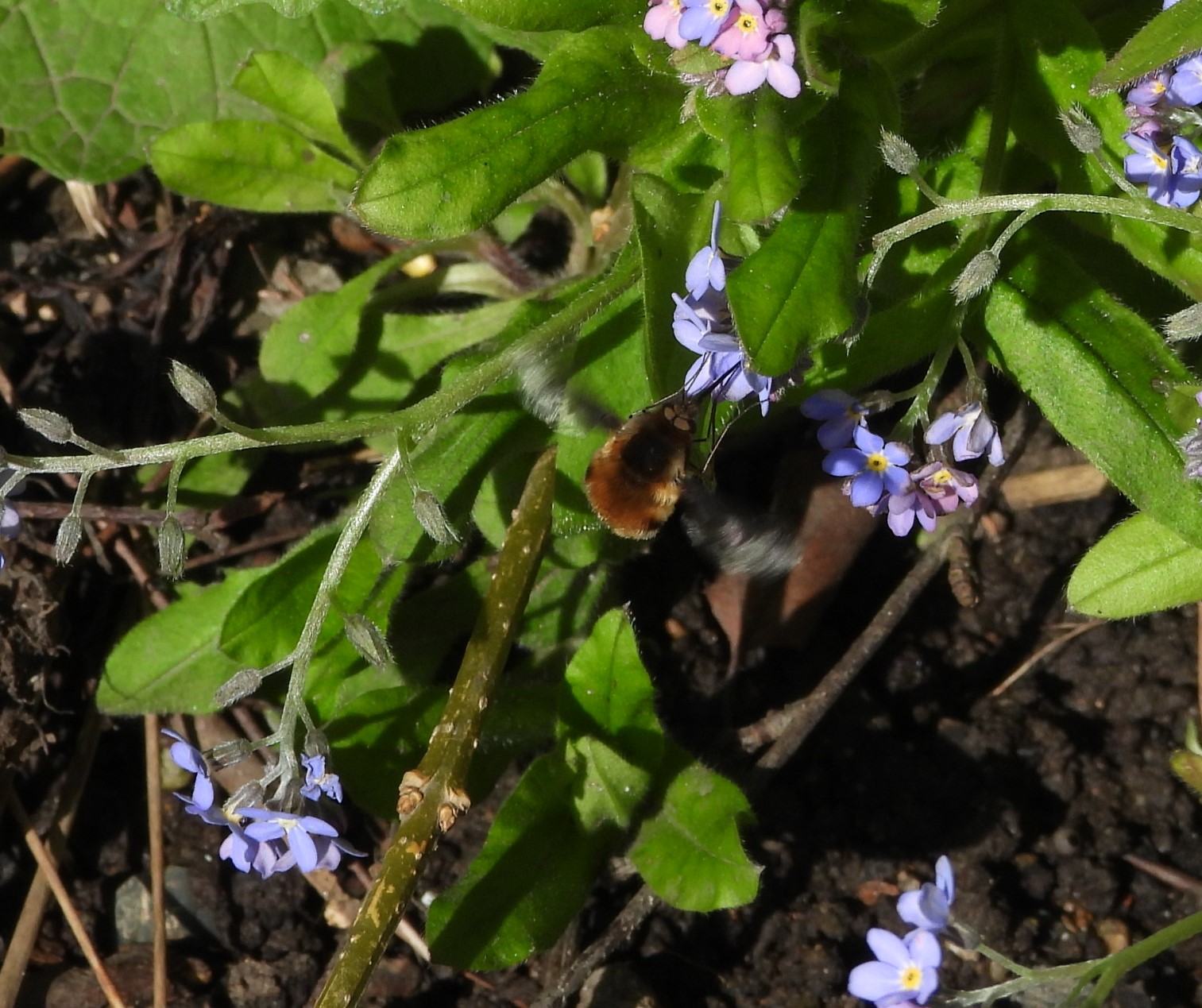
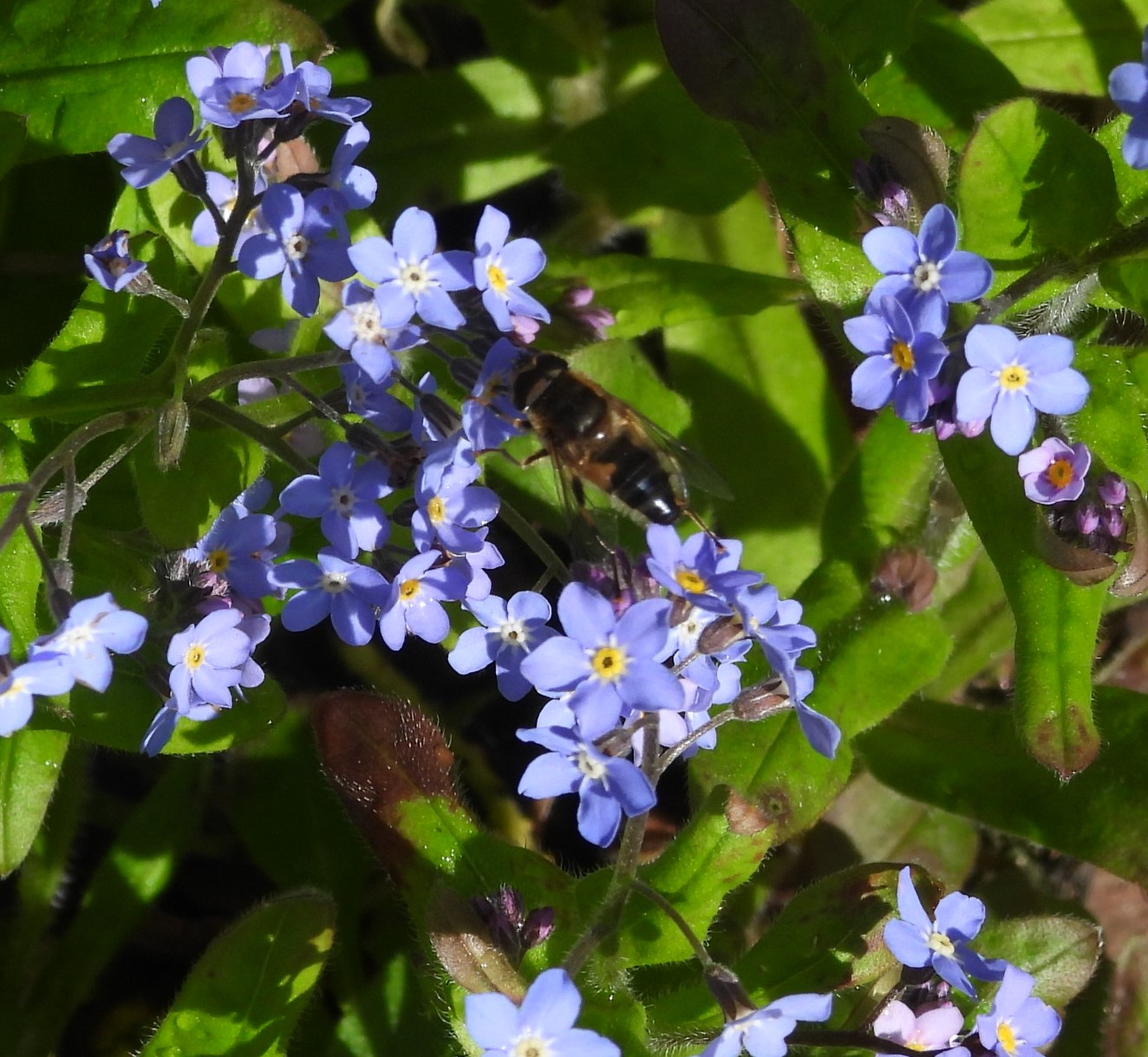
The sun has been out and the sightings have continued to pile up.
Last Tuesday (19th) I went to the Spetchells, partly hoping that the buffish mining bees wouldn't be out in force enabling me to search for other species such as ashy or tawny mining bees. In fact they were out in their usual tens of thousands making it hard to concentrate on much else and Gooden's Nomad Bee was again the only non-bumblebee seen. Both were up to their usual tricks.
Buffish Mining Bees
Gooden's Nomad Bee
In fact the main other species of note were a nice small tortoiseshell and the first speckled wood I have seen, which meandered out of some woodland when I was on my way back to the bike.
Small Tortoiseshell
Speckled Wood
As suspected after seeing a few males last week, female orange tips started visiting the garlic mustard crop on my back fence, annoyingly flying off again as soon as the camera was ready to fire. By contrast the first comma of the season to visit, much earlier than last year, hung around for a good few minutes.
Comma
But sightings and my knowledge frontier really took off on Saturday when I went on a bee and hoverfly walk with the Natural History Society of Northumbria at Morpeth.
I knew there was a possibility of seeing a tawny mining bee but it was a bit of a surprise to find one running the line at Morpeth Rugby Club before we had even set off on the walk!
Tawny Mining Bee
Although my expertise was considerably outshone by others in the group, I can take credit for seeing the first bee after we set out - a species I'd never heard of before Saturday, the hawthorn mining bee. I was also the first to identify a cuckoo bee crawling around some undergrowth that turned out to be a vestal cuckoo bumblebee. In the meantime, a rather nice looking wee blood bee had turned up. Apparently it's tricky to be sure about precisely which kind of blood bee it was as there are many varieties.
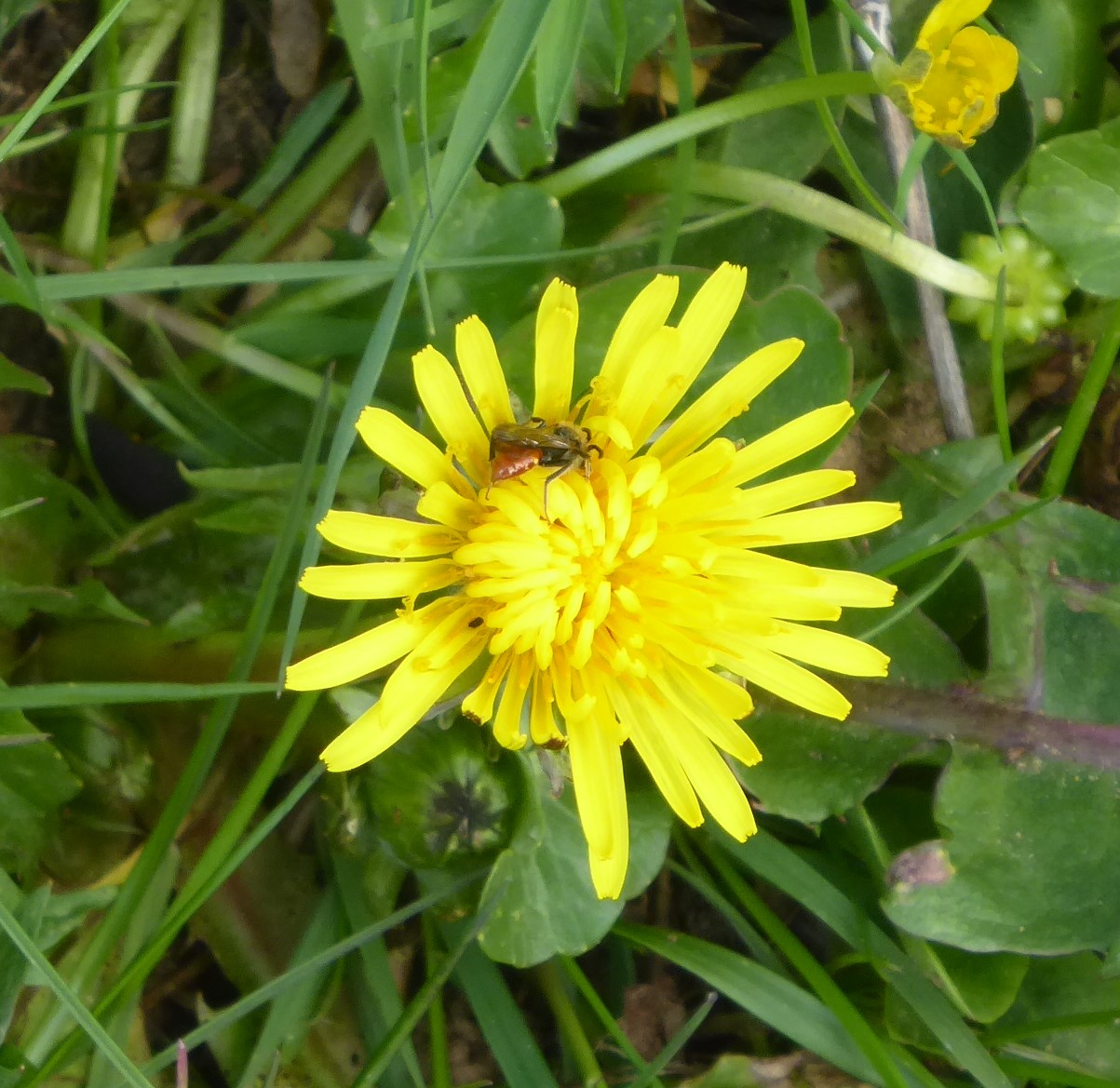
Blood Bee
However our most spectacular sighting was a fly, Ferdinandea cuprea, identified confidently by our leader Mark as only having been recorded in Northumberland on five previous occasions. I don't do flies other than bee imitators but collected the evidence nevertheless:
Ferdinandea cuprea
By contrast this cream spot ladybird is apparently our most common UK lady bird species. I must say I had no idea of this. Perhaps I should get more interested in spotting ladybirds though it does seem to involve a lot of crawling around in the undergrowth.
Cream Spot Ladybird
Perhaps it was the next sighting that got me thinking the most. I'm sure I read somewhere that there are only two nomad bees occurring in the North East - Gooden's and Marsham's - but this one was identified as a Lathbury's Nomad Bee:
Lathbury's Nomad Bee
A bit hard to see but there is a definite red stripe at the top of the abdomen.
Louise who spotted it says there are definitely five species of nomad bee in the North East and this has got me thinking that the one I've been seeing in the garden may not be a Gooden's as I have tended to assume. I must get a closer look at it when the sun comes out again.
Another nice sighting was an early bumblebee queen, the first I've seen this year:
Early Bumblebee Queen
And another I'd never even heard of let alone seen before was the sandpit mining bee.
Sandpit Mining Bees
There's a clear lesson to be taken from this - it's amazing what you can see on a half mile walk, especially when you're with people who know what they're talking about!
I seem to remember I did a post in April a couple of years ago entitled "Loads of Bees." Well the ongoing cold and damp spell has met that the exact reverse has been true and only now looks likely to improve.
There was a single small tortoiseshell on a group bike ride up the coast (cut short due to muddy conditions) but the only sighting in the garden has been a single red admiral fly past several weeks ago. Elsewhere there was one unidentified white by the Tyne on Saturday and that's all.
Apart from the odd honey bee, bees have fared scarcely any better and this all in spite of forget-me-nots being in full flower and a reasonable recovery by the garlic mustard, which seems a pity.
Up until Friday last week all I had seen worth noting was a queen wasp which took up brief residence in the summer house and a couple of visits from bee imitators.
Queen Wasp
Beefly
Tapered Dronefly
I think I'm right about the tapered dronefly, also having had a common dronefly to compare it with.
Then of Friday, a little rare sunshine produced a bit of a turnaround. As well as usual visitors in the shape of tree bumblebee, common carder bee and buff-tailed bumblebee, I was particularly pleased to see a tawny mining bee on garlic mustard a couple of times. I did think I'd seen one in the front garden last year but it was too brief a sighting to be certain.
Tawny Mining Bee
I thought I'd seen a buffish mining bee on dandelion about a week ago but the mobile phone photo was too poor to be sure but one turned up in the garden on Friday. It is of course the most common mining bee.
Also notable was a large early bumblebee.
Buffish Mining Bee
Early Bumblebee
It is interesting to think that in spite of the overall paucity of bee species, early bumblebee has turned up more often than usual. I reckon I've seen four already.
The obvious missing party in all this however is the red mason bee, which was around in big numbers last year when I was confident several nested in my bug hotel. Maybe it's not checkout time yet.
A fellow member from the Prudhoe U3A Naturewatch group thinks that the speckled wood I saw last week (see previous post) may have been variant specimen. I did consider this possibility on writing the entry but dismissed it as far-fetched.
As it happens I saw my second speckled wood of the year on a bike/hike trip to the Spetchells two days ago.
Somewhat More Speckled Wood
Here we can see that, while the speckles are pretty much 'out', some are still not as clear as the others. Assuming this one has been on the wing slightly longer than last week's, I'm still inclined to think that it's a case of more colour showing up with wear as happens with some bird species. It would be nice to see what an expert says though.
The main reason I went to the Spetchells was in the hope of seeing an ashy mining bee as I've started doing a bit of bee recording for the North East Bee Hunt There weren't any but there were rather lot of buffish mining bees...
It was like that pretty much everywhere, including the odd one that landed on my scruffy trainers. They weren't aggressive except towards the odd buff-tailed bumblebee that occasionally turned up. I'm glad I didn't have to count them as my nearest estimate would have been in the range 10,000 - 1,000,000!
On the way back I also finally managed to get a snap of one of this year's chiffchaffs in full song.
Chiffchaff singing chiff-chaff
The same thing happened last year. I heard loads before I actually saw one to photograph.
There were also a few butterflies by the Tyne, including one small tortoiseshell where I saw several last August.
In the garden, there have been one or two tree sparrow appearances plus also a lot of orange tips and the odd peacock and a few other whites that tantalisingly won't settle. It's also clear that the dunnocks have mated successfully and I suspect a pair of blackbirds have too, having several times seen the male entering a gap in the conifer hedge looking somewhat furtive.
This week was forecast to bring steady rain. In fact it only arrived in bucket loads over the past couple of days and in the meanwhile the sun got out often enough for continued appearances by red admiral, peacock, small tortoiseshell, comma, (mainly) large and small whites. A couple more queen bumblebees turned up, this time buff-tailed, and the pellucid fly made another appearance.
Last Saturday I glimpsed a large moth joining the diners on the buddleia. It appeared briefly for the next couple of days and looked very much like a humming bird hawk-moth. When I got the camera out the last day, it was nectaring on the wing and not settling on the flowers, so attempted photos were not much helpful. However it was possible to be confident of the identification on the basis of the orangey-brown wing colour and body shape alone.
In the end I attempted a video, which also captured one of the whites by chance:
I think I read somewhere that hummingbird hawk-moths have been commoner than usual this year.
It looks like we may have drier weather again soon, so hopefully there will be a few more butterflies and bees to brighten up the day.