Showing posts with label goldeneye. Show all posts

Monday, 23 February 2026

Win some and lose some...

I took the opportunity to try some birdwatching with AMG in North Northumberland yesterday, the weather being not totally sodden if windy.

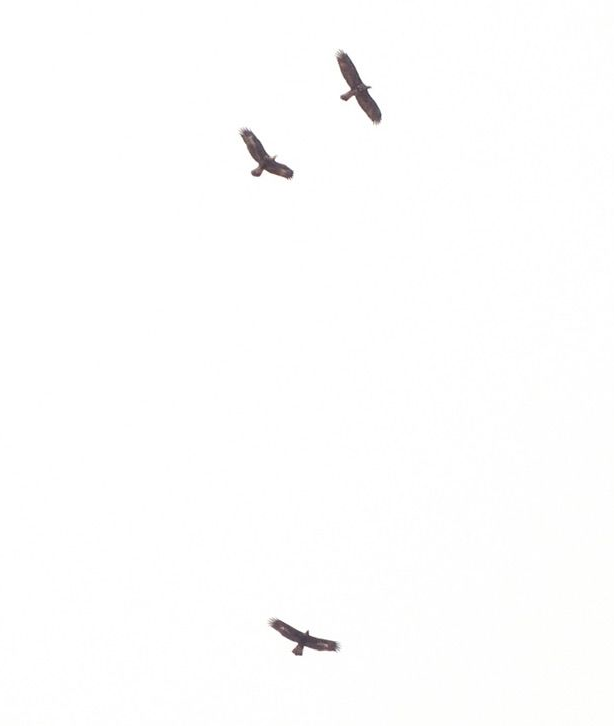
The main targets in mind were a juvenile white-tailed eagle that had been patrolling up and down the coastline and a flock of white-fronted geese on the estuary at Alnmouth.

We started with the latter, which were not to be found.  Instead there was a large number of wigeon - probably over 100 - and a lone curlew patrolling the mudflats.

Wigeon

Curlew

I knew that the eagle had appeared a good deal further South at Holywell Pond. As a firecrest and some yellow-browed warblers had been seen not far away in the Whitley Bay area, it looked like we should have headed South rather than North... 

I hoped it would return to where it was first seen - East Chevington Reserve where there are also marsh harriers, but we received the news on arrival that it had headed further South still into Durham.

However consolation was on hand as a red-necked grebe was reported on the main lake.

First we checked a flock of geese in one of the fields, which all turned out to be greylags.  I looked to see if there were any pink-footed geese but couldn't find any.

Greylag Geese

Hurrying along to the South Hide, it was indeed possible to spot the red-necked grebe but a bit difficult to photograph as it spent mmost of the time with its head tucked in. Never mind, this was a first ever sighting for me.

Red-necked Grebe

You can just about make out a hint of red as it starts to change to summer plumage.  

There were also a couple of goldeneye and, on moving to an observation platform a view of what were taken to be more curlew paddling just off a small island.

For some reason I mentioned as we left that whimbrel are similar to curlew. and on checking the photos I did start to wonder if several of them were indeed whimbrel.

Goldeneye


Curlew or Whimbrel?

It's difficult to tell in a shot at such distance but they do look a little pale and slender and there seemed to be the hint of an eye stripe on one or two birds.

Monday, 16 February 2026

A Minor Breakthrough

Things have been pretty quiet still - until yesterday.

Last week I had some time on the way back from Matfen on a bike ride, so I did a diversion via Whittle Dene Reservoir in the hope of seeing a little owl, though the few minutes I spent there meant there was little realistic chance of success.  I spent longer at Wylam to check for early run salmon at the fish pass but the river was full and the current possibly too strong for them to take it on.

Then yesterday i took advantage of the next spell of reasonable weather to follow up reported sightings of a slavonian grebe at Killingworth Lake.  As ever there was plenty of activity at the car park end where the ducks get fed and as I moved round anticlockwise I got good sightings of tufted duck (always a favourite) and goldeneye (one single male and a pair) and eventually a great-crested grebe.

Tufted Duck
Great Crested Grebe

Male and female Goldeneye

Eventually, I got to the far end of the lake where the slavonian grebe was said to be, only to be told by a twitcher that I'd missed it by about two minutes...

So I started foraging along the bankside, only to find a couple of greylag geese sailing along.

Greylag Goose

Then, on doubling back to where it had been first seen, there it was again! It seemed perfectly at ease and at times came within a few yards of the bank where we were taking repeated photos, paddling strongly and diving now and again for tiddlers.  It wasn't a first sighting as we encountered several breeding on a loch near Findhorn when I was there with V&A - but I certainly would not have expected to see one at Killingworth Lake. I was also surprised that there was only one of them and still in winter plumage.

Slavonian Grebe...
...in close-up

The above shots were taken when it got close to.  You can even see the drops of water on its back from diving.

Buoyed by success, I decided to try my luck at Clara Vale hide, where a green woodpecker had been seen a few days back.  A young lad was there already and said that though he had occasionally seen the green woodpecker, it had been an extremely quiet day with no notable sightings.

But as he was speaking, he caught a partial view of a little egret the other side of the island. Sure enough, it emerged briefly to allow a few photos before being frightened off, probably by some playing squirrels.

Little Egret

I think you can just about still see a fish in its beak.

Then it began to rain and we downed tools.

Meanwhile, there have been sightings of a white-tailed eagle at East Chevington. I ignored them at first, thinking it was probably a juvenile seeking territory and would move on quickly.  However it seems it has stayed on for at least a few days...

Monday, 6 November 2023

Mission Accomplished

It's a pity the weather in the middle weeks of October was so rubbish as one of my junior buddleia bushes actually produced a couple of decent sprigs during that period that could potentially have attracted a late butterfly or two.

Buddleia - the last blooms

Anyway persistent rain meant it wasn't to be.  The last butterfly I saw passed over the car park at Washington Sports Centre on 20th October.  It was brown so presumably a small tortoiseshell or comma, I couldn't tell.

One nice surprise was however a visit from a tree sparrow to the reduced offerings in the feeders.  Not a rare but nevertheless an infrequent occurrence.

Tree Sparrow

As you can maybe tell, it proved to be a bit of a poser.

After various postponements, we decided that the monsoon season was finally over at the weekend and I drove over to Alex and Vicki's for a visit to the massive reed bed on the River Tay between Port Allen and Errol.  The key target, the bearded tit, is supposed to inhabit the area but we didn't really rate the chances of success.  In particular I reckoned bearded tits might not fancy the extreme cold that can be experienced north of the Firth of Forth.  In fact it turned out to be a lovely day.  The trees were at their most colourful and bathed in sunshine.

After a fleeting encounter with a red squirrel, Vicki thought she heard some bearded tits. Then, on a pathway out through the reeds, we hit gold.  I saw one straight away but wasn't totally sure.  A twitcher turned up, himself sporting a magnificent russet beard, and soon they - the tits - were all over the place, at least a good few dozen of them.

We were snapping away busily as they mostly didn't stay in the same place for long.  And I was quite pleased that I even managed a couple of videos with my fancy new camera.

Bearded Tits

I realise there may have been some unconscious gender bias going on there as I seem to have zoomed in on the males, so here in the interests of balance are a couple of shots of the females.
Female Bearded Tit
Female Bearded Tit?

As you can see and maybe would have expected, they are clean shaven.  We did wonder though whether the second one might be a juvenile.  It was the first time I have seen bearded tits since I visited Minsmere 12 years ago.

After a most pleasant session and no sign of a marsh harrier, we gave ourselves the 'job done' sticker,  and spurning the chance to pursue a mandarin duck at Scone, we headed south for Loch Leven.

This was actually a good deal less rewarding as there wasn't too much going on in the first hide we visited and by the time we got to the second hide, the light was getting tricky so that I, at least found it tricky to see the colouration of the ducks.

In fact the best shots I got weren't of ducks at all:
Stonechat
Little Egret

The others we observed were a lot of coots, some teal, wigeon and a few goldeneye.  

I was a bit disappointed not to see any pink footed geese as there had been plenty around but days earlier and, on trying to perform alchemy on some distant greylags with the camera, I can now see that I actually captured a few whooper swans even further away.  The shot is unfortunately too blurry to publish - even on here!

Otherwise I did dryly remark that there was more wildlife on the steps going down to the trails - which you actually can't see on descending them.

The wildlife steps

Another visual did however catch my interest though.  It was a sign on the butterflies and moths present, which included a picture of a small blue.  Clearly a strong case for a revisit one summer...

There's an interesting sequel to our trip of a non-nature variety.  As we got ready to go home from Loch Leven, I wanted to check a couple of sightings on my mobile phone and discovered to my horror that I no longer had it. Vicki and Alex phoned it several times and got a ringing tone and I realised I had probably lost it somewhere on the woodland trail by the Tay earlier.

As we drove back there frantically to beat the dusk, Vicki got a call from Mr Huang, a (we think) Chinese tourist who'd picked it up and were able to meet him as he reached his airbnb in Errol.  Apparently he'd heard the alarm going off that I had set to remind me to text a friend.  

Bearded tits AND getting a phone back you lost on a woodland trail!  How much luckier can I get?

Tuesday, 10 October 2023

Never Give Up...

Sometimes I'm too much the pessimist.  Although we did not get the summer-like temperatures experienced in the South of England, we did get a warmer than usual murk with occasional bursts of sunshine into the high teens.  The upshot was that I called time too early on the buddleia, the largest bush suddenly producing a decent sprig of flower in its very centre over the last few days.  This managed to briefly attract a fine red admiral on the 8th October, thereby achieving a personal mini-ambition and establishing a record that may not last long in the face of climate change.

Red Admiral

Meanwhile i have a new toy, a Nikon Coolpix camera, bought especially with the idea in mind of boosting my birdwatching efforts.  The wee Panasonic Lumix I have been using is brilliant in many respects but the zoom can be slow and the focus imprecise.

Perhaps understandably the additional camera has brought some technical issues.  There was a good opportunity to try it out yesterday on a Naturewatch visit to Hauxley Nature Reserve.  As on recent visits to Hauxley nothing spectacular was sighted, which didn't trouble me as I was mainly using it to practice my camera skills.

It was therefore disturbing to note that I had difficulty in seeing much through the viewfinder and when focussing on distant birds.  I started to wonder if I was going to get any usable shots at all.  Anyway I persevered and  managed to solve the focussing issue after a bit.

Here is a gallery of the results:
Coal Tit
Bullfinches with Goldfinch
Chaffinch
Shoveler
Goldeneye
Grey Heron
Mallard
Mallow

Obviously the coal tit was taken in the garden and added as my first ever attempt. 

It wasn't until I got home before I solved how to resolve the dim viewfinder.  Easy enough when you know how but with 308 pages of user manual as well as a very intricate looking piece of photo processing software, it could be a long learning curve!

Tuesday, 3 October 2023

Surprise and Disappointment

 As expected the buddleia hasn't lasted into October well enough to have much chance of attracting further butterflies, as just two or three reasonable sprigs remain.  The last red admiral to visit was sighted on 24th September.  Perhaps surprisingly though, the penultimate visitor on the 21st was a one-off comma.

Comma

Holly blue sightings did manage to rise by one, making a presumed final total of 14.

On Friday I finally got round to manage a planned visit to Hammerlands at Moffat (now apparently The Green Frog) to see if I could catch a trout on my father's old fly fishing gear.  Unfortunately most of the lake was heavily weeded and I didn't catch anything - and neither did the other two visitors on the day.  I did however manage to see some hefty looking trout but most were moving around at considerable speed and seemed disinterested in any offerings.

Staying over with my son in Crawford, we then got out for a birdwatching trip to Lochwinnoch RSPB  that proved my theory that you will often see nothing interesting until you are on the point of giving up.

Although it was a pleasant walk, there wasn't that much birdlife around, the main items noted being shoveler, heron and long-tailed tit plus some distant views of goldeneye.

Goldeneye

One interesting section was the boardwalk to the Peel Tower, where there was an abundance of himalayan balsam.  We noted several bees and wasps nectaring on it, all of which seemed to have white markings on the thorax.  I wondered if the first one we saw was a rare bee or if some kind of disease was prevalent.  We eventually concluded that it was in fact pollen from the balsam as it affected all of them, including honey bee, carder bee and buff-tailed bumblebee.  Attempts to photograph it were  in vain as the marking simply doesn't show up well.  This was my best attempt:

Buff-tailed Bumblebee

On a nearby lake, we did manage to add great-crested grebe and tufted duck to the list for the day.
Tufted Duck
Great Crested Grebe

Giving up on further sightings, we headed for Lanark where we bought fish and chips, which we decided to eat at Lanark Loch, mainly because it is a known carp venue.

Leaving binoculars and cameras in the car, we found a bench near the water and opened up the chips.  It was no surprise when a couple of swans came over but they were then followed by up to 20 gulls we couldn't immediately identify.  It turned out they were bonaparte's gulls, an occasional migrant from North America.  Fortunately, Vicki managed to record this first ever sighting for me on her mobile phone.

Bonaparte's Gull

Tuesday, 28 March 2023

Exciting Springtime Sightings

 Starting with a bit of bad news, I found this dead great tit in the garden last week.  

Great Tit
I sort of assumed that it had crashed into the summerhouse, but on inspection it seemed to have a wound on its upper breast so maybe got nobbled by something.

Yesterday, I went on the first big trip of the year with son and fiancee to Leighton Moss, which provided a sufficient parade of sightings to justify even the £9 entry fee for non-RSPB members.

We saw a good number of marsh harriers flying at considerable height, which surprised me a bit.  On previous occasions in the Netherlands and at Leighton Moss before, I'd been used to seeing them flying low looking for prey.  Often they were in groups of two or more so I supposed that it was some sort of pre-mating routine, disturbed by occasional buzzards.  Anyway, I was delighted to get a photo of one in flight with my pocket camera, even though it wasn't brilliant.

Although we didn't manage to see one, we did hear numerous bitterns booming, which was a first time for me.  I must say 'booming' is a bit of a misnomer.  As one of the signs pointed out, it sounds much more like someone blowing over the top of an old-fashioned glass milk bottle.

Also not seen was the bearded tit.  We hadn't really expected them to show at this time of year although apparently they are still around.

One bird that is present is the ring-necked duck and I thought I might have seen one at distance from the tower.  In fact it proved to be just another tufted duck.

Shortly afterwards, heading for lunch I spotted some small red fungi next to the path.  I think they are called scarlet elf cups.

At the last hide we visited there was a view over several bits of land sticking out into the water, surrounded by various ducks.  A group of twitchers reckoned there was a water pipit working its way along one of them.  Unfortunately, try as we might, we couldn't confirm or deny it as a sighting as the photos we took of the wee bird were all too blurry.  Apparently it had been identified earlier by someone using a powerful telescope, so presumably correctly.

Overall, there were just too many photos to post individually, so I've amalgamated them together in  brief video.  Unfortunately there is no background music as that now costs extra from Microsoft!


Wednesday, 15 February 2023

Variety is the Spice...

By chance I managed two trips out in two days.

Last Sunday I was at Geltsdale with my son and his fiancee.  Unfortunately there was only a light breeze but we did manage to see a few birds of prey, notably several kestrel, one of which I thought might have been a sparrow hawk and a single buzzard as well as canada geese, lapwing, curlew and a stonechat.  Snowdrops are now out and there was a nice wee bunch near the RSPB Visitor Centre.

Snowdrops

The day after I was on a Naturewatch trip to Big Waters, which produced a pleasing variety of species, without turning up any major rarities.

As well as tufted duck and a couple of great crested grebe debating whether the mating season has started, there was a good head of lapwing on the stony island.

Lapwing

There were several teal around and one showed nicely on a sail past.

Teal

Further round we also caught up with wigeon, pochard and goldeneye.
Goldeneye
Wigeon
Pochard
Around the Western hide there were no snipe or water rail this time but several finches on the feeders and a pair of reed buntings, the female of which had a brownish head that kept us guessing for a while.

Reed Bunting

On the way to tennis today, I had a little time to spare at the weir on the Derwent and noticed some more teal that were standing and sliding around in the fast water by the fish run.  They appeared to be feeding on grubs in the newly-formed streamer weed.

On the way back there was also a pair of goosander diving away.  Usually all you see there is  couple of mallard and maybe a heron.

Sunday, 5 June 2022

Up in the Highlands 2

On day three we returned for some more eagle spotting.  By now the weather, which had gradually become cooler was distinctly chilly and we spent an hour snoozing in the car when it got heavy.

The cool turn had a decided effect on the chances of seeing butterflies and during the whole trip all we saw was half a dozen ambient whites and a single orange tip.

From the point of view of eagles, it was pretty much business as day one i.e. occasional distant and often uncertain sightings.  Overall we managed around half a dozen firm sightings over the two days and did not manage to convince ourselves that any of them were white-tailed rather than golden eagles.

However there was good compensation in the form of a variety of other species.  There was already some action on the way along the valley when I spotted a chaffinch-coloured bird flying over the road.  Rather baffled by its definite white rump, I eventually worked out it was probably a juvenile bullfinch.  More puzzling was what appeared to be a blackbird with pronounced white flashes on both upper wings and I haven't worked that one out at all.  Another flypast was a female redstart - a pleasant surprise as their distribution in the area is somewhat sparse.

On arrival at the parking area, Vicki spotted a golden plover with chicks by the nearby woods, so I took a wander back to see if I could find them.  I spotted a swallow on the telegraph wires, at which point a female mallard emerged from the roadside undergrowth and scuttled off at pace through the woods towards a nearby stream.

I noticed some movement by the water and decided to investigate.  As I approached two ducks fled downstream, each followed by a number of chicks.  I assumed they were mallards but having seen the photograph I managed to get, I'm not so sure about the second group.  In fact I wouldn't like to say what they are. Possible candidates might be gadwall (not common in Highlands) or female and young goldeneye.

Duck with chicks

As you can just see, they were also accompanied by a sand martin, one of a large number of hirondelles flying over the water at speed.

Back on the eagle spot, there was what looked like a merlin perched on the craggy rocks high behind us. Photos taken weren't entirely convincing but the fast, direct flight when it moved off persuaded me it wasn't a kestrel.  

The presence of swallows was confirmed when a couple perched on a nearby bridge for several minutes.  It's not often they are near enough long enough to see the red face and neck.

Swallow

Less conspicuously, a grey wagtail turned up several times during the day.

Grey Wagtail

Vicki took a little walk upstream towards an area of trees where ring ouzels are said to appear.  I had tried the same area on day one without success but, staying nearer the river, she managed to snap a tree pipit right on the edge of the riverbank.

We also saw red deer on several occasions and I got a glimpse of a mountain hare, but no mountain goats.

In spite of a late change of location to an area where white eagles can occur, we did not manage anything as spectacular as this photo Vicki took she and Alex visited in April:

Golden Eagles


Saturday, 5 February 2022

Out for the Ducks

Last weekend during the storms I was convinced I'd seen a white butterfly flattering past my front hedge.  The temperature was 11C but there is no evidence to suggest any whites appear in January so I guess it must have been a leaf.  There have been no surprises on the feeders apart from a female nuthatch turning up on the suet nuggets.  Nuthatches have not been seen here for a while.

One thing that did "turn up" was an explanation for the burrowings in my plant pots and for the fact I occasionally find an acorn or an oak sapling in them.

Grey Squirrel

Malcolm and I decided on a walk from Amble Dunes to East Chevington, which should have produced more interesting bird sightings.  The main thing saw was this dead ray, which I think may be a cuckoo ray although rays are not exactly a speciality with me and the spots have faded.  

Cuckoo Ray

I was expecting a lot of stonechats at least but all we actually got was a heron just south of Druridge, a couple of passing goldeneye as East Chevington Pond and some usual wader suspects as the tide went down on the way back.  

However I was pleased to manage as much as nine miles with the aid of my long-neglected walking sticks and very much enjoyed the concluding ice cream at Amble!

A recent bike ride only produced some audible skylarks and a fleeting bullfinch.

Sometimes the answer lies nearer home and a quickish visit to Killingworth Lake to check out the ducks yesterday proved more successful.  The main interest was reports of scaup and I did manage to see a few although it was hard to distinguish between the juveniles and the many young tufted ducks.  It was also nice to see some pochard again and get a close-up of a male goldeneye.
Pochard
Goldeneye
Scaup

At Killingworth the gulls, ducks, geese and swans are often found close to the bank at the West end because of the number of people who feed them.  Whether this is a good idea is another thing.