Showing posts with label kestrel. Show all posts

Thursday, 9 April 2026

Madeira Day 1

This year's attempt to hasten the arrival of Spring was a holiday in Madeira from 30th March to 6th April. It was fortunate that I planned for the whole week as the original Day 1 turned into Day 0 after heavy winds forced a detour and overnight stay in Fuertaventura (Canary Islands) only arriving at my designated hotel one day late at 4.00 pm. There was just time for a quick walk to find a speckled wood butterfly - which turned to be the first of several hundred during the week.

Fortunately I had nothing planned until a birdwatching tour the next day.

This required getting up at dawn to catch the bus to Funchal.  I don't really do sunrises and scenery but the view over Cabo Girao was quite impressive.

Madeiran Sunrise

After a quick breakfast I had time to take a quick look in the Municipal Park, where I was impressed by the brightly-coloured flowers produced overhead by some of the trees.  There was also a waterfall catching the low sun to show a small rainbow. 

Colourful Tree

Waterfall

The birdwatching took place to the East of Funchal.  On the coast nearby we found several of the noted trocaz pigeons, the nearest of which never fully emerged from the cacti, and a sample of the local kestrels.

Trocaz Pigeon
Kestrel

However the star turn was this Atlantic Canary, singing its heart out:

Atlantic Canary

Just a pity I thought it wasn't going to!.. Apparently this is the forerunner of the domesticated canary.

A brief visit to a levada near Camacha produced a good number of madeiran firecrest sightings as well as some madeiran chaffinches.

Firecrest

On some examples the crest on the Madeiran version is quite spectacular.  Gere you can't see it at all.

Then it was back to a rugged piece of coast near Canico where I was pleased to get my first sighting of a clouded yellow this year.

Clouded Yellow

This was also a known location for spectacled warbler, which I was keen to see as I only heard them on  a previous trip to France in 2015  Unfortunately it proved to be tricky as they were plentiful but weaving in and out of the undergrowth and I was cursing myself for not having brought the lens hood for my camera as it was hard to focus in the bright and windy conditions.  After some patience (others' as well as my own) I did manage to get a fairly acceptable shot.

Spectacled Warbler

You can actually see it has a bit of nesting material in its mouth.

There was also a brief distant sighting of bertholets pipit - another first for me - as well as of a couple of hoopoe.

After the tour I got dropped off at the Parque de Santa Catarina on the promise of a sedge warbler on the island, for which however I had no interest.  By now the wall lizards were out and about and there were a couple of the larger examples quickly apparent as soon as I reached the lake.

Wall Lizards

The slightly smaller one however is technically still a juvenile as it retains a stripe on the upper body.

I was to learn in coming days that the appearance of wall lizards signifies that butterflies may be around.  Just after I saw them I noticed that a monarch butterfly - one of my key targets - was fluttering past the island on the left hand side of the lake.  Anyway I decided (rather coolly, I thought) to snap the lizards and meet the monarch when it reached the other side of the lake.

This duly occurred but it refused to settle until I pursued it into a children's play park, when it did settle high up in a bush. I focused on the exact branch and took the shots, only to find later that they did not show the butterfly.  No idea what happened there.  The only other thing I saw on going round the lake was a bunch of very lazy muscovy ducks snoozing under a tree.

Muscovy Ducks

I then decided to return to the Municipal Garden as I'd noted that the wee restaurant had scabbard fish on the menu.  There was some time to sit around and observe during which I spotted a red admiral and this interesting looking hoverfly - later identified on iNaturalist as an epauletted hoverfly

Epauletted Hoverfly

The even better surprise came when another monarch turned up and posed reliably on a flower bed near some teenage girls.
Monarch - upperwing
Monarch - underwing

Overall, a pretty successful day.

Sunday, 22 March 2026

Win some, lose some...

The siskins have continued to visit the garden.  I thought it was just a pair and so was quite surprised this week to see four of them on a feeder.  One couple however fled before my attempt to record the moment.

Also visiting, apart from a few two- and seven-spot ladybirds, have been a number of buff-tailed bumblebee queens prospecting the garden for possible nesting sights.  They were really tricky to photograph as they were either on the move or ferreting around in the undergrowth.  I thought I was about to nail it when one of them disappeared down a crevice in the decking.  I must have waited three or four minutes for it to come back into shot, which it never did.  So either it escaped by another route without me noticing or hearing, or I can expect a bumblebee nest in my decking...

In the end I had to make do with a brief video of one visitor:

Buff-tailed Bumblebee Queen

Also heard but not seen in the garden and nearby have been a few chiffchaff.

Yesterday I was out for a walk at Geltsdale with V&A together with recent arrival E, who managed to sleep through the proceedings uninterrupted.

I soon saw a curlew on approaching the car park and found a couple of stonechat on arrival.  Eventually we headed South nominally hoping to happen upon a whinchat but without much conviction.  Instead we came across numerous chaffinches and a reed bunting pair.

Stonechat
Reed Bunting
Further sightings overhead were a couple of kestrel mobbing a buzzard and a possible pink-footed goose.

The weather was quite warm so there were also a couple of butterfly sightings - both peacocks.

Having covered the likely whinchat area, we set off back via the former quarry where short-eared owls have been turning up.  We were probably an hour or two too early to be successful.  Instead there were several lapwing and on the way a very distant roe deer

Lapwing
Roe Deer

The lapwing seemed to be on the verge of proving a display flight but never quite went through with it. 

I always think the rockier sides of the quarry area look good for peregrine falcon, who would be due to nest about now, but none were seen.

On the way back we did however meet up with a decent flock of fieldfare.  They saw us and kept on the move.  Distracted by another bumblebee queen, I missed the best chance of a photo. They can't be with us for much longer this year.

Yesterday I had planned to head West to Parkhead on the bike, but the cycle path was closed and I didn't fancy the proposed hilly detour.  Instead I took a more casual trundle along the banks of the Derwent, which did produce a couple of active goosander. 

Goosander

Returning by the Tyne was less productive apart from a couple of cormorants and a brief check at the hide at Clara Vale produced nothing of note at all.

"Win some, lose some..."

Thursday, 24 October 2024

Much ado about Sparrows

Since being mislead by the pale starlings last week, I've experienced a good bit more uncertainty - this time about sparrows.

It struck me that there was something slightly odd about a bird I thought was a sparrow. It spent a good long time sitting in the plum tree before finally feeding for a long while at the bird table - not too sparrow-like in itself.

Dunnock

It's the head pattern that troubled me, the rather dark head and white neck band and bib. Anyway google lens thinks it's a dunnock, which surprises me as there's not much flecking on the breast.  I wouldn't normally have much trouble spotting a dunnock.

I'm please to say that a female nuthatch has visited my new caged bird feeder several times over the past few days.  However it makes sure it lands so it's mainly obscured and flies off as soon as I point the camera at it.

Also still at it is the grey squirrel, so there must be more nuts buried somewhere under the lawn.

Where are my nuts?

The sparrow fixation continued when I finally got to Holy Island yesterday, on a day when people generally agreed not much was going on.

The first bird I saw was again motionless in a tree, as if resting, and appeared at first sight to have a yellowish sheen, suggesting perhaps a female yellowhammer or even an exotic warbler...  So I took more photos and tried to get closer.
Sparrow?

Sparrow

Yes, it's actually the same bird.  The yellowish tinge on the first bird is a trick of the low sunlight, the erect posture somewhat untypical and the apparently large beak an illusion.

After a quiet spell, I got another shot of a bird in a tree, largely facing away from me, wasn't sure what it was but thought "Probably sparrow."

Linnet

So google lens thought linnet - entirely possible.

There was however no mistaking the sparrows that decided to assault the remains of my coffee break.  Not many species learn to be so cheeky.

Definitely Sparrows

After the lunch/coffee break - I wasn't sure which - I got what were some quite pleasing results with the camera.

Heading towards the harbour, a call of nature diverted me to the nearby cliffs where a kestrel was hovering.  I tried to video it but it kept moving and then started hovering at more or less head height no more than five yards or so to my left.

Kestrel

So, if you like, I got a bird's eye view of a bird.

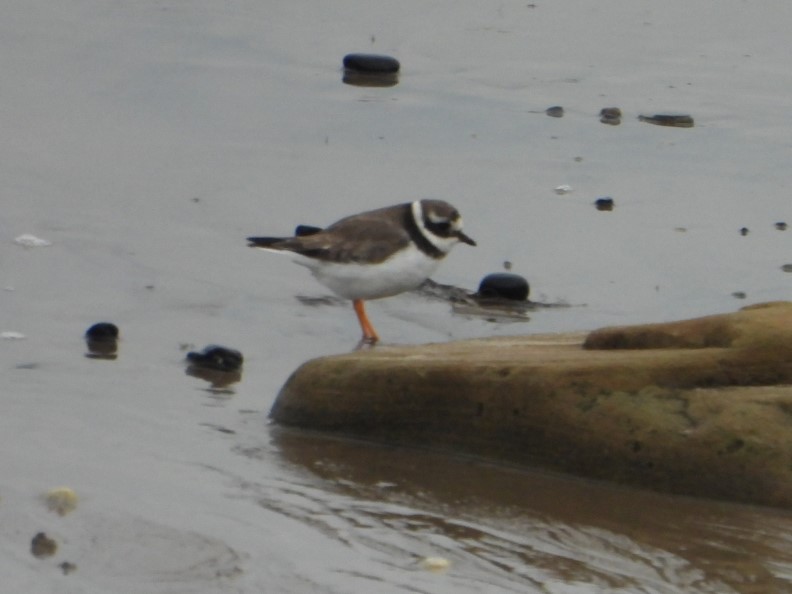
In the harbour area I caught up with another ring-necked plover and was particularly satisfied to pick out one of a pair of rock pipits from a well-camouflaged background.

Ring-necked Plover
Rock Pipit

Google lens however thinks the rock pipit is a corn bunting - oh dear, I don't think so!

But probably the best was this pale-bellied brent goose, because of how far away it was:

Brent Goose

You can't see much of the neck stripe because of its head position.  Incidentally that isn't blood in the water but the reflection of the paintwork from a nearby boat moored at the water's edge.

There was just the one.  However the chap at the crab sandwich stall (I was still hungry) reckoned there had been as many as 6,000 but most had gone inland.  Sure enough, when I ventured further towards the causeway, there were 20 or 30 more, including I think some of the dark-bellied variety.

Brent Geese

Friday, 18 October 2024

Getting Back into Birds

As the summer has faded into autumn, I've started to think more about birds.  In past years I've had some really good luck with birdwatching, which more recently has drained away.  I've increasingly suffered from bird blindness through looking down for butterflies and bees rather than scanning the skies and trees.

A week ago on Saturday, I was in Scotland to see my son and daughter in law, when we fitted in a brief trip to Baron's Haugh RSPB Reserve near Motherwell.  It was actually quite disappointing as not too much was showing - until I looked a bit more closely.

I got a quick early video of a kestrel deciding not to hover but the loch itself was pretty quiet apart from a few standards such as shoveler and lapwing.

Shoveler
Lapwing

There were a small number of waders that I reckoned at first sight to be insignificant but on closer inspection they turned out to be snipe.

Snipe

I was quite pleased about this as I've usually seen them furtively prowling through the reeds rather than in the open.

It was actually quite warm later in the afternoon and I counted four speckled wood flying around the trees.

Overall I haven't been too satisfied with the bird photographs I've taken on my new camera to date, so i asked my daughter in law for some ideas and she's adjusted some of the settings.

The first opportunity to try them out should have been last Tuesday, when I planned a trip to Holy Island to check for migrants but the weather was so appalling that I chickened out.

Instead I decided to visit Newbiggin this Tuesday, as one or two of the more rare buntings had been reported there.

As I wasn't heading for Norway, I skipped the pub and made my way instead onto Newbiggin Moor.


Last Pub before Norway

Working my way up the coastal path, I took opportunities to try out some distance shots of redshank with reasonable success, when I got a slight surprise.

Surprise Plover

Now I reckon on balance this was ring-necked rather than a lesser ring-necked plover, as these should now all have departed and there was no sign of a yellow ring around the eye. It was also the only one I spotted running around the beach. 

There were a few curlew around. one politely posing well on the golf course:

Curlew

I continued along to the point where people sometimes put bird food down and caught up with a numerous flock of linnets, but nothing more special.  Starting back however, I came across a chap lying in wait for a snow bunting  he'd seen briefly.  He also mentioned that a lapland bunting sometimes mingles with the linnets.  This eventually had me scouring the photos to see if I could transform a linnet into a lapland bunting - but it didn't work.

Linnets

Some of the males still had the last vestiges of their summer plumage.

My hands were getting cold so I didn't wait for the snow bunting.

On the way back I remembered a tip on holding the camera and got the best shot of a redshank, later running into a bird that puzzled me and clearly wasn't a redshank.  It turned out it was a turnstone, just didn't quite have the neck pattern I'm familiar with.
Redshank
Turnstone

The tide was just starting to go down and there was a typically large flock of golden plover winging around, landing and relanding.

Golden Plover

My last sighting was of a group of birds that were on the wet rocks near the cliff.  At first I thought there were starlings, which is the general opinion on facebook but on looking at the photo, I'm not so sure.


Starlings?

Some of these birds seem to have brown supercilia and a light colouration I don't see in shots of starlings.  A trick of the light? However there is certainly one added bonus as the one in the bottom right hand area has been identified as a rock pipit.  there's also a small warbler right at the front, partly obscured.

You have to admire the tenacity of some bird watchers - these two have been holding continuous watch over Newbiggin Bay ever since I first visited years ago.

Birdwatchers

Overall I was partly but not fully satisfied with the improved results from the camera.  However it was very windy, as you can hear in the video.

Just for the record I saw three more speckled wood at the Tennis Club on 14th October - maybe the last this year.


Monday, 20 March 2023

Onshore and Inland

Having survived a cold snap over the past week, I decided on a trip to the coast on Thursday after dropping my ebike off for a service.  I'd thought about concentrating on birdwatching but decided to meet a friend instead, and actually saw a couple of things anyway.

Walking into Cullercoats there was a stonechat on the promenade railing and a woman drew my attention to a kestrel hovering for long periods over the foreshore.

Kestrel

I've never had the chance to capture a hovering kestrel with my wee camera before so it was a pleasing result.

Having collected my bike again, I saw what I initially thought was a woodpecker of some kind crossing my path at the top of the Byker Link track, where there is a bit of a flytipper's paradise.  It had a stripey appearance that put me in mind of illustrations I had seen of a three-toed woodpecker.  Knowing it couldn't really be that I stopped and approached with camera in hand.  The bird took fright at my high vis jacket and made itself scarce but I saw it long enough to note that it was a leucistic blackbird.

The day after I was on a Naturewatch walk to Letah Wood near Hexham.  The main idea was to see the wild daffodils that grow there, which should have been showing well.  However the cold weather over the previous few days has held them back and it was hard to find a decent batch.

Wild Daffodils

There were plenty of birds singing but high up in the canopy and I only actually saw a robin and some woodpigeons.  

However, there was a very healthy tree fungus, probably a shelf fungus and a healthy colony of wood ants.
Shelf Fungus
Wood Ants

The day after I was out again after visiting my son's new house in Crawford when we went along a nice track near Leadhills.  Before we got soaked in a sudden downpour we had managed to see all of curlew, lapwing, buzzard, red kite, meadow pipit, pied wagtail, and raven.

However most sightings were at distance above the horizon.  At one point a lapwing was mobbing a buzzard.  It must be because nesting time is near.

Today I briefly saw the first bumble bee of the year in the garden and at the tennis courts there were several honey bees struggling across the surface. They must have come out too early.

Wednesday, 15 February 2023

Variety is the Spice...

By chance I managed two trips out in two days.

Last Sunday I was at Geltsdale with my son and his fiancee.  Unfortunately there was only a light breeze but we did manage to see a few birds of prey, notably several kestrel, one of which I thought might have been a sparrow hawk and a single buzzard as well as canada geese, lapwing, curlew and a stonechat.  Snowdrops are now out and there was a nice wee bunch near the RSPB Visitor Centre.

Snowdrops

The day after I was on a Naturewatch trip to Big Waters, which produced a pleasing variety of species, without turning up any major rarities.

As well as tufted duck and a couple of great crested grebe debating whether the mating season has started, there was a good head of lapwing on the stony island.

Lapwing

There were several teal around and one showed nicely on a sail past.

Teal

Further round we also caught up with wigeon, pochard and goldeneye.
Goldeneye
Wigeon
Pochard
Around the Western hide there were no snipe or water rail this time but several finches on the feeders and a pair of reed buntings, the female of which had a brownish head that kept us guessing for a while.

Reed Bunting

On the way to tennis today, I had a little time to spare at the weir on the Derwent and noticed some more teal that were standing and sliding around in the fast water by the fish run.  They appeared to be feeding on grubs in the newly-formed streamer weed.

On the way back there was also a pair of goosander diving away.  Usually all you see there is  couple of mallard and maybe a heron.