Showing posts with label curlew. Show all posts

Sunday, 22 March 2026

Win some, lose some...

The siskins have continued to visit the garden.  I thought it was just a pair and so was quite surprised this week to see four of them on a feeder.  One couple however fled before my attempt to record the moment.

Also visiting, apart from a few two- and seven-spot ladybirds, have been a number of buff-tailed bumblebee queens prospecting the garden for possible nesting sights.  They were really tricky to photograph as they were either on the move or ferreting around in the undergrowth.  I thought I was about to nail it when one of them disappeared down a crevice in the decking.  I must have waited three or four minutes for it to come back into shot, which it never did.  So either it escaped by another route without me noticing or hearing, or I can expect a bumblebee nest in my decking...

In the end I had to make do with a brief video of one visitor:

Buff-tailed Bumblebee Queen

Also heard but not seen in the garden and nearby have been a few chiffchaff.

Yesterday I was out for a walk at Geltsdale with V&A together with recent arrival E, who managed to sleep through the proceedings uninterrupted.

I soon saw a curlew on approaching the car park and found a couple of stonechat on arrival.  Eventually we headed South nominally hoping to happen upon a whinchat but without much conviction.  Instead we came across numerous chaffinches and a reed bunting pair.

Stonechat
Reed Bunting
Further sightings overhead were a couple of kestrel mobbing a buzzard and a possible pink-footed goose.

The weather was quite warm so there were also a couple of butterfly sightings - both peacocks.

Having covered the likely whinchat area, we set off back via the former quarry where short-eared owls have been turning up.  We were probably an hour or two too early to be successful.  Instead there were several lapwing and on the way a very distant roe deer

Lapwing
Roe Deer

The lapwing seemed to be on the verge of proving a display flight but never quite went through with it. 

I always think the rockier sides of the quarry area look good for peregrine falcon, who would be due to nest about now, but none were seen.

On the way back we did however meet up with a decent flock of fieldfare.  They saw us and kept on the move.  Distracted by another bumblebee queen, I missed the best chance of a photo. They can't be with us for much longer this year.

Yesterday I had planned to head West to Parkhead on the bike, but the cycle path was closed and I didn't fancy the proposed hilly detour.  Instead I took a more casual trundle along the banks of the Derwent, which did produce a couple of active goosander. 

Goosander

Returning by the Tyne was less productive apart from a couple of cormorants and a brief check at the hide at Clara Vale produced nothing of note at all.

"Win some, lose some..."

Saturday, 14 March 2026

No surprises

In terms of rarities, you wouldn't say too much has turned up in the North East this year and so it has been with my own sightings.

I was pleased to see that the siskins have continued to appear in the garden so that I managed to get a better picture of the pair.

Siskins

However an instant drop in temperature to -4C the night after the butterfly appeared and a continuing chilly and wet spell has ruled out further butterfly sightings.

Last Sunday I met with J&J at Nosterfield Nature Reserve in North Yorkshire where we saw a number of birds but nothing to get excited about.  Here's a summary of the results, not necessarily in the order seen:

Cormorant et al
Curlew
Shoveler
Lapwing
Teal

Tufted Duck


Wigeon

However it was J who arguably made the best sightings, first discovering a flock of what we worked out were linnets in a tree and then finding a beetle.  Unlike another lady walker, I made nothing of it and didn't get the camera out.  Later I realised I had just seen something quite uncommon :- a bloody-nosed beetle.

Bloody-nosed Beetle Sign

Apparently this was the earliest in the year that one has been seen there...

Monday, 23 February 2026

Win some and lose some...

I took the opportunity to try some birdwatching with AMG in North Northumberland yesterday, the weather being not totally sodden if windy.

The main targets in mind were a juvenile white-tailed eagle that had been patrolling up and down the coastline and a flock of white-fronted geese on the estuary at Alnmouth.

We started with the latter, which were not to be found.  Instead there was a large number of wigeon - probably over 100 - and a lone curlew patrolling the mudflats.

Wigeon

Curlew

I knew that the eagle had appeared a good deal further South at Holywell Pond. As a firecrest and some yellow-browed warblers had been seen not far away in the Whitley Bay area, it looked like we should have headed South rather than North... 

I hoped it would return to where it was first seen - East Chevington Reserve where there are also marsh harriers, but we received the news on arrival that it had headed further South still into Durham.

However consolation was on hand as a red-necked grebe was reported on the main lake.

First we checked a flock of geese in one of the fields, which all turned out to be greylags.  I looked to see if there were any pink-footed geese but couldn't find any.

Greylag Geese

Hurrying along to the South Hide, it was indeed possible to spot the red-necked grebe but a bit difficult to photograph as it spent mmost of the time with its head tucked in. Never mind, this was a first ever sighting for me.

Red-necked Grebe

You can just about make out a hint of red as it starts to change to summer plumage.  

There were also a couple of goldeneye and, on moving to an observation platform a view of what were taken to be more curlew paddling just off a small island.

For some reason I mentioned as we left that whimbrel are similar to curlew. and on checking the photos I did start to wonder if several of them were indeed whimbrel.

Goldeneye


Curlew or Whimbrel?

It's difficult to tell in a shot at such distance but they do look a little pale and slender and there seemed to be the hint of an eye stripe on one or two birds.

Saturday, 28 December 2024

Quiet at The Coast

The forecast was for it to be mild over the festive season and, sure enough I woke up on Christmas Eve morning to witness a red admiral flying around my garden.  it did not settle but seemed to be in good health, flying around robustly.

I spent most of Christmas at Alnwick, having taken advantage of the opportunity to try again for the grey headed lapwing at East Chevington en route.  It had appeared the day before but didn't show.  

However a major consolation was the appearance of a pair of marsh harriers.  I could only get some distance shots of the (I think) female at several hundred yards range but nevertheless worth recording.  Marsh harriers have been turning up in the area for some time but it's the first time I've seen one in Northumberland.

Marsh Harrier at distance

They showed up again briefly around dusk somewhat closer and I got a good view of the wing edgings of the male.  Unfortunately their flight was a bit irregular and didn't last long.  Presumably they are breeding.

A chap who was looking for the grey-headed lapwing reckoned it might be amongst the lapwings in a field near the coastal path.  However I got a view of the 'lapwings' in the camera viewfinder.  They were clearly geese, so I wasn't tempted.

The only birds I got reasonably close to, apart from a single wren, were a couple of moorhens who had forsaken the nearby pond to go foraging in a grassy field.

Moorhens

Turnstone

A Christmas Day walk on Warkworth Beach brought totally calm conditions with virtually no wind and a flat sea nearing high tide.  Unsurprisingly a large number of dogwalkers were out so that birds were not to be found on the foreshore and the only one I saw was a single turnstone on the rocks, its bright underside undermining an otherwise effective camouflage.

It spent its time turning over the seaweed rather than the stones though.

I think I did see a seal pop its head out of the water out at sea a couple of times, but couldn't confirm.

It was the dogs who were the most active animals by far, including the Grays' Arthur who excelled himself and startled other dog owners by digging a hole in the sand big enough for him to be buried in.  This is one of his earlier trial runs:


Daft Dog


It was similarly quiet on Boxing Day when we did another beach walk at Low Newton.  What birds there were were swimming in the bay or snoozing out on the rocks and difficult to decipher.  There were some more turnstone and I think these may be dunlin, while bobbing on the sea there was what Google Lens thought was a Bonaparte's Gull.  But I suspect it was a black-headed gull and others on facebook thought so too.
Dunlin?
Black-headed Gull
As the pub and public toilets were both closed, I had a view over the fields and nearby lake and could make out curlew and greylag geese.

Greylag Goose
Wigeon

In a way the best sighting was the last.

Just before we left I got a clear view over the northern part of the bay, where a few more birds were noticeable.

Floating around on the sea was a group of wigeon, the first time I have ever seen them on salt water.

I suspect they don't do this often, preferring inland lakes - and certainly a much clearer view than the ones at Geltsdale.  It was  probably testament to how calm the conditions were all day.

Tuesday, 17 December 2024

Reflections and A Narrowly Failed Twitch


Christmas Cactus
It struck me recently that I don't pay much attention to flowers. I really should as recognising flowers is help in finding butterflies and bees in the summer.

The trigger for this thought was the christmas cactus on the windowsill, which is looking particularly smart this year and may even last until the 25th for once. In previous years, perhaps when the heating has been on more, it has often had it by mid-December.

On Saturday, a notably cold and rather windy day, I went to Geltsdale with Alex and Vicki to exchange presents and check for sightings.

Here it
 became apparent that I am suffering from increasing bird blindness.  Almost immediately after setting off, Alex spotted a flypast by a peregrine which Vicki even manged to get a photo of while I remained blissfully unaware and could see nothing but grey sky.

Peregrine Falcon

Similarly I could not spot the first stonechat they saw skirting the first bit of woodland.  I did see the grouse Alex spotted on the horizon once he'd pointed it out and did get a photo against the light.

I fiddled with the result to see if it might prove to be a black grouse but the only difference was a rather apocalyptic background while the bird remained a dark shadow:

Grouse

We reached the lake, where a number of wigeon were having a doze.  I got some shots but, like the rest I took on the day, the focus wasn't great.  I think the cold may have caused some condensation on the lens and the wind anyway made it different to hold the camera steady and avoid the lakeside reeds in distance shots.

One phot was slightly different and puzzled me briefly but I think it is just an unclear rear view of a mallard. 

Wigeon
Mallard

After that it was quiet for a while.  There was nothing but a few tits and chaffinches near the feeders at the Information Centre.

It's often the case withe birdwatching that you see nothing for a longish period, and then several things in quick succession.  It was probably a full twenty minutes before I (for a change) saw a few birds landing in a tree, which turned out to be bullfinches.

Bullfinch

Then  Alex noticed a barn owl hunting early and eventually landing some distance away, and another stonechat showed up on the moorland.

We walked back past the quarry through some attractive countryside but only saw another - or perhaps the same - barn owl, again at some distance.

Barn Owl

While this was going on, a mega rarity was again being sighted at East Chevington Reserve in the shape of a grey headed lapwing, so I decided to try my luck the day after.

I arrived about 11.20  and parked where a lot of other cars were standing.  This proved to be next to the field where the bird had been sighted while I was at Geltsdale, but it had flown to a distant ploughed field near which the shapes of standing people could just be made out.

I walked up there, which took longer than expected by a roundabout route, only to be told that the bird had not been seen since 10.20 am. The story was that a marsh harrier had appeared and frightened off the lapwings while the grey-headed version had circled a few times and then resettled not to be seen since.

So I hung around for about an hour, peering into the distance across many furrows of mud and seeing nothing.  One of the twitchers, some of whom had come considerable distances, however said he'd managed to spot 64 lapwings in the area I had been surveying!

Eventually, at 1.30 pm with only an hour of decent light left, I decided to look elsewhere.  On the walk back it was apparent that all the twitchers were following me, the latest news being that the lapwings including the suspect bird had left en groupe and headed for Cresswell Pond/Druridge Pools depending who you talked to.

So all I got for my efforts was some unusable shots of pheasants and half-hidden curlews, a single female reed bunting and a group of greater twitchers.
Reed Bunting
Twitchers

One of them asked me if I'd seen the birds move on.  Well I did briefly see a distant flock on the skyline, impossible to distinguish, but my reaction was that they were too small for lapwings.  

It's a bird that has kept returning to the area for over a week now, so who knows...

Friday, 18 October 2024

Getting Back into Birds

As the summer has faded into autumn, I've started to think more about birds.  In past years I've had some really good luck with birdwatching, which more recently has drained away.  I've increasingly suffered from bird blindness through looking down for butterflies and bees rather than scanning the skies and trees.

A week ago on Saturday, I was in Scotland to see my son and daughter in law, when we fitted in a brief trip to Baron's Haugh RSPB Reserve near Motherwell.  It was actually quite disappointing as not too much was showing - until I looked a bit more closely.

I got a quick early video of a kestrel deciding not to hover but the loch itself was pretty quiet apart from a few standards such as shoveler and lapwing.

Shoveler
Lapwing

There were a small number of waders that I reckoned at first sight to be insignificant but on closer inspection they turned out to be snipe.

Snipe

I was quite pleased about this as I've usually seen them furtively prowling through the reeds rather than in the open.

It was actually quite warm later in the afternoon and I counted four speckled wood flying around the trees.

Overall I haven't been too satisfied with the bird photographs I've taken on my new camera to date, so i asked my daughter in law for some ideas and she's adjusted some of the settings.

The first opportunity to try them out should have been last Tuesday, when I planned a trip to Holy Island to check for migrants but the weather was so appalling that I chickened out.

Instead I decided to visit Newbiggin this Tuesday, as one or two of the more rare buntings had been reported there.

As I wasn't heading for Norway, I skipped the pub and made my way instead onto Newbiggin Moor.


Last Pub before Norway

Working my way up the coastal path, I took opportunities to try out some distance shots of redshank with reasonable success, when I got a slight surprise.

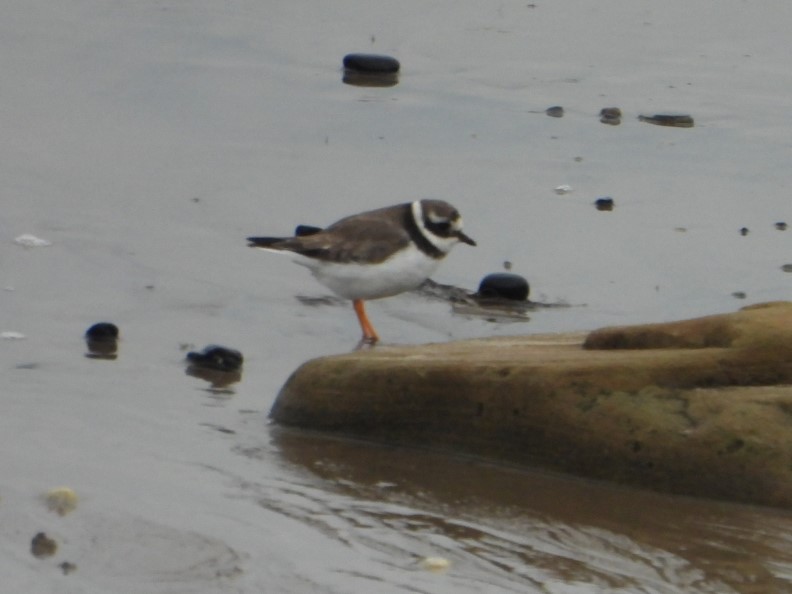
Surprise Plover

Now I reckon on balance this was ring-necked rather than a lesser ring-necked plover, as these should now all have departed and there was no sign of a yellow ring around the eye. It was also the only one I spotted running around the beach. 

There were a few curlew around. one politely posing well on the golf course:

Curlew

I continued along to the point where people sometimes put bird food down and caught up with a numerous flock of linnets, but nothing more special.  Starting back however, I came across a chap lying in wait for a snow bunting  he'd seen briefly.  He also mentioned that a lapland bunting sometimes mingles with the linnets.  This eventually had me scouring the photos to see if I could transform a linnet into a lapland bunting - but it didn't work.

Linnets

Some of the males still had the last vestiges of their summer plumage.

My hands were getting cold so I didn't wait for the snow bunting.

On the way back I remembered a tip on holding the camera and got the best shot of a redshank, later running into a bird that puzzled me and clearly wasn't a redshank.  It turned out it was a turnstone, just didn't quite have the neck pattern I'm familiar with.
Redshank
Turnstone

The tide was just starting to go down and there was a typically large flock of golden plover winging around, landing and relanding.

Golden Plover

My last sighting was of a group of birds that were on the wet rocks near the cliff.  At first I thought there were starlings, which is the general opinion on facebook but on looking at the photo, I'm not so sure.


Starlings?

Some of these birds seem to have brown supercilia and a light colouration I don't see in shots of starlings.  A trick of the light? However there is certainly one added bonus as the one in the bottom right hand area has been identified as a rock pipit.  there's also a small warbler right at the front, partly obscured.

You have to admire the tenacity of some bird watchers - these two have been holding continuous watch over Newbiggin Bay ever since I first visited years ago.

Birdwatchers

Overall I was partly but not fully satisfied with the improved results from the camera.  However it was very windy, as you can hear in the video.

Just for the record I saw three more speckled wood at the Tennis Club on 14th October - maybe the last this year.


Tuesday, 11 April 2023

Low Force and High Force Wind

On Saturday I joined up with Jennifer and Joe who are walking the Pennine Way in stages.

We met at Middleton-in-Teesdale to do the section to High Force.  Unfortunately I 'hit the wall' at about four miles and only made it to Low Force, the easy access to High Force from the nearby hotel having closed about 15 minutes before I got there. 

High Force

We saw surprisingly little wildlife during the couple of hours or so.  We thought there was a flock of fieldfares in some trees and there were three butterflies, one of which was a red admiral and a few buff-tailed bumblebee queens.  Birdwise there was the odd lapwing and curlew plus a few pied wagtails.

One surprise though was three completely white mallards that paddled their way across the Tees below Low Force.  Apparently this almost certainly means they were escapees as mallards held domestically are often bred to lose their natural colours.

We actually saw more birds while driving around the moors from place to place: partridge, a possible cuckoo, red grouse and short-eared owl.  And many skylarks.

A buff tailed bumblebee queen finally landed in my garden the other day.  So far they hadn't settled.

Queen Buff-tailed Bumblebee

Due to poor weather I hadn't been out on the bike for a long time apart from a couple of short refresher rides.  Again not much was seen but having got stopped at the level crossing at Wylam, I took a snap of the grey heron that frequently resides there.

Heron

Anyway, on Sunday I took advantage of what had been an excellent weather forecast for a ride up the coast to Cresswell and Druridge - except that the non-stop sunshine expected never happened and I was buffeted all day by a heavy onshore breeze that made me wish I'd taken my winter gloves!

On the Blyth estuary I got a couple of nice views of shelduck and redshank on the mudflats.
Shelduck
Redshank
I've always liked shelduck.

I did a detour around the Newbiggin area in search of Sandy Bay where rarities sometimes turn up - notably a bluethroat recently- but couldn't find it and made a quick exit to escape the Easter festivities.

At Cresswell and Druridge the most notable sighting was my first bar-tailed godwits, which turned up in both locations.  The one of Cresswell has spilled some weed on itself.

Bar-tailed godwit

I had hoped for avocets, which have recently appeared at both locations but unfortunately no luck and the spoonbill at Druridge didn't show either.  

Nevertheless there was a reasonable tally of further sightings recorded including a little egret in the corner at Cresswell, sanderling, lapwing, canada and greylag geese, shoveler, teal, wigeon, lapwing and several more shelduck
Lapwing
Shoveler

Unsurprisingly no butterflies were seen.