Showing posts with label redshank. Show all posts

Saturday, 20 December 2025

A Matter of Luck

So here we are dhortly before the solstice and there are still one or two flowers just about in bloom in the garden.

Snapdragon?
Snapdragon...
or Antirrhinum?
... or antirrinhum?

Around the corner a couple of other plants are growing new leaves as if it was already Spring in spite of a sudden frost early this morning.

Rumours of a growing colony of snow buntings on The Links at Whitley Bay proved to much for me to resist and today I headed for the suspect area, barely 300 yards from the student flat I was in at 2 Davison Avenue 50 years ago.  As many as 20 had been showing up consistently for over a week, presumably feeding on grass seed.

I moved down from Briardene Car Park in observation mode but at first it looked like oystercatcher and redshanks were the ones harvesting the seeds.
Oystercatchers
Redshanks
In the end it was an easy job to find the snow buntings, as there was a couple of people I know who were already watching them.
Snow Buntings en groupe
Snow Bunting close-up

Overall we counted around 15.

Of course this wasn't really great luck.  Now settled it is quite likely they will stay in the area until early
Spring, as happened a few years back when some stayed over at St Mary's Island.  But having missed them twice at Seaton Sluice a couple of months back, it felt like a success.

The whole process can't have taken more than about 30 minutes so I decided to go for broke and check out reports of a lone black redstart down the road at Cullercoats.

This was a bit more of a 'needle in a haystack' task as I didn't have a precise idea of their location. I decided to investigate the bay south of the Lifeboat Station, hoping that it wouldn't be put off by the local restrictions:

Notice prohibiting the digging of worms
You have been warned!

This tactic however proved fruitless and I was starting to feel cold and in need of coffee when, coming off a breakwater and stopping to watch a pied wagtail, I noticed another plausible area to the North of the prohibited worms and thought I made out the shape of a bloke clambering over the rocks with a camera.

A quick view through the telephoto lens confirmed this to be correct - so obviously I had to take a walk along.  The bloke had set up his camera to focus on a nearby rock, obviously hoping the bird would come and pose.  It didn't but I thought I momentarily saw a black redstart moving to his right. Shortly afterwards, another chap turned up and said "Have you seen it?" then confirmed this was the right place.

Ultimately the guy with the camera pointed it out on a small rock, pleasing the non-bird watchers who had turned up to ask what we were looking at.  I think it was a female, like the one I saw at Tynemouth in 2020.

Black Redstart

Obviously this was the result of sheer luck of the kind I had a run of a while back but seems to have deserted me lately.  Hopefully it has changed.  It also goes to prove the maxim I share with one of the lady spectators today - don't look for the bird, look for men (and sometimes women) with huge cameras!

Friday, 18 October 2024

Getting Back into Birds

As the summer has faded into autumn, I've started to think more about birds.  In past years I've had some really good luck with birdwatching, which more recently has drained away.  I've increasingly suffered from bird blindness through looking down for butterflies and bees rather than scanning the skies and trees.

A week ago on Saturday, I was in Scotland to see my son and daughter in law, when we fitted in a brief trip to Baron's Haugh RSPB Reserve near Motherwell.  It was actually quite disappointing as not too much was showing - until I looked a bit more closely.

I got a quick early video of a kestrel deciding not to hover but the loch itself was pretty quiet apart from a few standards such as shoveler and lapwing.

Shoveler
Lapwing

There were a small number of waders that I reckoned at first sight to be insignificant but on closer inspection they turned out to be snipe.

Snipe

I was quite pleased about this as I've usually seen them furtively prowling through the reeds rather than in the open.

It was actually quite warm later in the afternoon and I counted four speckled wood flying around the trees.

Overall I haven't been too satisfied with the bird photographs I've taken on my new camera to date, so i asked my daughter in law for some ideas and she's adjusted some of the settings.

The first opportunity to try them out should have been last Tuesday, when I planned a trip to Holy Island to check for migrants but the weather was so appalling that I chickened out.

Instead I decided to visit Newbiggin this Tuesday, as one or two of the more rare buntings had been reported there.

As I wasn't heading for Norway, I skipped the pub and made my way instead onto Newbiggin Moor.


Last Pub before Norway

Working my way up the coastal path, I took opportunities to try out some distance shots of redshank with reasonable success, when I got a slight surprise.

Surprise Plover

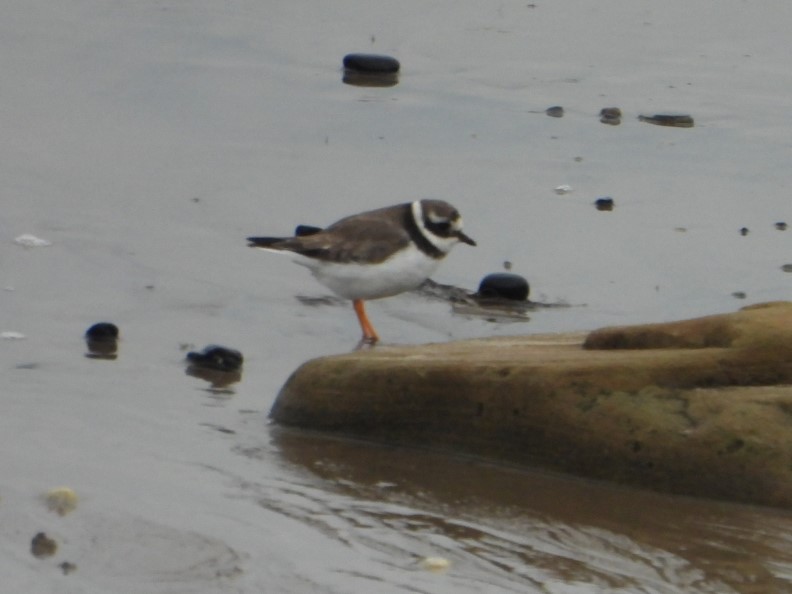
Now I reckon on balance this was ring-necked rather than a lesser ring-necked plover, as these should now all have departed and there was no sign of a yellow ring around the eye. It was also the only one I spotted running around the beach. 

There were a few curlew around. one politely posing well on the golf course:

Curlew

I continued along to the point where people sometimes put bird food down and caught up with a numerous flock of linnets, but nothing more special.  Starting back however, I came across a chap lying in wait for a snow bunting  he'd seen briefly.  He also mentioned that a lapland bunting sometimes mingles with the linnets.  This eventually had me scouring the photos to see if I could transform a linnet into a lapland bunting - but it didn't work.

Linnets

Some of the males still had the last vestiges of their summer plumage.

My hands were getting cold so I didn't wait for the snow bunting.

On the way back I remembered a tip on holding the camera and got the best shot of a redshank, later running into a bird that puzzled me and clearly wasn't a redshank.  It turned out it was a turnstone, just didn't quite have the neck pattern I'm familiar with.
Redshank
Turnstone

The tide was just starting to go down and there was a typically large flock of golden plover winging around, landing and relanding.

Golden Plover

My last sighting was of a group of birds that were on the wet rocks near the cliff.  At first I thought there were starlings, which is the general opinion on facebook but on looking at the photo, I'm not so sure.


Starlings?

Some of these birds seem to have brown supercilia and a light colouration I don't see in shots of starlings.  A trick of the light? However there is certainly one added bonus as the one in the bottom right hand area has been identified as a rock pipit.  there's also a small warbler right at the front, partly obscured.

You have to admire the tenacity of some bird watchers - these two have been holding continuous watch over Newbiggin Bay ever since I first visited years ago.

Birdwatchers

Overall I was partly but not fully satisfied with the improved results from the camera.  However it was very windy, as you can hear in the video.

Just for the record I saw three more speckled wood at the Tennis Club on 14th October - maybe the last this year.


Tuesday, 11 April 2023

Low Force and High Force Wind

On Saturday I joined up with Jennifer and Joe who are walking the Pennine Way in stages.

We met at Middleton-in-Teesdale to do the section to High Force.  Unfortunately I 'hit the wall' at about four miles and only made it to Low Force, the easy access to High Force from the nearby hotel having closed about 15 minutes before I got there. 

High Force

We saw surprisingly little wildlife during the couple of hours or so.  We thought there was a flock of fieldfares in some trees and there were three butterflies, one of which was a red admiral and a few buff-tailed bumblebee queens.  Birdwise there was the odd lapwing and curlew plus a few pied wagtails.

One surprise though was three completely white mallards that paddled their way across the Tees below Low Force.  Apparently this almost certainly means they were escapees as mallards held domestically are often bred to lose their natural colours.

We actually saw more birds while driving around the moors from place to place: partridge, a possible cuckoo, red grouse and short-eared owl.  And many skylarks.

A buff tailed bumblebee queen finally landed in my garden the other day.  So far they hadn't settled.

Queen Buff-tailed Bumblebee

Due to poor weather I hadn't been out on the bike for a long time apart from a couple of short refresher rides.  Again not much was seen but having got stopped at the level crossing at Wylam, I took a snap of the grey heron that frequently resides there.

Heron

Anyway, on Sunday I took advantage of what had been an excellent weather forecast for a ride up the coast to Cresswell and Druridge - except that the non-stop sunshine expected never happened and I was buffeted all day by a heavy onshore breeze that made me wish I'd taken my winter gloves!

On the Blyth estuary I got a couple of nice views of shelduck and redshank on the mudflats.
Shelduck
Redshank
I've always liked shelduck.

I did a detour around the Newbiggin area in search of Sandy Bay where rarities sometimes turn up - notably a bluethroat recently- but couldn't find it and made a quick exit to escape the Easter festivities.

At Cresswell and Druridge the most notable sighting was my first bar-tailed godwits, which turned up in both locations.  The one of Cresswell has spilled some weed on itself.

Bar-tailed godwit

I had hoped for avocets, which have recently appeared at both locations but unfortunately no luck and the spoonbill at Druridge didn't show either.  

Nevertheless there was a reasonable tally of further sightings recorded including a little egret in the corner at Cresswell, sanderling, lapwing, canada and greylag geese, shoveler, teal, wigeon, lapwing and several more shelduck
Lapwing
Shoveler

Unsurprisingly no butterflies were seen.

Wednesday, 29 September 2021

Late Summer Sightings

Long-tailed Tits

The long-tailed tits are still very keen on the suet ball feeder. Typically they arrive in good numbers but are clearly nervy and make off at the least disturbance so visits don't last long.  I notice too that they won't come much if the feeder is well-filled, perhaps fearsome of something bigger than them, but prefer to wait for the other tits to whittle the supplies down somewhat.

Up until about a week ago, large numbers of small tortoiseshells were continuing to visit the buddleia, often eight or nine at a time.  As the buddleia blooms gradually died back, it was possible to see as many as four or five clinging to the same sprig, occasionally landing on the shed or elsewhere to warm up a bit when the sun weakened.  In one case elsewhere proved to be my foot.  This was pleasing as about a month ago a red admiral landed on my shoulder.  I got the photo but accidently deleted it and so had no proof. 

Small Tortoiseshell on large foot

On the 20th,  the buddleia also attracted an early bumblebee queen.  I gather there have been a few on the wing and probably saw one a few days before as well.  On the same day I had been on a bike ride in mediocre weather not seeing much at all and certainly no butterflies.  Having also thought I'd already seen my only painted lady for the year it was bit of a surprise when one turned up on the route past Ryton Golf Club, and kindly posed on the track for a few seconds.

Painted Lady

Alex and Vicki visited at the weekend.  On Saturday we spent a good deal of time in the hide at Clara Vale, hoping that a kingfisher would turn up.  It didn't.  We just saw a little grebe and a couple of moorhens and nothing more to add on a tour of the small Nature Reserve.

The day after we made a trip to Holy Island on what was palpably the last day of the September mild spell.  Although a little too early for spectacular sightings we did manage to see a raven, redshanks, rock pipits, sanderling, ringed plovers, razorbill, cormorant, guillemot as well as a school of seals.

Bar-tailed Godwit
Ringed Plovers
Seals

There was also a little brown job that was in the same area as a flock of pipits but I didn't think it was one.  Awaiting identification on that one...

Lastly, on a quick visit to the Gertrude Jekyll Garden near the castle, we stumbled on my third painted lady of the season.  They all looked pretty fresh.  Perhaps there are more around than I thought.

Another Painted Lady

It's getting to the time of year when I wonder what will be the last butterfly I see.  The latest contender on the buddleia anyhow was this red admiral, found clinging to the last decent sprig of flower in the wind yesterday.

Red Admiral

Wednesday, 4 November 2020

Thursday 4th November

 Having heard that there were crossbills and siskins in some numbers at East Cramlington Pond, I set off there a week ago.

The search was somewhat complicated by the fact there seems to be two locations answering to that name.  The one I found first was the Nirthumberland Wildlife Trust Reserve, which was pretty quiet but there were some honey bees around the artificial hives and some redwing in the trees on the western side, which was in sun.

I'd noticed there was an area of conifers to the North and headed towards them, thinking that they were more likely to attract crossbills and siskins.  Here there was another larger and less overgrown pond and a quite extensive area calling itself East Cramlington Nature Reserve.  I scouted around a good deal without seeing or hearing virtually anything but eventually did hear birds moving around the edge of one area.  Most of these proved to be long-tailed and other tits but I did briefly pick out one siskin among them.  No crossbills though.

With some time available, I moved on to Holywell Pond, where a spoonbill was reported about ten days earlier.  I missed the main path down to the pond after trouble parking and ended up approaching from the waggonway.

I found the area I took to be Holywell Pond, a wide area of shallow water set in ploughed farmland.  There were a few ducks at distance, which look to have been gadwall and in retrospect were a pleasing spot.

Gadwall

On setting off again, I could catch sight of another expanse of water which proved to be the real Holywell Pond, though in fact it produced less interesting sightings - just a few swans and gulls and some tufted ducks.

Yesterday, the spectacular sightings of a fortnight ago no longer much in evidence, I decided to take a coastal walk north from Newbiggin, watching out for any twite.

A very white gull with red legs landed briefly in front of me but eluded the camera and I had to puzzle
out what it might be afterwards.  The most likely explanation seems to be black-headed gull - without the black head of course.

Eider Duck
Down on the foreshore I got a good view of a rock pipit but on the whole there wasn't much about in the morning beyond gulls, cormorants and a good head of pied wagtails.

There were some smaller birds about but annoyingly they all seem to fly straight over me and into the sun, carried away quickly by a moderate breeze.  The only ones that landed took fright too quickly to be identified.

Further along I did see an eider duck diving repeatedly.

It was amazing to reflect that a hoopoe briefly turned up in the Lynemouth area, having first made land at Newbiggin.  I had no expectation that it would still be there, especially if it was as unimpressed by the scenery around the old aluminium smelter as I was.  Curiously though, there were a few stonechats in the bushes around th outflow from the mine contamination processing plan, which was about the same colour as them - rust red.

Things were a bit more lively as there were a good number of waders active as the tide moved in.  There were a few redshanks and some turnstone amongst others, and a lot more brown birds which were very quick to take flight when I approached.

On reflection, I suspect though that they were all rock pipits.

Rock Pipit


Saturday, 16 February 2019

Saturday 16th February

Hot on the heels of the water rail success on Monday, I decided to try my luck with the snow buntings at St Mary's Island again. As driving there by any route is a nuisance and the weather was improving, I decided to cycle there from the Quayside, overruling my better judgment that hi-vis jacket and samll binoculars might not be advisable.  I also found no room in my bag for a bird guide.

In fact it couldn't have worked out much better.  En route along cycle track 72, I saw about eight magpies in the same tree close to the Tyne Tunnel, and roughly the same number again round about - more than ever before in the same view.

I rode right through to St Mary's without stopping and immediately heard an invisible skylark over the adjacent fields.  Following the call of nature on the edge of the nature reserve, I got a good view of a curlew in the same field, as well as canada geese, mallard and teal in the reserve itself.  Then I cycled very slowly towards the lighthouse with camera and binoculars at the ready.

When looking for an uncommon bird, the best plan seems to be to not look for the bird but to watch out for a twitcher with a huge camera lens.  It worked again today as soon as I reached the second car park.  There was the twitcher and the three snow buntings were running around on the grassy slope eating seeds - one male and two females.

Snow Buntings
Snow buntings have the reputation of not being shy of humans and this little group was relatively unphased by most repeated disturbances, including amusingly that from the middle-aged bikers in the car park less than ten yards away, revving their throttles.

Occasionally the birds retired to the foreshore or the railings on the promenade but always came back while I sat for around half an hour having my lunch.

It was a flat, high tide and there wasn't much else about apart from a few cormorants.  I took a couple more looks into the reserve but only saw a group of redshanks on the pool if you discount these Dartmoor ponies that are employed to keep the vegetation down.

Dartmoor Ponies at work
There were stories of a black redstart at Tynemouth as well as a ring-necked parakeet in Newcastle but hey, I'd seen both of those in my travels to Europe.  So I decided to head back in a vain attempt to beat the rush hour.

Monday, 10 December 2018

Monday 10th December

I seem to have been more preoccupied with fitness than nature over the past few weeks.

My attempts to tempt smaller birds into the garden and discourage jackdaws have pretty much failed.  The one thing that has clearly been established is that jackdaws will eat niger seed.  I'm surprised they bother.  Anyway I'm playing more with the idea that the lack of cover since I cut down the larger pear tree (the smaller one is of course entirely bare now) favours the jackdaws more than the woodland birds.  The lack of frost so far might also mean less pressure for them to find food.

Today the Naturewatch group today visited the Washington Wildfowl and Wetlands Trust reserve.  It was fine from the point of view of getting some close up views of domesticated exotics such as the black-headed
Buff-headed goose
swan, buff-headed geese and chilean flamingoes but when we got to the main Wader Pond it was covered in ice and we didn't see much apart from a few moorhens and a couple of snipe skulking in the reeds.

We had lunch in the Lagoon Hide by the Wear where a bit more was visible, notably a number of teal and a redshank until everything was disturbed by a spooked roe dear that was bolting along the bankside.

In the end we probably saw more woodland birds - some redwing on the walkway, a volley of long-tailed tits and a good selection of 'usual suspects' on the very extensive display of feeders in front of the last hide. 
Bullfinch and coal tit
A couple of pleasant extras were treecreeper and a few bullfinches though I never saw anything in the way of a greenfinch, tree sparrow or marsh tit.

Right at the end I did enjoy a good view of a pair of eurasian cranes from the tearoom window.  They were
Eurasian crane
probably domesticated too but as they have started to recolonise East Anglia, they represented in my head a more genuine sighting.

It was quite apparent that there are many more fascinating visitors to the reserve than were around today.

Wednesday, 11 January 2017

Wednesday 11th January

A rather windy bike ride to Castle Douglas a week ago did not produce much.  The most interesting sighting was two red kites playing around right above the town garden centre just as all the cyclists arrived.  Otherwise, the predominant bird was the robin.  Also wrens, a few goldfinches, and a couple of young buzzards sitting close to the road.

Redshank Steps Out
Malcolm in Northumberland is getting more interested in birdwatching, so there were more interesting results on my latest visit last weekend.  A dog walking trip to Alnmouth Beach on Sunday soon produced redshank, turnstone, sanderling, pied wagtail and rock pipit.  A visit to Warkworth a couple of days later also provided a brief sighting of a seal.

Later on Sunday we visited the pond at Low Newton in somewhat fading light and quickly managed to sight a pair of tufted ducks away from the coots and mallard.  A number of ducks on the far side looked like wigeon to me but an experienced bird watcher from Yorkshire thought they were teal. The photographic evidence isn't conclusive.  Just before the onset of dusk there was a single litle grebe (a first sighting for me) and some whooper swans feeding on the farmland opposite.

The Monday found us trying new pastures at Stag Rock just North of Bamburgh.  This time it was the
Purple Sandpipers - I hope!
brightness that caused some confusion and we spent some time trying to identify a group of birds that we eventually decided were just some unusually quiet and rather plump oystercatchers.

My identification skills with ducks and waders are still somewhat uncertain but I'm fairly confident I managed further first sightings of common scoter and purple sandpiper.  Also apparent were turnstone, sanderling, curlew, herring gull and a couple of stonechat on the edge of the beach.

There wasn't much more swimming further out in the sea apart from a small number of eider and one slight disappointment was the non-appearance of any long-tailed duck. Nevertheless, a rewarding visit to the area for both of us.

Later we briefly went to Fenham Flats opposite Lindisfarne around twilight, just as the geese moved off en masse to roost. They were probably pink-footed geese but far to far off to allow any identification.  So the only new thing we saw was several groups of shelduck, but always a favourite of mine

Monday, 21 November 2016

Monday 21st November

Rather slim pickings over the past few weeks, but here's a summary of what has happened.

Last Wednesday, did a windy bike ride to Crocketford and back through the Glenkilns. Three long-tailed tits passed through a tree on the cycle track and a red kite was sailing around just South of Crocketford. On the way back there were good sightings of three more kites and a buzzard.
Squirrel on Guard

Stopped on the hill where red squirrels and tits often come down to feed, but few did.  The one squirrel that did turn up seemed more intent on guarding the feeders than eating itself, though it did take a couple of bits of apple.

The following day, I followed up news that waxwings are in the Dumfries area, but didn't see any in the obvious areas of Dock Park and St Michael's Churchyard though the latter already contained plenty of yewberries and the blackbirds and thrushes were making merry.

On Friday I travelled to Alnwick and paused briefly at Bolam Lake where a couple of male goldeneye were visible.

Unidentified
At the coast over the weekend there was not a whole lot to see.  However the rocks at Alnmouth contained some sanderling and redshank, plus these waders (right) which I haven't been able to identify. I'm wondering if they were juvenile plovers.

Also unidenitifiable were some large brown-looking diving birds that we at first mistook for seals, but they were too far off to even hazard a guess at.

At home my favourite coal tit is still busy and was picking minute grubs out of the pear tree today.

Saturday, 16 January 2016

Saturday 16th January

Spent a few days in Northumberland, which resulted in a lengthy walk at Low Newton.  Part of the idea was to check out the nature reserve that we discovered exists behind the Ship Inn - which was probably the source of the yellow-browed warbler reported in an earlier post.

In fact the beach was the main source of action.  Spent some time watching a cormorant sitting on a pile of rocks in the first bay, wondering if it might be a shag - interesting to find on researching more today that, according to bird-x.com 'There is no clear distinction between the term "cormorant" and "shag". ' Now that I didn't know!

Some usual suspects started turning up, i.e. greenshank, redshank and sanderling.  Further out some tufted ducks were fishing and once we passed a large outcrop of rocks, I was able to identify a pair of eider ducks even further out, messing around in the surface swell - so a first sighting.

On the way back to the pub, a large number of smaller birds were messing around by the kelp brought up by storms and I figured out they were rock pipits - another first sighting! By this time I was glad I had brought the bird book along, even though my fingers got pretty cold every time I got it out.  Just heading off the beach there were a few stonechats in the dunes.  I didn't need the bird book for them, but it was nice to see them again.


Stonechat
Rock Pipit - honest!


In fact the nature reserve, which was heavily flooded so the full path couldn't be covered, didn't have much to add to this.  Apart from more 'shanks, there were some greylag geese on the far side of the pond, too far away to see if other species were among them - plus a few wigeon and a single lapwing.

By now it was getting cold and we made it to the pub.

Thursday, 9 October 2014

Thursday 9th October

Visited friends in Alnwick last weekend.  While investigating the paltry train service from Acklington Station, I heard a sound I recognised and eventually confirmed the presence of long-tailed tits in the trees.  Have not seen a long-tailed tit all summer and, on reflection, it's mainly the winter when I see them.  Why should this be?

Several beach walks but no spectacular sightings of migrants, although did manage to identify a redshank between two oystercatchers - not bad for me as don't really do sea birds.  Also a kestrel perched on a telegraph wire on the coastal road, the first time I've seen this for years.  It used to happen all the time.

We also had difficulty identifying a tree on the outskirts of Alnwick.  Consulting the book of trees on my return home, the nearest guess I could come up with was a black poplar, but I've no idea how likely that is.  Must get the book of trees out more often - haven't done any tree spotting for ages.

Only one butterfly though, confirming summer is at an end. Last red admiral on the buddleia was 13th September.

Yesterday a bike ride to Caerlaverock via Heathhall and Clarencefield.  Many chaffinches, a nice view of a goldfinch in flight and a couple of skeins of returning barnacles, otherwise quiet and once again not a single bird of prey.

I've been reading an old book by Douglas Watson who suggests that the bean goose used to be common in Galloway.  None of my modern bird books mention it as a local species.  In any case, I suspect I'd have difficulty distinguishing it from the other grey geese except for the Greenland white-fronted.