Showing posts with label rock pipit. Show all posts

Thursday, 24 October 2024

Much ado about Sparrows

Since being mislead by the pale starlings last week, I've experienced a good bit more uncertainty - this time about sparrows.

It struck me that there was something slightly odd about a bird I thought was a sparrow. It spent a good long time sitting in the plum tree before finally feeding for a long while at the bird table - not too sparrow-like in itself.

Dunnock

It's the head pattern that troubled me, the rather dark head and white neck band and bib. Anyway google lens thinks it's a dunnock, which surprises me as there's not much flecking on the breast.  I wouldn't normally have much trouble spotting a dunnock.

I'm please to say that a female nuthatch has visited my new caged bird feeder several times over the past few days.  However it makes sure it lands so it's mainly obscured and flies off as soon as I point the camera at it.

Also still at it is the grey squirrel, so there must be more nuts buried somewhere under the lawn.

Where are my nuts?

The sparrow fixation continued when I finally got to Holy Island yesterday, on a day when people generally agreed not much was going on.

The first bird I saw was again motionless in a tree, as if resting, and appeared at first sight to have a yellowish sheen, suggesting perhaps a female yellowhammer or even an exotic warbler...  So I took more photos and tried to get closer.
Sparrow?

Sparrow

Yes, it's actually the same bird.  The yellowish tinge on the first bird is a trick of the low sunlight, the erect posture somewhat untypical and the apparently large beak an illusion.

After a quiet spell, I got another shot of a bird in a tree, largely facing away from me, wasn't sure what it was but thought "Probably sparrow."

Linnet

So google lens thought linnet - entirely possible.

There was however no mistaking the sparrows that decided to assault the remains of my coffee break.  Not many species learn to be so cheeky.

Definitely Sparrows

After the lunch/coffee break - I wasn't sure which - I got what were some quite pleasing results with the camera.

Heading towards the harbour, a call of nature diverted me to the nearby cliffs where a kestrel was hovering.  I tried to video it but it kept moving and then started hovering at more or less head height no more than five yards or so to my left.

Kestrel

So, if you like, I got a bird's eye view of a bird.

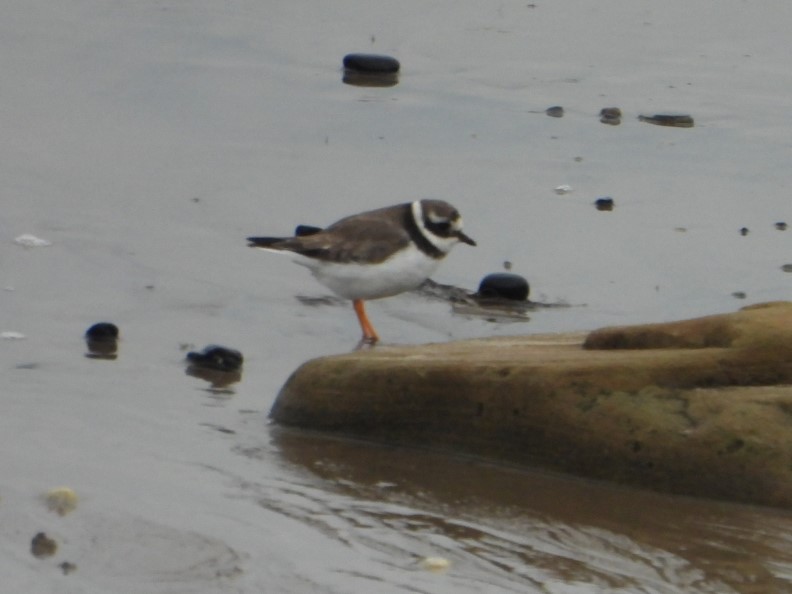
In the harbour area I caught up with another ring-necked plover and was particularly satisfied to pick out one of a pair of rock pipits from a well-camouflaged background.

Ring-necked Plover
Rock Pipit

Google lens however thinks the rock pipit is a corn bunting - oh dear, I don't think so!

But probably the best was this pale-bellied brent goose, because of how far away it was:

Brent Goose

You can't see much of the neck stripe because of its head position.  Incidentally that isn't blood in the water but the reflection of the paintwork from a nearby boat moored at the water's edge.

There was just the one.  However the chap at the crab sandwich stall (I was still hungry) reckoned there had been as many as 6,000 but most had gone inland.  Sure enough, when I ventured further towards the causeway, there were 20 or 30 more, including I think some of the dark-bellied variety.

Brent Geese

Friday, 18 October 2024

Getting Back into Birds

As the summer has faded into autumn, I've started to think more about birds.  In past years I've had some really good luck with birdwatching, which more recently has drained away.  I've increasingly suffered from bird blindness through looking down for butterflies and bees rather than scanning the skies and trees.

A week ago on Saturday, I was in Scotland to see my son and daughter in law, when we fitted in a brief trip to Baron's Haugh RSPB Reserve near Motherwell.  It was actually quite disappointing as not too much was showing - until I looked a bit more closely.

I got a quick early video of a kestrel deciding not to hover but the loch itself was pretty quiet apart from a few standards such as shoveler and lapwing.

Shoveler
Lapwing

There were a small number of waders that I reckoned at first sight to be insignificant but on closer inspection they turned out to be snipe.

Snipe

I was quite pleased about this as I've usually seen them furtively prowling through the reeds rather than in the open.

It was actually quite warm later in the afternoon and I counted four speckled wood flying around the trees.

Overall I haven't been too satisfied with the bird photographs I've taken on my new camera to date, so i asked my daughter in law for some ideas and she's adjusted some of the settings.

The first opportunity to try them out should have been last Tuesday, when I planned a trip to Holy Island to check for migrants but the weather was so appalling that I chickened out.

Instead I decided to visit Newbiggin this Tuesday, as one or two of the more rare buntings had been reported there.

As I wasn't heading for Norway, I skipped the pub and made my way instead onto Newbiggin Moor.


Last Pub before Norway

Working my way up the coastal path, I took opportunities to try out some distance shots of redshank with reasonable success, when I got a slight surprise.

Surprise Plover

Now I reckon on balance this was ring-necked rather than a lesser ring-necked plover, as these should now all have departed and there was no sign of a yellow ring around the eye. It was also the only one I spotted running around the beach. 

There were a few curlew around. one politely posing well on the golf course:

Curlew

I continued along to the point where people sometimes put bird food down and caught up with a numerous flock of linnets, but nothing more special.  Starting back however, I came across a chap lying in wait for a snow bunting  he'd seen briefly.  He also mentioned that a lapland bunting sometimes mingles with the linnets.  This eventually had me scouring the photos to see if I could transform a linnet into a lapland bunting - but it didn't work.

Linnets

Some of the males still had the last vestiges of their summer plumage.

My hands were getting cold so I didn't wait for the snow bunting.

On the way back I remembered a tip on holding the camera and got the best shot of a redshank, later running into a bird that puzzled me and clearly wasn't a redshank.  It turned out it was a turnstone, just didn't quite have the neck pattern I'm familiar with.
Redshank
Turnstone

The tide was just starting to go down and there was a typically large flock of golden plover winging around, landing and relanding.

Golden Plover

My last sighting was of a group of birds that were on the wet rocks near the cliff.  At first I thought there were starlings, which is the general opinion on facebook but on looking at the photo, I'm not so sure.


Starlings?

Some of these birds seem to have brown supercilia and a light colouration I don't see in shots of starlings.  A trick of the light? However there is certainly one added bonus as the one in the bottom right hand area has been identified as a rock pipit.  there's also a small warbler right at the front, partly obscured.

You have to admire the tenacity of some bird watchers - these two have been holding continuous watch over Newbiggin Bay ever since I first visited years ago.

Birdwatchers

Overall I was partly but not fully satisfied with the improved results from the camera.  However it was very windy, as you can hear in the video.

Just for the record I saw three more speckled wood at the Tennis Club on 14th October - maybe the last this year.


Wednesday, 29 September 2021

Late Summer Sightings

Long-tailed Tits

The long-tailed tits are still very keen on the suet ball feeder. Typically they arrive in good numbers but are clearly nervy and make off at the least disturbance so visits don't last long.  I notice too that they won't come much if the feeder is well-filled, perhaps fearsome of something bigger than them, but prefer to wait for the other tits to whittle the supplies down somewhat.

Up until about a week ago, large numbers of small tortoiseshells were continuing to visit the buddleia, often eight or nine at a time.  As the buddleia blooms gradually died back, it was possible to see as many as four or five clinging to the same sprig, occasionally landing on the shed or elsewhere to warm up a bit when the sun weakened.  In one case elsewhere proved to be my foot.  This was pleasing as about a month ago a red admiral landed on my shoulder.  I got the photo but accidently deleted it and so had no proof. 

Small Tortoiseshell on large foot

On the 20th,  the buddleia also attracted an early bumblebee queen.  I gather there have been a few on the wing and probably saw one a few days before as well.  On the same day I had been on a bike ride in mediocre weather not seeing much at all and certainly no butterflies.  Having also thought I'd already seen my only painted lady for the year it was bit of a surprise when one turned up on the route past Ryton Golf Club, and kindly posed on the track for a few seconds.

Painted Lady

Alex and Vicki visited at the weekend.  On Saturday we spent a good deal of time in the hide at Clara Vale, hoping that a kingfisher would turn up.  It didn't.  We just saw a little grebe and a couple of moorhens and nothing more to add on a tour of the small Nature Reserve.

The day after we made a trip to Holy Island on what was palpably the last day of the September mild spell.  Although a little too early for spectacular sightings we did manage to see a raven, redshanks, rock pipits, sanderling, ringed plovers, razorbill, cormorant, guillemot as well as a school of seals.

Bar-tailed Godwit
Ringed Plovers
Seals

There was also a little brown job that was in the same area as a flock of pipits but I didn't think it was one.  Awaiting identification on that one...

Lastly, on a quick visit to the Gertrude Jekyll Garden near the castle, we stumbled on my third painted lady of the season.  They all looked pretty fresh.  Perhaps there are more around than I thought.

Another Painted Lady

It's getting to the time of year when I wonder what will be the last butterfly I see.  The latest contender on the buddleia anyhow was this red admiral, found clinging to the last decent sprig of flower in the wind yesterday.

Red Admiral

Wednesday, 5 May 2021

Wednesday 5th May

Last Thursday I decided to brave the weather and take a fishing trip to Brenkley Pond, partly as I still had some usuable maggots from several weeks ago and was happy enough to catch a few smaller fish on waggler in view of the ongoing near-freezing temperatures at night.  That was exactly what I got - 6 small perch and 6 small roach, some of which rivalled the ones at Milkhope for minuteness.

Even on fine tackle bites were infrequent and finicky and had a knack of arriving at inconvenient moments when I was pouring a coffee or fiddling with gear, so I should probably have caught more.  At least the presence of perch is likely to weed out some of the smaller fish over time.

Covid travel restrictions having been relaxed I took the opportunity to meet up with Alex and Vicki at a certain Scottish moorland last Friday in search of birds of prey.  Maximum temperature forecast 9C, actual temperature on arrival 3C, enlivened by strongish wind and a squally shower.

Within half an hour of arrival, we spotted what we thought was a barn owl hunting and soon there were two or three on the go.  Then hen harriers started to appear, both male and female, overall about a dozen sightings though some may have been the same birds returning.  Some of the males were displaying by zigzagging up and down on the horizon.

Not really dressed for the  cold, I was more interested in fiddling with a flask of tea and a pork pie than the camera, so left it to Vicki to provide the photos.  

Male Hen Harrier
Short-Eared Owl

It transpired on closer inspection that the photos were of short-eared owls, though I suppose it's just about possible that both were present.  At one point two owls were together and there was a clear size difference and all sightings were at some distance.  However the habitat certainly makes short-eared owl a good deal more likely.  We had also hoped for peregrine falcon or merlin but neither showed up, not even on returning later in the day.  Still, having only ever seen one male hen harrier before, it was great to see several on the same day.

Meanwhile, on a brief walk up a nearby valley, we encountered numerous meadow pipits, the first two swallows I have seen this year, a few pied and and one grey wagtail.  I had a notion there might have been a white wagtail but it didn't hang about, neither did one larger pipit on the stream which I suppose was a rock pipit.  On the return walk, there were a number of willow warblers around and one reed bunting as well as a pair of stonechats back on the moor.

I suspect this Spring will turn out to have been a disaster for butterflies and there have been remarkably few on the wing these last ten days.  Today a white landed that was either a female orange tip or a green-veined white.  After it departed a male orange tip appeared.  Otherwise there has been nothing apart from a single speckled wood at the tennis club on Sunday.

Orange Tip

Monday, 7 December 2020

Monday 7th December

Having caught sight of a jay showing well on the edge of Chopwell Woods as I returned from the doctor's,  I decided to take a walk there last week.  This was also to test my theory that you see far less in the way of birdlife there than you would expect from what is an apparently attractive area.

The theory was pretty much proven.  I wandered around for an hour or two, trying to keep off the main tracks as much as possible.  Birdsong was notably absent as I went.  Eventually I caught sight of a nuthatch on a conifer and got one distant sighting of a jay in a tree.  There were a few tits singing in the trees on the way out but that was it.  Overall I think you're more likely to see deer there than a notable bird, but can't really say why.

I'd have seen more if I'd stayed in the garden, which is where I saw this female greenfinch a few days ago.  Getting the rear view first, I thought it might be a siskin, which would have been a garden first.  Something about this bird strikes me as not quite right  (too pale?) but greenfinches are certainly around although not on the feeder.

On Saturday I took advantage of some improved weather to track down the black redstart at Tynemouth.  It wasn't where I expected to find it. Instead there was an eider duck quite near to the shore.

Eider Duck

Eventually after fish 'n' chips I managed to locate a birdwatcher who told me where to look, just outside the pier rather than inside the harbour.  Others reported it hadn't been seen for  half an hour but when one left, it duly turned up, moving about the rocks and occasionally pursued by a jealous robin.

It was hard to get decent shots in the shade but once again "mission accomplished".  It seemed paler than the ones I have seen in Germany.
Black Redstart
Black Redstart
An additional bonus was a rock pipit patrolling the same area.

Rock Pipit

With some time available I moved on and did a walk from Seaton Sluice to St Mary's Island where there was at least a hundred lapwing at the water's edge just after low tide.  I looked for golden plover among them but instead found these waders at distance. 

Waders


Wednesday, 11 January 2017

Wednesday 11th January

A rather windy bike ride to Castle Douglas a week ago did not produce much.  The most interesting sighting was two red kites playing around right above the town garden centre just as all the cyclists arrived.  Otherwise, the predominant bird was the robin.  Also wrens, a few goldfinches, and a couple of young buzzards sitting close to the road.

Redshank Steps Out
Malcolm in Northumberland is getting more interested in birdwatching, so there were more interesting results on my latest visit last weekend.  A dog walking trip to Alnmouth Beach on Sunday soon produced redshank, turnstone, sanderling, pied wagtail and rock pipit.  A visit to Warkworth a couple of days later also provided a brief sighting of a seal.

Later on Sunday we visited the pond at Low Newton in somewhat fading light and quickly managed to sight a pair of tufted ducks away from the coots and mallard.  A number of ducks on the far side looked like wigeon to me but an experienced bird watcher from Yorkshire thought they were teal. The photographic evidence isn't conclusive.  Just before the onset of dusk there was a single litle grebe (a first sighting for me) and some whooper swans feeding on the farmland opposite.

The Monday found us trying new pastures at Stag Rock just North of Bamburgh.  This time it was the
Purple Sandpipers - I hope!
brightness that caused some confusion and we spent some time trying to identify a group of birds that we eventually decided were just some unusually quiet and rather plump oystercatchers.

My identification skills with ducks and waders are still somewhat uncertain but I'm fairly confident I managed further first sightings of common scoter and purple sandpiper.  Also apparent were turnstone, sanderling, curlew, herring gull and a couple of stonechat on the edge of the beach.

There wasn't much more swimming further out in the sea apart from a small number of eider and one slight disappointment was the non-appearance of any long-tailed duck. Nevertheless, a rewarding visit to the area for both of us.

Later we briefly went to Fenham Flats opposite Lindisfarne around twilight, just as the geese moved off en masse to roost. They were probably pink-footed geese but far to far off to allow any identification.  So the only new thing we saw was several groups of shelduck, but always a favourite of mine

Sunday, 2 October 2016

Sunday 2nd October

Another trip to Northumberland at the end of last week, which resulted in a pleasant walk along the coast between Craster and Dunstanburgh Castle.

I was a little surprised to sight a number of wheatears, all male, moving around the rocks on the shoreline. I've seen wheatears in coastal areas before but not on the shoreline, plus I would have expected them to be on their way back to Africa by now. Maybe they were getting ready for the effort. There were also a couple of rock pipits darting around in similar fashion.

Nearer the castle, a seal pooped its head out of the water now and again and a couple of eider duck were spotted amongst the floating seagulls.  In the fields next to the castle, quite a large number of swallows were flying around at speed and I was told they are usually there.  The entrance castle itself was guarded by some young cows who seem to like small dogs.

On the way back the smaller birds had been replaced by a number of calling turnstone.

Meanwhile I am hoping that my stray sunflower might attract a goldfinch or two.  So far the only visitor has been a hyperactive coal tit.


Wheatear
Eider duck

Cows and castle

Saturday, 16 January 2016

Saturday 16th January

Spent a few days in Northumberland, which resulted in a lengthy walk at Low Newton.  Part of the idea was to check out the nature reserve that we discovered exists behind the Ship Inn - which was probably the source of the yellow-browed warbler reported in an earlier post.

In fact the beach was the main source of action.  Spent some time watching a cormorant sitting on a pile of rocks in the first bay, wondering if it might be a shag - interesting to find on researching more today that, according to bird-x.com 'There is no clear distinction between the term "cormorant" and "shag". ' Now that I didn't know!

Some usual suspects started turning up, i.e. greenshank, redshank and sanderling.  Further out some tufted ducks were fishing and once we passed a large outcrop of rocks, I was able to identify a pair of eider ducks even further out, messing around in the surface swell - so a first sighting.

On the way back to the pub, a large number of smaller birds were messing around by the kelp brought up by storms and I figured out they were rock pipits - another first sighting! By this time I was glad I had brought the bird book along, even though my fingers got pretty cold every time I got it out.  Just heading off the beach there were a few stonechats in the dunes.  I didn't need the bird book for them, but it was nice to see them again.


Stonechat
Rock Pipit - honest!


In fact the nature reserve, which was heavily flooded so the full path couldn't be covered, didn't have much to add to this.  Apart from more 'shanks, there were some greylag geese on the far side of the pond, too far away to see if other species were among them - plus a few wigeon and a single lapwing.

By now it was getting cold and we made it to the pub.