Showing posts with label golden plover. Show all posts

Friday, 18 October 2024

Getting Back into Birds

As the summer has faded into autumn, I've started to think more about birds.  In past years I've had some really good luck with birdwatching, which more recently has drained away.  I've increasingly suffered from bird blindness through looking down for butterflies and bees rather than scanning the skies and trees.

A week ago on Saturday, I was in Scotland to see my son and daughter in law, when we fitted in a brief trip to Baron's Haugh RSPB Reserve near Motherwell.  It was actually quite disappointing as not too much was showing - until I looked a bit more closely.

I got a quick early video of a kestrel deciding not to hover but the loch itself was pretty quiet apart from a few standards such as shoveler and lapwing.

Shoveler
Lapwing

There were a small number of waders that I reckoned at first sight to be insignificant but on closer inspection they turned out to be snipe.

Snipe

I was quite pleased about this as I've usually seen them furtively prowling through the reeds rather than in the open.

It was actually quite warm later in the afternoon and I counted four speckled wood flying around the trees.

Overall I haven't been too satisfied with the bird photographs I've taken on my new camera to date, so i asked my daughter in law for some ideas and she's adjusted some of the settings.

The first opportunity to try them out should have been last Tuesday, when I planned a trip to Holy Island to check for migrants but the weather was so appalling that I chickened out.

Instead I decided to visit Newbiggin this Tuesday, as one or two of the more rare buntings had been reported there.

As I wasn't heading for Norway, I skipped the pub and made my way instead onto Newbiggin Moor.


Last Pub before Norway

Working my way up the coastal path, I took opportunities to try out some distance shots of redshank with reasonable success, when I got a slight surprise.
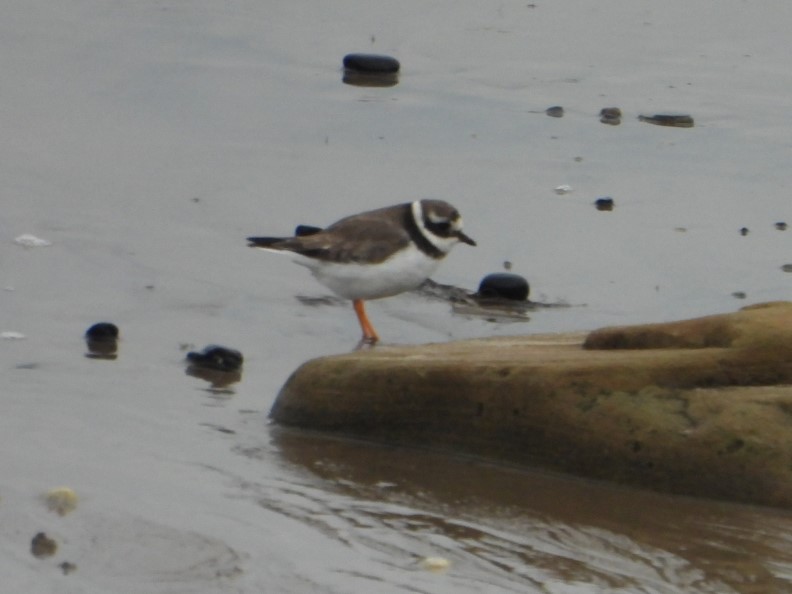
Surprise Plover

Now I reckon on balance this was ring-necked rather than a lesser ring-necked plover, as these should now all have departed and there was no sign of a yellow ring around the eye. It was also the only one I spotted running around the beach. 

There were a few curlew around. one politely posing well on the golf course:

Curlew

I continued along to the point where people sometimes put bird food down and caught up with a numerous flock of linnets, but nothing more special.  Starting back however, I came across a chap lying in wait for a snow bunting  he'd seen briefly.  He also mentioned that a lapland bunting sometimes mingles with the linnets.  This eventually had me scouring the photos to see if I could transform a linnet into a lapland bunting - but it didn't work.

Linnets

Some of the males still had the last vestiges of their summer plumage.

My hands were getting cold so I didn't wait for the snow bunting.

On the way back I remembered a tip on holding the camera and got the best shot of a redshank, later running into a bird that puzzled me and clearly wasn't a redshank.  It turned out it was a turnstone, just didn't quite have the neck pattern I'm familiar with.
Redshank
Turnstone

The tide was just starting to go down and there was a typically large flock of golden plover winging around, landing and relanding.

Golden Plover

My last sighting was of a group of birds that were on the wet rocks near the cliff.  At first I thought there were starlings, which is the general opinion on facebook but on looking at the photo, I'm not so sure.


Starlings?

Some of these birds seem to have brown supercilia and a light colouration I don't see in shots of starlings.  A trick of the light? However there is certainly one added bonus as the one in the bottom right hand area has been identified as a rock pipit.  there's also a small warbler right at the front, partly obscured.

You have to admire the tenacity of some bird watchers - these two have been holding continuous watch over Newbiggin Bay ever since I first visited years ago.

Birdwatchers

Overall I was partly but not fully satisfied with the improved results from the camera.  However it was very windy, as you can hear in the video.

Just for the record I saw three more speckled wood at the Tennis Club on 14th October - maybe the last this year.


Wednesday, 13 December 2023

Beginning afresh at Newbiggin

One consistent star performer on the stage of my garden bird table is the coal tit.  He/she, since there appears to be no difference, loves to harvest the numerous black sunflower seeds, always exiting backstage into the trees to consume them.

Recently, one bird made at least a dozen successive visits and you can only wonder if it isn't rather energy-sapping to perform in this energetic fashion.  Here's a brief sample:

Coal Tit feeding

Last week I at last achieved an objective when I visited Newbiggin and managed to catch up with some twites towards Beacon Point.

Twite

In fact there was a massive flock of about 50 to 100 birds visiting the seaside as they often do at this time of year.  Apparently there were a few shore larks around too but a jackdaw came down and flushed them shortly before I arrived.  There have been records of snow buntings at Newbiggin, but I think that was a little further down the coast.

Also in evidence on the day were a couple of meadow pipis and, as so often on the coast in Northumberland, stonechats:
Meadow Pipit
Stonechat

Down on the beach, there were a large number of birds dozing by the rock pools near the shoreline.  I took them to be golden plover.  However I was a bit stiff and and didn't fancy going down from the path and took photos at considerable distance.  On comparing them with images in my bird book I thought they looked more like dunlin or knot.  But it seems that golden plover they are.

Golden Plover

Facebook does have some uses!


Sunday, 5 June 2022

Up in the Highlands 2

On day three we returned for some more eagle spotting.  By now the weather, which had gradually become cooler was distinctly chilly and we spent an hour snoozing in the car when it got heavy.

The cool turn had a decided effect on the chances of seeing butterflies and during the whole trip all we saw was half a dozen ambient whites and a single orange tip.

From the point of view of eagles, it was pretty much business as day one i.e. occasional distant and often uncertain sightings.  Overall we managed around half a dozen firm sightings over the two days and did not manage to convince ourselves that any of them were white-tailed rather than golden eagles.

However there was good compensation in the form of a variety of other species.  There was already some action on the way along the valley when I spotted a chaffinch-coloured bird flying over the road.  Rather baffled by its definite white rump, I eventually worked out it was probably a juvenile bullfinch.  More puzzling was what appeared to be a blackbird with pronounced white flashes on both upper wings and I haven't worked that one out at all.  Another flypast was a female redstart - a pleasant surprise as their distribution in the area is somewhat sparse.

On arrival at the parking area, Vicki spotted a golden plover with chicks by the nearby woods, so I took a wander back to see if I could find them.  I spotted a swallow on the telegraph wires, at which point a female mallard emerged from the roadside undergrowth and scuttled off at pace through the woods towards a nearby stream.

I noticed some movement by the water and decided to investigate.  As I approached two ducks fled downstream, each followed by a number of chicks.  I assumed they were mallards but having seen the photograph I managed to get, I'm not so sure about the second group.  In fact I wouldn't like to say what they are. Possible candidates might be gadwall (not common in Highlands) or female and young goldeneye.

Duck with chicks

As you can just see, they were also accompanied by a sand martin, one of a large number of hirondelles flying over the water at speed.

Back on the eagle spot, there was what looked like a merlin perched on the craggy rocks high behind us. Photos taken weren't entirely convincing but the fast, direct flight when it moved off persuaded me it wasn't a kestrel.  

The presence of swallows was confirmed when a couple perched on a nearby bridge for several minutes.  It's not often they are near enough long enough to see the red face and neck.

Swallow

Less conspicuously, a grey wagtail turned up several times during the day.

Grey Wagtail

Vicki took a little walk upstream towards an area of trees where ring ouzels are said to appear.  I had tried the same area on day one without success but, staying nearer the river, she managed to snap a tree pipit right on the edge of the riverbank.

We also saw red deer on several occasions and I got a glimpse of a mountain hare, but no mountain goats.

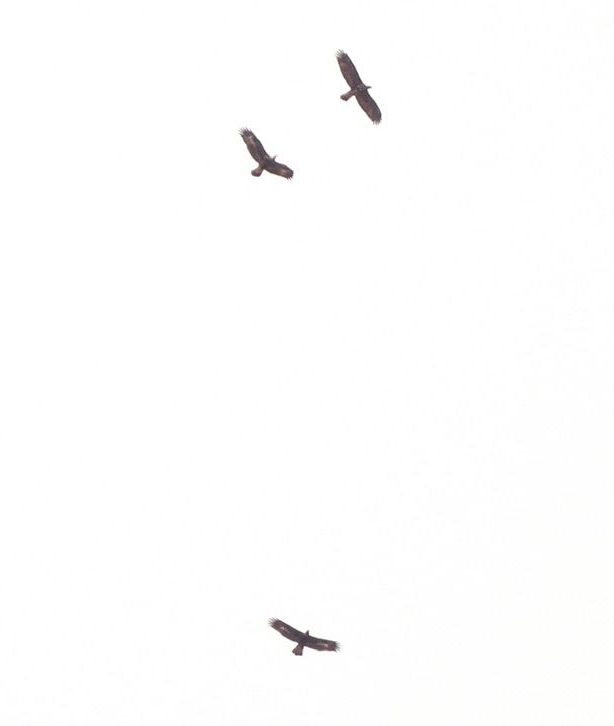
In spite of a late change of location to an area where white eagles can occur, we did not manage anything as spectacular as this photo Vicki took she and Alex visited in April:

Golden Eagles


Saturday, 15 January 2022

Surprise Visits

Having concluded that a lack of suet nuggets would lead to a lack of long-tailed tits, it was interesting to be proved wrong when they started turning up on the peanut feeders in similar numbers.  It left me wondering whether I should stop feeding the nuggets as you get a better view of them on the nuts.

Long-tailed tits

Curlew

I got out a couple of times.  On Tuesday I did a bike ride along the Tyne.  By the time I got there I was pretty cold and there were a few large chunks of ice floating downstream.  When the forecast sun finally got out on the way back, I saw three male bullfinches in a tree just before Newburn Bridge.  They were less shy than normal, probably focussed on the presence of a single female.  A bit further past Newburn where the trail leaves the river, there were a couple of thrushes flapping their tails at each other.  It looked like some birds are at least thinking about finding a mate.

On Thursday,  we did a walk from Seaton Sluice to St Mary's Island in a stiff and chilly breeze.  Apart from a few curlew in a cemetery, there wasn't much to see but it turned out most birds were hiding out on the rocks north of the car park, presumably out of the worst of the wind.

There were a good few oystercatchers, a few lapwing and several turnstone.  We reckoned there was also a large flock of golden plover nearer the lighthouse, but it was hard to be certain at distance.  On the island itself, a good few seals were lolling about as they are pretty much commonplace there nowadays.
Oystercatcher
Turnstone - with starling


Stoats
I have been bemoaning the lack of less common species in the garden this winter.  But this morning a couple of stoats turned up and started a major fight on the path by the lawns.  I though I'd captured the whole encounter, which lasted several minutes, on video but must have pressed the wrong button!  Presumably it was a fight between two males rather than a mating event.  

As stoats attack rats, I am prepared to extend them a cautious welcome.


Saturday, 10 April 2021

Saturday 10th April

 I noted some while back that spottings in my garden are a bit upside down in that birds that are normally common appear seldom - and vice versa.  A recent surprise was to spot two 'rarities' at the same time last week, a male garden sparrow and a siskin.  A female sparrow also turned up a couple of days later, as did briefly a goldfinch.  Both birds can be seen close at hand but don't usually visit the garden.  You'd really expect more siskins, given the amount of nearby woodland.

Siskin

To cap that I also got the best view I have ever had of a jay, which hung around for a couple of minutes just behind the bottom fence.  This happened while I was getting dressed upstairs, hence alas no photo.

The weather has done a major u-turn putting an end to butterfly sightings but Spring has now sprung and other species are abundant.  

A week ago on Friday Frances and I did a very scenic walk along the Blyth at Humford Mill near Bedlington.  There was wild garlic and other woodland flowers starting to come out all over the place, plus one plant I knew I recognised but needed to check - alternate leaf golden saxifrage.  There was less in the way of birdlife apart from a grey wagtail and a quick flash of a dipper flying downstream.

Grey Wagtail
Alternate Leaf Golden Saxifrage

Although the weather was already starting to cool there were a good few bumblebee queens on the move, one of which seemed to me on the basis of video evidence seemed to be a buff-tailed bumblebee.

One week later it was quite chilly when Malcolm and I set out from Low Newton to the outskirts of Beadnell against a northerly wind.

There were skylarks all over the place with a good number of meadow pipits, one of which posed nicely on a stretch of cut grass near a holiday park.

Meadow Pipit

It was one of those days when the further we walked, the more we saw.  By the time we got back we had also seen kestrels, stonechats, a flock of geese in flight that eventually landed at distance and looked to contain a mixture of greylag and pink-footed geese. there were a good few shelduck around, a couple of which were just about near enough to catch in the camera, though I never even spotted the curlew that was next to them.  A shallow pond produced a couple of gadwall and lapwing as well. however I was most pleased with a quick but unmistakeable view of a golden plover through the binoculars.

Shelduck - and curlew

Afterwards we stopped for a coffee back at Low Newton.  The tide was in and there was a proliferation of sanderling, redshank and oystercatchers on the crowded shoreline and a fleet of eider duck further out.

I reckoned there were some other small birds running around with the sanderling and took a few casual shots thinking to identify them later.  In fact I totally missed the foreshore and got instead a couple of blurred shots of birds in flight above the waves.  One had an upwardly curved beak but wasn't an avocet so I suppose possibly a godwit.  The other was a small wader but from what little I had looked more like illustrations of Temminck's Stint than the dunlin or knot I anticipated.  That however seems rather more unlikely.

If we had visited the foreshore at the beginning rather than the end of the day, I might have paid it more attention.

Monday, 7 December 2020

Monday 7th December

Having caught sight of a jay showing well on the edge of Chopwell Woods as I returned from the doctor's,  I decided to take a walk there last week.  This was also to test my theory that you see far less in the way of birdlife there than you would expect from what is an apparently attractive area.

The theory was pretty much proven.  I wandered around for an hour or two, trying to keep off the main tracks as much as possible.  Birdsong was notably absent as I went.  Eventually I caught sight of a nuthatch on a conifer and got one distant sighting of a jay in a tree.  There were a few tits singing in the trees on the way out but that was it.  Overall I think you're more likely to see deer there than a notable bird, but can't really say why.

I'd have seen more if I'd stayed in the garden, which is where I saw this female greenfinch a few days ago.  Getting the rear view first, I thought it might be a siskin, which would have been a garden first.  Something about this bird strikes me as not quite right  (too pale?) but greenfinches are certainly around although not on the feeder.

On Saturday I took advantage of some improved weather to track down the black redstart at Tynemouth.  It wasn't where I expected to find it. Instead there was an eider duck quite near to the shore.

Eider Duck

Eventually after fish 'n' chips I managed to locate a birdwatcher who told me where to look, just outside the pier rather than inside the harbour.  Others reported it hadn't been seen for  half an hour but when one left, it duly turned up, moving about the rocks and occasionally pursued by a jealous robin.

It was hard to get decent shots in the shade but once again "mission accomplished".  It seemed paler than the ones I have seen in Germany.
Black Redstart
Black Redstart
An additional bonus was a rock pipit patrolling the same area.

Rock Pipit

With some time available I moved on and did a walk from Seaton Sluice to St Mary's Island where there was at least a hundred lapwing at the water's edge just after low tide.  I looked for golden plover among them but instead found these waders at distance. 

Waders