Showing posts with label mallard. Show all posts

Monday, 6 January 2025

New Year Bonuses

The pattern over the rest of the festive period has been for restricted sightings but with the occasional bonus prize.

I did a quickish walk around the QEII with a friend when there was very little to see in the way of ducks or waders but a single herring gull turned up among the swans at the hotel end.

Herring Gull

For a while I did wonder whether it might be a different gull but the expert opinion was 'third winter herring gull.'  So there!

I spent New Year with V&A in Crawford, driving there in pelting rain.  We didn't get out the next day but Alex got a great shot of the Northern Lights!

Aurora Borealis

I hasn't to add I didn't get a thing and it wasn't even visible to the naked eye.  But pretty good considering we weren't further North.

On the 2nd we managed a trip to Airds Moss, which looked very promising but seeing anything following the sudden temperature drop and in an almost total lack of wind was hard going.

A heron flew along the valley at one point and, thanks to Alex's supreme spotting skills, we picked out a flock of goldfinches feeding in some distant trees, although getting a decent shot of them was a different story as they hid behind the withering catkins.

He then managed to spot a good number of distant fieldfares feeding near a large collection of molehills. Again, getting at a decent view was difficult, this time as they were at considerable distance.

Goldfinch
Fieldfare
Just to prove there were more than one each:
Goldfinches
Fieldfares

This was however the first time I have seen any fieldfares for a very long time, so worthy of note. As far as I could detect, no redwing were present.

A couple of days ago I made a visit to Whittle Dene to check for a little owl but it looks to me that some of the cracks in the wall where it supposedly nests have been filled in.  

The fishing lakes were pretty clear apart from a couple of mallard, gulls and a couple of tufted ducks a very long way off.  

A little investigation up the back of the nature reserve proved fruitless.

Yesterday the snow came down heavily and there was a frenzy of birds at the feeders.  At last the long-tailed tits participated fully and there were five of them at one point attacking a nearly empty suet ball feeder.

It wasn't the best photo, but the little things don't stay still for long!


Tuesday, 17 December 2024

Reflections and A Narrowly Failed Twitch


Christmas Cactus
It struck me recently that I don't pay much attention to flowers. I really should as recognising flowers is help in finding butterflies and bees in the summer.

The trigger for this thought was the christmas cactus on the windowsill, which is looking particularly smart this year and may even last until the 25th for once. In previous years, perhaps when the heating has been on more, it has often had it by mid-December.

On Saturday, a notably cold and rather windy day, I went to Geltsdale with Alex and Vicki to exchange presents and check for sightings.

Here it
 became apparent that I am suffering from increasing bird blindness.  Almost immediately after setting off, Alex spotted a flypast by a peregrine which Vicki even manged to get a photo of while I remained blissfully unaware and could see nothing but grey sky.

Peregrine Falcon

Similarly I could not spot the first stonechat they saw skirting the first bit of woodland.  I did see the grouse Alex spotted on the horizon once he'd pointed it out and did get a photo against the light.

I fiddled with the result to see if it might prove to be a black grouse but the only difference was a rather apocalyptic background while the bird remained a dark shadow:

Grouse

We reached the lake, where a number of wigeon were having a doze.  I got some shots but, like the rest I took on the day, the focus wasn't great.  I think the cold may have caused some condensation on the lens and the wind anyway made it different to hold the camera steady and avoid the lakeside reeds in distance shots.

One phot was slightly different and puzzled me briefly but I think it is just an unclear rear view of a mallard. 

Wigeon
Mallard

After that it was quiet for a while.  There was nothing but a few tits and chaffinches near the feeders at the Information Centre.

It's often the case withe birdwatching that you see nothing for a longish period, and then several things in quick succession.  It was probably a full twenty minutes before I (for a change) saw a few birds landing in a tree, which turned out to be bullfinches.

Bullfinch

Then  Alex noticed a barn owl hunting early and eventually landing some distance away, and another stonechat showed up on the moorland.

We walked back past the quarry through some attractive countryside but only saw another - or perhaps the same - barn owl, again at some distance.

Barn Owl

While this was going on, a mega rarity was again being sighted at East Chevington Reserve in the shape of a grey headed lapwing, so I decided to try my luck the day after.

I arrived about 11.20  and parked where a lot of other cars were standing.  This proved to be next to the field where the bird had been sighted while I was at Geltsdale, but it had flown to a distant ploughed field near which the shapes of standing people could just be made out.

I walked up there, which took longer than expected by a roundabout route, only to be told that the bird had not been seen since 10.20 am. The story was that a marsh harrier had appeared and frightened off the lapwings while the grey-headed version had circled a few times and then resettled not to be seen since.

So I hung around for about an hour, peering into the distance across many furrows of mud and seeing nothing.  One of the twitchers, some of whom had come considerable distances, however said he'd managed to spot 64 lapwings in the area I had been surveying!

Eventually, at 1.30 pm with only an hour of decent light left, I decided to look elsewhere.  On the walk back it was apparent that all the twitchers were following me, the latest news being that the lapwings including the suspect bird had left en groupe and headed for Cresswell Pond/Druridge Pools depending who you talked to.

So all I got for my efforts was some unusable shots of pheasants and half-hidden curlews, a single female reed bunting and a group of greater twitchers.
Reed Bunting
Twitchers

One of them asked me if I'd seen the birds move on.  Well I did briefly see a distant flock on the skyline, impossible to distinguish, but my reaction was that they were too small for lapwings.  

It's a bird that has kept returning to the area for over a week now, so who knows...

Thursday, 18 January 2024

Missed Opportunities

The last few days have been a series of near misses.

Last week I went looking for waxwings on a track near Killingworth and, for the second time this winter, found that I had arrived a day too late and the main flock and all the berries had disappeared.  So I decided to make a call at Gosforth Park where a bittern has been appearing.  

I managed to guess which hide it would be near and there were four of us waiting for it to poke its nose pout from the reeds.  Unfortunately it had decided not to do so until we had all disappeared, which one by one we duly did.  The only other noteworthy thing I saw was a little egret on the scrape

On Monday I took a trio to venue I hadn't previously heard of - Pow Hill Country Park near Derwent Water as there had been some crossbills sighted.  In fact there wasn't much doing apart from one female according to a twitcher, so I contented myself with some experimental photography of some mallards on the lake a couple of hundred yards away to compare different modes on the new camera. This was the declared winner:

Mallards

It was taken in bird mode.  The runner up in automatic mode was also perfectly acceptable, unlike the P mode which seems to over expose considerably.  I must be doing something wrong.

There was an area near the car park where woodland birds seemed to gather so I decided to check it out.  Prospects were initially dimmed by a bloke in a high vis jacket and leading two dogs plus wife, who decided to walk straight through the area I was surveying. 

When I went back a bit later something interesting happened.  Another family man turned up and starting stretching his hand out and the wee birds clearly knew he was offering bird food. Sure enough he soon had coal tits and chaffinches eating from his hand.  I know this can take place but had never seen it before.  It also became obvious that there was bird food on some of the old tree trunks in the same clearing and all the birds seemed to have little fear of people.

In terms of sightings, it was another period where my own garden produced more than my trips out.  Having not been seen for some time, both nuthatch and woodpecker turned up in the space of the couple of days.

I mentioned last time that a blue tit was feeding on the mahonia bush.  This has continued and early one morning I noticed a bird that wasn't a blue tit doing the same, though often in the depths of the bush.  I eventually caught a glimpse of a reddish head and thought it must be a redpoll.  On closer inspection though it proved to be an overwintering female blackcap, as had happened to or three years back.  I wonder if it was the same bird...

Female Blackcap


Tuesday, 10 October 2023

Never Give Up...

Sometimes I'm too much the pessimist.  Although we did not get the summer-like temperatures experienced in the South of England, we did get a warmer than usual murk with occasional bursts of sunshine into the high teens.  The upshot was that I called time too early on the buddleia, the largest bush suddenly producing a decent sprig of flower in its very centre over the last few days.  This managed to briefly attract a fine red admiral on the 8th October, thereby achieving a personal mini-ambition and establishing a record that may not last long in the face of climate change.

Red Admiral

Meanwhile i have a new toy, a Nikon Coolpix camera, bought especially with the idea in mind of boosting my birdwatching efforts.  The wee Panasonic Lumix I have been using is brilliant in many respects but the zoom can be slow and the focus imprecise.

Perhaps understandably the additional camera has brought some technical issues.  There was a good opportunity to try it out yesterday on a Naturewatch visit to Hauxley Nature Reserve.  As on recent visits to Hauxley nothing spectacular was sighted, which didn't trouble me as I was mainly using it to practice my camera skills.

It was therefore disturbing to note that I had difficulty in seeing much through the viewfinder and when focussing on distant birds.  I started to wonder if I was going to get any usable shots at all.  Anyway I persevered and  managed to solve the focussing issue after a bit.

Here is a gallery of the results:
Coal Tit
Bullfinches with Goldfinch
Chaffinch
Shoveler
Goldeneye
Grey Heron
Mallard
Mallow

Obviously the coal tit was taken in the garden and added as my first ever attempt. 

It wasn't until I got home before I solved how to resolve the dim viewfinder.  Easy enough when you know how but with 308 pages of user manual as well as a very intricate looking piece of photo processing software, it could be a long learning curve!

Tuesday, 11 April 2023

Low Force and High Force Wind

On Saturday I joined up with Jennifer and Joe who are walking the Pennine Way in stages.

We met at Middleton-in-Teesdale to do the section to High Force.  Unfortunately I 'hit the wall' at about four miles and only made it to Low Force, the easy access to High Force from the nearby hotel having closed about 15 minutes before I got there. 

High Force

We saw surprisingly little wildlife during the couple of hours or so.  We thought there was a flock of fieldfares in some trees and there were three butterflies, one of which was a red admiral and a few buff-tailed bumblebee queens.  Birdwise there was the odd lapwing and curlew plus a few pied wagtails.

One surprise though was three completely white mallards that paddled their way across the Tees below Low Force.  Apparently this almost certainly means they were escapees as mallards held domestically are often bred to lose their natural colours.

We actually saw more birds while driving around the moors from place to place: partridge, a possible cuckoo, red grouse and short-eared owl.  And many skylarks.

A buff tailed bumblebee queen finally landed in my garden the other day.  So far they hadn't settled.

Queen Buff-tailed Bumblebee

Due to poor weather I hadn't been out on the bike for a long time apart from a couple of short refresher rides.  Again not much was seen but having got stopped at the level crossing at Wylam, I took a snap of the grey heron that frequently resides there.

Heron

Anyway, on Sunday I took advantage of what had been an excellent weather forecast for a ride up the coast to Cresswell and Druridge - except that the non-stop sunshine expected never happened and I was buffeted all day by a heavy onshore breeze that made me wish I'd taken my winter gloves!

On the Blyth estuary I got a couple of nice views of shelduck and redshank on the mudflats.
Shelduck
Redshank
I've always liked shelduck.

I did a detour around the Newbiggin area in search of Sandy Bay where rarities sometimes turn up - notably a bluethroat recently- but couldn't find it and made a quick exit to escape the Easter festivities.

At Cresswell and Druridge the most notable sighting was my first bar-tailed godwits, which turned up in both locations.  The one of Cresswell has spilled some weed on itself.

Bar-tailed godwit

I had hoped for avocets, which have recently appeared at both locations but unfortunately no luck and the spoonbill at Druridge didn't show either.  

Nevertheless there was a reasonable tally of further sightings recorded including a little egret in the corner at Cresswell, sanderling, lapwing, canada and greylag geese, shoveler, teal, wigeon, lapwing and several more shelduck
Lapwing
Shoveler

Unsurprisingly no butterflies were seen.

Monday, 3 October 2022

The End Of Summer

It has been an ambition of mine for some while to coax the buddleia bushes into retaining enough blossoms past the end of September to attract a few last butterflies.  This year has to go down as a near miss.

A red admiral managed an appearance on the 29th September and there was a large white on the 30th but by today there are so few flowers left that it looks like there is no realistic chance of further visitors.

The last Red Admiral

Frustratingly I can't know if anything turned up in the good weather yesterday as Malcolm and I decided to go to Holy Island, where there had been a couple of sightings of a rustic bunting..

There it was still pretty much summer weather all day but we didn't see anything of great note - let alone the rustic bunting - and neither did anyone else we spoke to.  In fact we didn't see many birds at all in our wanderings.

There were a few sanderling and turnstone plodging in the mud near the pier, the latter seeming to be between their summer and winter suits.

Turnstones

Further along the bay there was a pair of eiders and a heron, but nothing in the Vicar's garden apart from one cockerel lying on a flower bed.

Male Eider Duck

We paused at a pub for liquid refreshment and shared a picnic bench with a number of crumb-stealing sparrows, the one species we did see a lot of, more in fact than I see anywhere nearer home. It was nice to see them close up.

Sparrows

Walking further around the island produced even more sparse results - mainly a stonechat posing nicely and this oversized owl.
Stonechat
Owl
We stopped at the bird hide where there were a large number of ducks on the shallow lake. However identification was difficult against the light and because they all had their heads tucked firmly down. In fact some of them looked like they were completely stuck in the mud. Definitely present were mallard, mute swan, coot, little grebe and probably teal.

It was pleasing not to see any dead birds but we did see this partly exposed human skeleton on the archaeological dig at the sight of a possible mediaeval monastery.

Skull

Presumably it belonged to a mediaeval monk rather than a twitcher who waited around too long for the rustic bunting.

Sunday, 5 June 2022

Up in the Highlands 2

On day three we returned for some more eagle spotting.  By now the weather, which had gradually become cooler was distinctly chilly and we spent an hour snoozing in the car when it got heavy.

The cool turn had a decided effect on the chances of seeing butterflies and during the whole trip all we saw was half a dozen ambient whites and a single orange tip.

From the point of view of eagles, it was pretty much business as day one i.e. occasional distant and often uncertain sightings.  Overall we managed around half a dozen firm sightings over the two days and did not manage to convince ourselves that any of them were white-tailed rather than golden eagles.

However there was good compensation in the form of a variety of other species.  There was already some action on the way along the valley when I spotted a chaffinch-coloured bird flying over the road.  Rather baffled by its definite white rump, I eventually worked out it was probably a juvenile bullfinch.  More puzzling was what appeared to be a blackbird with pronounced white flashes on both upper wings and I haven't worked that one out at all.  Another flypast was a female redstart - a pleasant surprise as their distribution in the area is somewhat sparse.

On arrival at the parking area, Vicki spotted a golden plover with chicks by the nearby woods, so I took a wander back to see if I could find them.  I spotted a swallow on the telegraph wires, at which point a female mallard emerged from the roadside undergrowth and scuttled off at pace through the woods towards a nearby stream.

I noticed some movement by the water and decided to investigate.  As I approached two ducks fled downstream, each followed by a number of chicks.  I assumed they were mallards but having seen the photograph I managed to get, I'm not so sure about the second group.  In fact I wouldn't like to say what they are. Possible candidates might be gadwall (not common in Highlands) or female and young goldeneye.

Duck with chicks

As you can just see, they were also accompanied by a sand martin, one of a large number of hirondelles flying over the water at speed.

Back on the eagle spot, there was what looked like a merlin perched on the craggy rocks high behind us. Photos taken weren't entirely convincing but the fast, direct flight when it moved off persuaded me it wasn't a kestrel.  

The presence of swallows was confirmed when a couple perched on a nearby bridge for several minutes.  It's not often they are near enough long enough to see the red face and neck.

Swallow

Less conspicuously, a grey wagtail turned up several times during the day.

Grey Wagtail

Vicki took a little walk upstream towards an area of trees where ring ouzels are said to appear.  I had tried the same area on day one without success but, staying nearer the river, she managed to snap a tree pipit right on the edge of the riverbank.

We also saw red deer on several occasions and I got a glimpse of a mountain hare, but no mountain goats.

In spite of a late change of location to an area where white eagles can occur, we did not manage anything as spectacular as this photo Vicki took she and Alex visited in April:

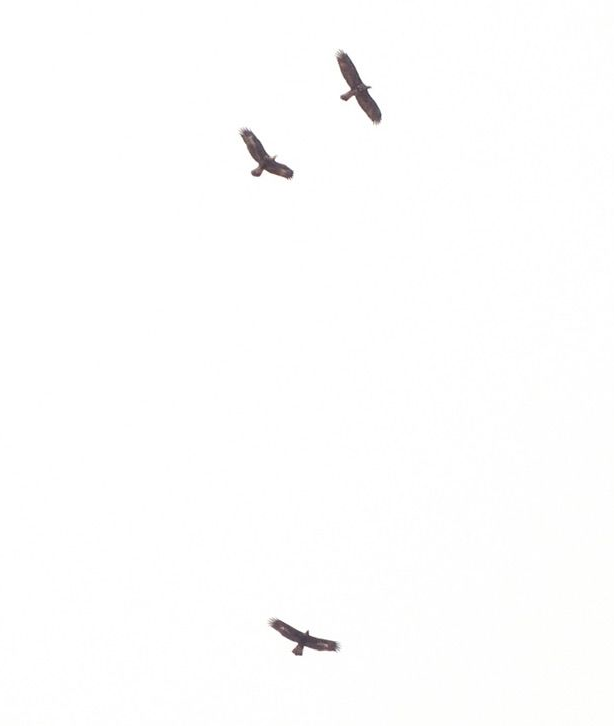
Golden Eagles


Saturday, 16 February 2019

Saturday 16th February

Hot on the heels of the water rail success on Monday, I decided to try my luck with the snow buntings at St Mary's Island again. As driving there by any route is a nuisance and the weather was improving, I decided to cycle there from the Quayside, overruling my better judgment that hi-vis jacket and samll binoculars might not be advisable.  I also found no room in my bag for a bird guide.

In fact it couldn't have worked out much better.  En route along cycle track 72, I saw about eight magpies in the same tree close to the Tyne Tunnel, and roughly the same number again round about - more than ever before in the same view.

I rode right through to St Mary's without stopping and immediately heard an invisible skylark over the adjacent fields.  Following the call of nature on the edge of the nature reserve, I got a good view of a curlew in the same field, as well as canada geese, mallard and teal in the reserve itself.  Then I cycled very slowly towards the lighthouse with camera and binoculars at the ready.

When looking for an uncommon bird, the best plan seems to be to not look for the bird but to watch out for a twitcher with a huge camera lens.  It worked again today as soon as I reached the second car park.  There was the twitcher and the three snow buntings were running around on the grassy slope eating seeds - one male and two females.

Snow Buntings
Snow buntings have the reputation of not being shy of humans and this little group was relatively unphased by most repeated disturbances, including amusingly that from the middle-aged bikers in the car park less than ten yards away, revving their throttles.

Occasionally the birds retired to the foreshore or the railings on the promenade but always came back while I sat for around half an hour having my lunch.

It was a flat, high tide and there wasn't much else about apart from a few cormorants.  I took a couple more looks into the reserve but only saw a group of redshanks on the pool if you discount these Dartmoor ponies that are employed to keep the vegetation down.

Dartmoor Ponies at work
There were stories of a black redstart at Tynemouth as well as a ring-necked parakeet in Newcastle but hey, I'd seen both of those in my travels to Europe.  So I decided to head back in a vain attempt to beat the rush hour.

Wednesday, 16 January 2019

Wednesday 16th January

Wallington Hall
Deciding I couldn't fancy another trip to windy Whitley Bay after snow buntings, I decided to take a run up to Wallington Hall in Northumberland.  A hawfinch was reported there in December but I wasn't surprised not to see any.  Nor did I see the lesser kestrel or spotted crake that apparently have visited lately, nor a red squirrel.. Nevertheless I really liked the place, clearly designed for enjoyment and with a rich variety of interesting features within easy walking distance.

I took a relaxing stroll to the main bird hide, where the birds have been encouraged to come very close and are as a result quite tame.  It was pretty much the normal assortment of species that turn up on feeders, pleasingly including quite a few greenfinches and at one point, a jay flew in and settled briefly on the ground.  One woman thought she had seen a brambling abd I spent a fair amount of time watching the chaffinch flocks without being able to confirm.

The best moment though was when a treecreeper turned up and instead of creeping up the trees, affixed itself to one of the feeders for several minutes. It then surprised me even more by landing on the ground underneath the seed feeder and foraging for fallen crumbs.

Treecreeper on nuts
Treecreeper on ground
I think this must be learned behaviour.  I've never seen a treecreeper behave like this before.

I ended with a quick tour of the lakes in the East Wood, which revealed a couple of shovellers, mallard and a little grebe.

A pleasant day.