Showing posts with label redstart. Show all posts

Sunday, 5 June 2022

Up in the Highlands 2

On day three we returned for some more eagle spotting.  By now the weather, which had gradually become cooler was distinctly chilly and we spent an hour snoozing in the car when it got heavy.

The cool turn had a decided effect on the chances of seeing butterflies and during the whole trip all we saw was half a dozen ambient whites and a single orange tip.

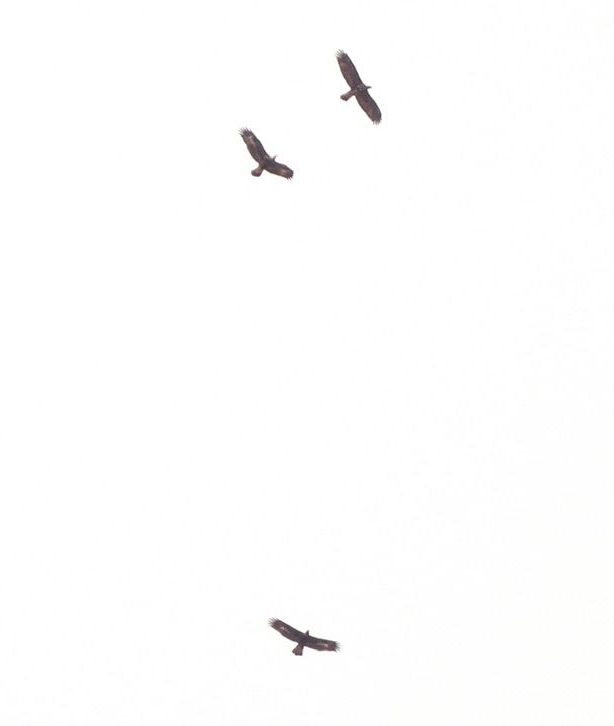
From the point of view of eagles, it was pretty much business as day one i.e. occasional distant and often uncertain sightings.  Overall we managed around half a dozen firm sightings over the two days and did not manage to convince ourselves that any of them were white-tailed rather than golden eagles.

However there was good compensation in the form of a variety of other species.  There was already some action on the way along the valley when I spotted a chaffinch-coloured bird flying over the road.  Rather baffled by its definite white rump, I eventually worked out it was probably a juvenile bullfinch.  More puzzling was what appeared to be a blackbird with pronounced white flashes on both upper wings and I haven't worked that one out at all.  Another flypast was a female redstart - a pleasant surprise as their distribution in the area is somewhat sparse.

On arrival at the parking area, Vicki spotted a golden plover with chicks by the nearby woods, so I took a wander back to see if I could find them.  I spotted a swallow on the telegraph wires, at which point a female mallard emerged from the roadside undergrowth and scuttled off at pace through the woods towards a nearby stream.

I noticed some movement by the water and decided to investigate.  As I approached two ducks fled downstream, each followed by a number of chicks.  I assumed they were mallards but having seen the photograph I managed to get, I'm not so sure about the second group.  In fact I wouldn't like to say what they are. Possible candidates might be gadwall (not common in Highlands) or female and young goldeneye.

Duck with chicks

As you can just see, they were also accompanied by a sand martin, one of a large number of hirondelles flying over the water at speed.

Back on the eagle spot, there was what looked like a merlin perched on the craggy rocks high behind us. Photos taken weren't entirely convincing but the fast, direct flight when it moved off persuaded me it wasn't a kestrel.  

The presence of swallows was confirmed when a couple perched on a nearby bridge for several minutes.  It's not often they are near enough long enough to see the red face and neck.

Swallow

Less conspicuously, a grey wagtail turned up several times during the day.

Grey Wagtail

Vicki took a little walk upstream towards an area of trees where ring ouzels are said to appear.  I had tried the same area on day one without success but, staying nearer the river, she managed to snap a tree pipit right on the edge of the riverbank.

We also saw red deer on several occasions and I got a glimpse of a mountain hare, but no mountain goats.

In spite of a late change of location to an area where white eagles can occur, we did not manage anything as spectacular as this photo Vicki took she and Alex visited in April:

Golden Eagles


Monday, 21 June 2021

The return of my bike after a wheel replacement has led to an increase in cycling activity.

On the 12th June, I took a brief trip up the Waskerley Way, hoping to see some butterfly species that haven't been showing up so far.  The only result in that direction was a couple of passing red admirals and a speckled wood.  Once up on the moorland, I did find a bank of bilberry not in flower, a good bit of uncut fern and some advanced bird's foot trefoil but no resulting pollinators. Lapwing, curlew and skylark were around but otherwise the most noticeable feature was the impressive view.

Waskerley Way

The most exciting thing was a momentary sighting of a redstart on the path on the way back down, just after I'd had a close up rear view of a red kite.

On Wednesday I set out from Newbiggin to head for East Chevington Pond, where one or two rarities have been spotted.

Going slowly, I again kept a careful eye on the bird's foot trefoil between Lynemouth and Cresswell but again no common blue were seen.  What I did see was a collection of what I was fairly confident were linnets around a house just South of the first caravan site.  A few turned up later coming back along the dunes but in both cases they didn't hang around.  Linnets are nervous birds.

Stopping at the north end of Cresswell Pond, I didn't really expect to see the spoonbill that had been reported a few days earlier. After returning from inspecting the undergrowth and stumbling upon a red admiral, I spoke to a chap who thought he had seen a little egret.  However another chap with a telescope confirmed it was indeed the spoonbill and I could pick it out in a field on the other side, snoozing with its beak tucked in.  There were some avocets around but I didn't spot them, just a lot of gulls including a little gull.

It was only on the way back in the afternoon that the spoonbill was active and I got a good view of it.  Apart from my visit to Minsmere several years ago I hadn't seen them in this country before.

Spoonbill


Little Gull

Compared to that East Chevington pond was a bit of an anticlimax as all I saw beside more gulls was several cormorants.  At least I got the chance to check out where the hides and approaches to them are.

On the way back more individual red admirals were around, none of them settling.  I counted five by the end of the day.  Again there were a lot of skylarks and several meadow pipits around, on a couple of occasions perching quite close.

Unusually I only saw one stonechat but a nice surprise was a whitethroat on a lone bush in the dunes.

Whitethroat

... Or at least I think it's a whitethroat as I'm still not sure when a whitethroat is a lesser whitethroat.  

On a fitness ride on Friday, I think I may have seen a meadow brown or two, but very much in the passing.

Monday, 11 June 2018

Monday 11th June

Female nuthatch
Of course the day after I complained about the jackdaws yobbish behaviour putting off other birds, a nuthatch turned up on the peanut feeder for the first time, a female.  It hasn't stopped me cutting down on the bird food over the past couple of days, though partly because I've been out most of the time.

I did a bike ride along cycle track 10 to Stamfordham and enjoyed the flatter landscape in the area.  There were some flowers just past Seaton Burn that I at first thought were orchids and haven't managed to identify, again lots of skylarks singing and most pleasingly a male redstart that appeared in some oaks just west of Stamfordham. Plus some sort of maple I wasn't totally sure about.

I held off reporting this as I knew that the Prudhoe U3A Nature Watch trip to Hawthorn Dene near Easington was coming off today, a venue that is known to be rich in wildlife because of the magnesian limestone geology (dolomite).

This inevitably lead to a profundity of less common flowers being seen and frankly I really did find it more or less impossible to keep up with the sightings.  We certainly saw some bee orchids and some mouse-ear hawkweed but eventually all the new names just swamped me. I stuck to what I know more - butterflies and birds.

And there was indeed a fair bit to occupy the attention in those areas.  Having not yet seen a blue this year, it was pleasing to see at least twenty common blues at different times and get a decent picture.  I saw my first small heath of the year and managed to get a picture of a dingy skipper (though it was very dingy) as well as a chimney sweeper moth.  I don't think I've seen as much flower meadow in one place for a long time.

Common blue
Chimney sweeper
Dingy dingy skipper
Ogling female kestrel
We did actually manage to get a glimpse of a skylark and an excellent view of a female kestrel, which some people thought was eyeing us up so it could move in to hunt in the same area once we passed on.  I was particularly pleased to see a whitethroat passing through.  There were also sand martins, a few swallows and pipits, a fulmar and a reed bunting.

The general consensus was the area will produce even more sightings in a couple of weeks in view of the delayed summer.

Maybe I will return.

Wednesday, 21 June 2017

Wednesday 21st June

Got out on a small fishing trip on Saturday, mainly to use up some of the bait from the earlier trips this month.  I had intended to go to Lochfoot but the north bank has been rendered virtually inaccessible by extended heavy fencing.  So I ended up legering from the north bank at Mill Loch.

At first it looked like it might be another blank as bites were not forthcoming for a while.  Of course, as soon as I set up a second rod, the bites did start to come and I landed a perch, a roach and two more perch in a fairly short period around three to four o' clock.  After that bites got shyer and harder to detect.  I switched to corn on one rod, retaining red maggot on the other and got another three roach before packing up mid-evening.  None of them were any size and there were no bream.

The catch before release

Another angler told me he had been catching good roach and six bream from the western stretch of the north bank, which seems to be the favoured stretch these days.  However it is an awful long way from the road.  I was exhausted enough after carting the gear as it was!

Yesterday, Vicki and I decided on another quick walk at Kingholm Quay.  Once again it was quite productive and there were a couple of pleasant surprises.

It started quietly setting off towards Glencaple with a brief sighting of a female greenfinch and a couple of ringlet butterflies (first of the year) that flew around restlessly without ever settling plus a green-veined white (probable) doing exactly the same.  There was also an extensive pink-flowering bush that may have been some sort of domestic escapee.

Another unidentified pink flower

We then spotted two or three birds behaving very furtively in a group of dog roses.  I got enough of a view to reckon they might be sedge warblers, but it proved impossible despite several attempts to get any sort of a photo.  Then Vicki used her phone to confirm the spotting and actually played the sedge warbler call a afew times, which immediately drew a considerable response from all around!  So we unconsciously found a new means of identifying bird life.

Shortly thereafter I spotted a fascinating section of rough scrub.  I was trying to follow a small flock of birds entering a tree when a redstart showed up in the binoculars as it settled in the undergrowth just in front.  It didn't stay for long but long enough to identify it positively.  I haven't seen one for a few years now.

On the way back there were more similar encounters with warblers and butterflies, including a couple of willow warblers.  At one point a small brown butterfly settled that I expected to be a small copper.  However it proved to be a skipper.  On appearance I thought it might be a small or essex skipper but they are not common here and not yet officially on the wing, so I suppose that large skipper is the obvious answer.  Frustratingly, no photograph was possible yet again but we did rather better with a single red admiral that was nectaring on flowers - the first of the year for me.

Red admiral

You can see how fresh it looks, so I think it must have hatched recently.


Monday, 25 June 2012

24rd June and 25th June

Went up the Ahorn lift and walked to Edelhutte.  A bit cloudy so not so rich in butterflies but highlighted by excellent view of male and female ring ouzel that flew fortuitously into tree just past a rock edge as I was approaching.  I even knew from the calls and could readily see the white edgings to male's feather patterns but was 90% luck - right place at right time. Got photographs but too blurred to show much.

I saw several crag martins (apparently) and an annoying pipit that clearly wasn't a meadow pipit and kept flying up at 45 degrees chirruping all the way and back down onto the same rock.  This may have been a water pippet, which does occur in the Tirol.  Also several black redstarts.


The next day rain interrupted walk up one of the valleys towards Schlegeis at Teufelsbrucke.  Only one butterfly, but did get very good view of redstart in hedgerow which was constantly tutting and calling and seemed to follow me around.  There were also some tits moving around non-stop that at first I took for willow or marsh tits but there bibs were far too big, extending way down onto chest.  Again there are one or two rarities that looked possible but on balance I think they must have been the local variation of coal tit without the usual pinkish hue and white stripe at back of head.  My German bird book indicates some difference and some photographs of the Tannenmeise do look very like willow/marsh tit.

Sunday, 17 July 2011

17th July

Walk at Moffat Community Wildlife Reserve.  Willow warblers, redstarts.  Plenty of butterflies in spite of mixed weather -  ringlets, meadow browns (several although apparently in decline elsewhere) and two small tortoiseshells.  Pleasant mixed habitat.

Also did Earshaig Walk.  Lots of siskins, spotted woodpecker and excellent view of male redstart on way marker  Lots more ringlets and two large(?) skippers.

Thursday, 12 May 2011

12th May

Bike ride from Penrith to Hawes Water in pursuit of ring ouzel - unsuccessful.  Other results not spectacular.  Male redstart at same point just North of hotel on way there and way back.  Thrush, stonechat.